
Karma and Bhagya: Why Effort and Fortune Need Each Other
Is success earned or given? How karma, bhagya and the 9th and 10th houses of your chart explain why effort and fortune work best together.

Ask almost anyone in Nepal or India why one person thrives and another struggles, and two words come up within a minute: karma and bhagya. "She worked so hard — that is her karma." "He was simply lucky — that is his bhagya." Often both are said about the same person, in the same breath.
The two words are usually set against each other, as if one has to win. Vedic astrology sees it differently. Effort and fortune are not rivals. They are two houses that sit side by side in every birth chart, and the charts that rise furthest are the ones where those two houses talk to each other.
Two words, two meanings
In everyday Nepali and Hindi, karma carries two meanings at once. It means action — the work you do, the duty you carry out (karma garnu, to do one's work). And it also means the result of past action that comes back to you, which is why people say something is "in one's karma" when they mean it was bound to happen.
Bhagya means fortune: what is given rather than earned, the door that opens before you knock. It comes from the root bhaj, to share or apportion — your share, your allotted portion.
Notice the overlap. When karma means "what comes back from the past", it becomes almost the same as bhagya. That overlap is not a confusion. It is the key to the whole question.
The three kinds of karma
Vedanta, the philosophical tradition Jyotish grew up alongside, divides karma into three.
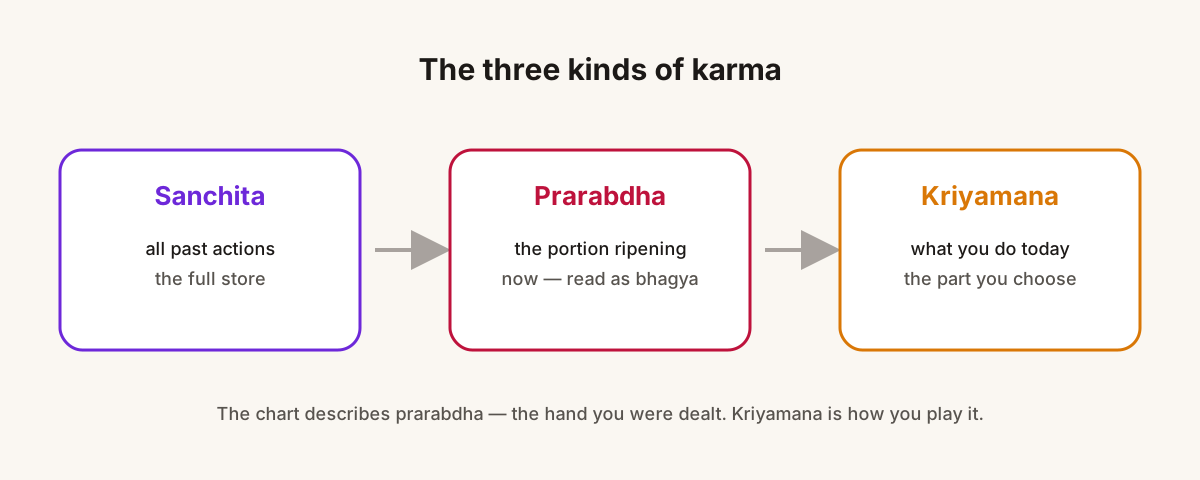
- Sanchita karma — the total store of everything you have done, across all of it. Far too large to experience at once.
- Prarabdha karma — the portion of that store that has "begun to bear fruit" in this life. It is the hand you were dealt: your family, your body, your talents, the timing of the major chapters of your life. When people say bhagya, this is mostly what they mean.
- Kriyamana karma (also called agami) — what you are doing now, today, with full freedom to choose. It is also the seed of tomorrow's fortune.
Put simply: your bhagya is your past karma arriving. Your karma today is your future bhagya being written. They are the same river at two points in its course.
What the birth chart actually shows
A Vedic birth chart is, in this framework, a map of prarabdha — the ripening portion. That is why astrologers can speak about timing: the chart shows when certain fruits come due. But the chart cannot do your kriyamana for you. It shows the season; it does not plough the field.
The texts place the two ideas in neighbouring houses.
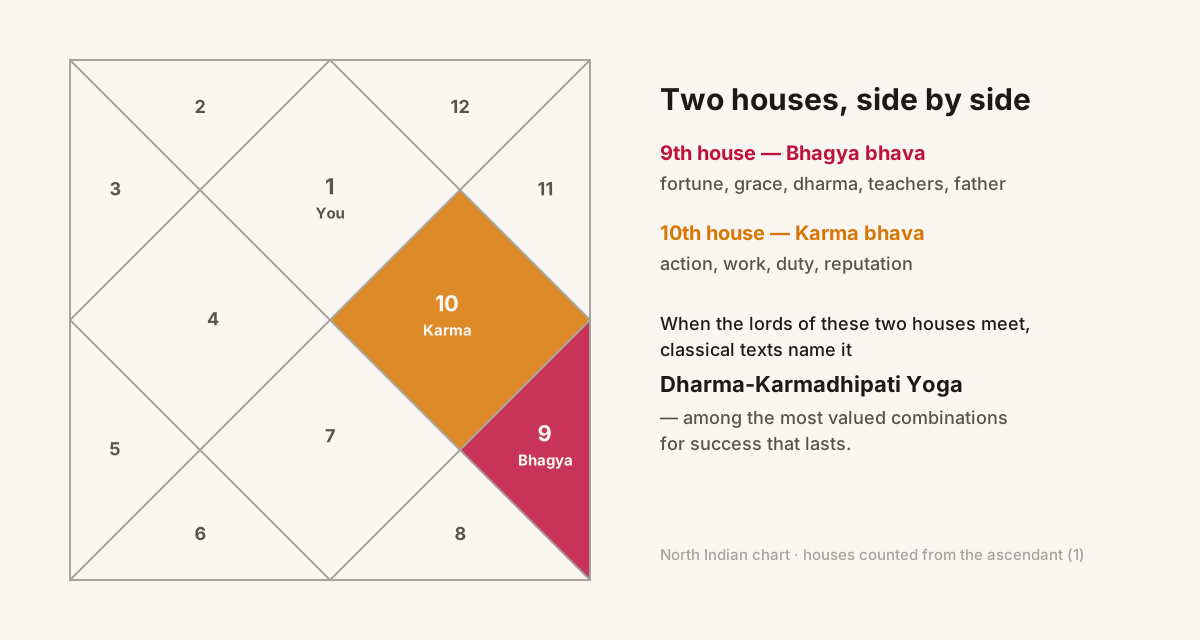
The 9th house is the bhagya bhava — the house of fortune, grace and dharma. It also rules teachers, blessings, higher learning, long journeys and, in the North Indian tradition, the father. A strong 9th is the person for whom help appears at the right moment.
The 10th house is the karma bhava — the house of action: profession, duty, achievement, reputation, the visible work of your life. A strong 10th is the person who builds, steadily and in public view.
Look at a chart with only one of these strong and you see two familiar stories.
- Strong 10th, weak 9th: tireless effort, real skill, but things take longer than they should. Promotions arrive late; the right mentor never quite appears. Success comes, but it is fought for at every step.
- Strong 9th, weak 10th: opportunities fall into the lap — the scholarship, the introduction, the inheritance — but they are not built upon. Fortune visits and moves on.
When the two houses meet: Dharma-Karmadhipati Yoga
Classical astrology names a special combination for when the lords of the 9th and 10th houses are joined — by sitting together, exchanging signs, or aspecting each other: Dharma-Karmadhipati Yoga, the union of the lord of dharma and fortune with the lord of action. It is counted among the most valuable raja yogas, the combinations for lasting success.
The symbolism is exact. Fortune that is joined to action becomes achievement. Action that is joined to fortune becomes ease. Neither alone produces what the two produce together.
Most charts do not have this yoga in its textbook form, and that is fine. The principle still holds in every chart: look at how the 9th and 10th houses and their lords relate, and you learn how a person's effort and their luck are likely to cooperate — and where they need help.
So which matters more?
The Bhagavad Gita gives the most quoted answer, in its second chapter: you have a right to your action, but never to its fruits. It is usually remembered in Nepali as karma gara, phal ko asha nagara — do your work, and don't cling to the result.
This is not fatalism. It is the opposite. The Gita does not say results do not matter; it says that the part you control is the action, and that obsessing over the part you do not control — timing, grace, other people — weakens the action itself.
Astrology adds one practical layer: timing. There are periods (dashas) when the 9th house is strongly activated and doors open more easily, and periods when the 10th is activated and steady effort is what pays. A wise person works in both, but works differently:
- In a 9th-house season, say yes. Reach out to teachers, apply, travel, ask. Fortune is moving; put yourself in its path.
- In a 10th-house season, build. Show up daily, finish what you started, take responsibility. Effort compounds now.
- In difficult seasons — when a hard Saturn transit or a challenging dasha is running — the work is quieter: consolidate, keep commitments, prepare. These are not wasted years. They are often when the foundations of the next rise are laid.
Effort is also a form of fortune
One more turn of the idea. The capacity to work hard — health, discipline, a clear mind, people who believe in you — is itself part of your bhagya. And good fortune that arrives without effort is often lost, because nothing was built to hold it.
That is why the balance matters. Pure reliance on bhagya becomes waiting. Pure reliance on karma becomes exhaustion. The chart shows where you stand between the two; your choices decide what you do with it.
Reading your own 9th and 10th houses
If you want to see this in your own chart, look at three things:
- The signs on your 9th and 10th houses and where their lords sit. A 9th lord placed in a kendra (1st, 4th, 7th or 10th house) or a trikona (1st, 5th or 9th) tends to support fortune; a 10th lord in the same places supports achievement.
- Whether the two lords connect — together, in each other's signs, or aspecting one another.
- Which dasha is running now, and whether its lord is tied to the 9th, the 10th, or both. That tells you which kind of season you are in.
You can calculate your chart for free and see your houses and running dasha on your dashboard — or ask Vedhora's astrologer how your 9th and 10th houses work together, and what the current period asks of you.
Fortune and effort were never opponents. In the best lives they work like two hands: one opens, the other builds.
Discover Your True Planetary Placements
Calculate your true Sidereal Lagna, Chandra Rashi, Nakshatras, and 120-year Vimshottari Dasha timeline with verified astronomical precision.
Calculate Your Free Kundli