
Twins: Same Minute, Different Lives
If astrology works, why do twins live different lives? The ascendant, the divisional charts and the dashas shift in minutes. A worked 20-minute example.

It's the oldest challenge to astrology: twins. Same mother, same place, same day, sometimes only minutes apart, and yet one becomes a doctor and the other an artist. One marries young and the other never marries. If the stars decide, why don't twins share a fate?
The astrologers took this question seriously long before anyone used it as an objection. C.S. Patel's Ashtakavarga states it bluntly:
"Even in the case of twins born at an interval of 15, 30 or 45 minutes, having same Lagna rasi, they have their future events quite different. One of them may die and the other may survive. One becomes a rich man while the other remains poor."
The tradition's answer comes down to one word: time. A birth chart isn't a picture of the day. It's a picture of the minute.
The ascendant moves fast
The planets move slowly. The Moon shifts about half a degree an hour, and the others far less. But the ascendant, the sign rising on the eastern horizon, turns through the whole zodiac every day. As the old textbook The Art of Astrology notes, "a new degree of the zodiac rises every four minutes and thus even the horoscopes of twins may differ considerably." Twins, it adds, are usually born "at an interval of from twenty minutes to several hours apart."
And sometimes that interval crosses a border: "When the last of a sign is rising for one of the twins, the other will usually be born under the next sign."
A worked example: 20 minutes
Let's test it. We used Vedhora's engine on a real date, 14 March 1992, in Delhi, and imagined three babies born ten minutes apart:
- 7:45 am: ascendant Pisces 24°31′, navamsa ascendant Aquarius, Saturn's mahadasha starting 16 January 2001
- 7:55 am: ascendant Pisces 27°58′, navamsa ascendant Pisces (now vargottama, a much stronger ascendant), Saturn's mahadasha starting 3 December 2000
- 8:05 am: ascendant Aries 1°23′, a different rising sign altogether, navamsa ascendant Aries, Saturn's mahadasha starting 21 October 2000
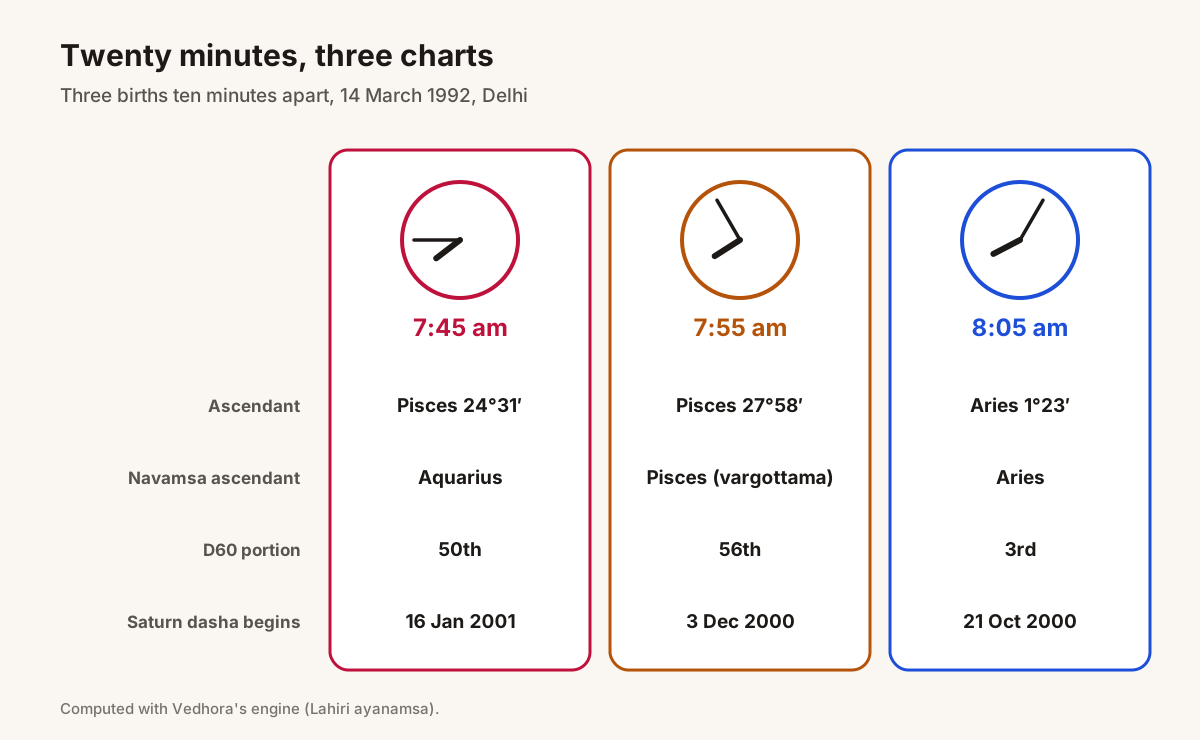
In twenty minutes:
- The rising sign changed. Pisces became Aries. Every house, every house lord and every yoga built on the houses was reshuffled.
- The navamsa changed twice. The D9 is the chart of inner strength and marriage, and it went from Aquarius to Pisces to Aries (how the navamsa works).
- The dasha clock shifted by three months. In this chart, every ten minutes moved each mahadasha about six weeks earlier (how the dasha clock is set).
Finer and finer charts
Vedic astrology has divisional charts precisely to tell nearly identical births apart. The finer the division, the faster it changes:
- The navamsa (D9) changes about every 13 minutes.
- The dashamsa (D10), the career chart, changes about every 12 minutes.
- The shashtiamsa (D60), which slices each sign into sixty parts of half a degree, can change every two minutes.
In our example, the D60 portion of the ascendant went from the 50th to the 56th to the 3rd in twenty minutes. Classical texts treat the D60 as the subtlest chart of all, the one that carries the imprint of past karma. Even twins born a few minutes apart sit in different shashtiamsas.
Same chart, different houses
There's a second, elegant answer, and it applies even if two twins really did share an identical chart. Joni Patry explains it in Eastern Astrology for Western Minds:
"In the case of twins that are born minutes apart with birth charts almost the same, you would differentiate them by looking at the 3rd house, as the younger sibling, and the 11th house as the elder sibling."
In other words, the same sky is read from a different seat. In the elder twin's chart, the 3rd house (younger siblings) describes the younger twin. In the younger twin's chart, the 11th house (elder siblings) describes the elder. Each twin is the other's sibling-house, and the chart tells the story from that angle.
Different souls, different karma
Finally, the tradition makes a philosophical point. The Best Way to Use Shad Bala puts it simply. Twins born almost together will share signs and strength values, "however philosophically being two different Jeeva Atmas, they have different Karmic evolution." It adds that "the few minutes or seconds of difference in the longitude of Moon may sometimes have the secret."
The chart describes the field each person is born into. How a soul moves through that field, and what it brings with it, isn't identical just because the clock nearly was.
What this means for you
The twin question is really a lesson about birth time. If a twenty-minute difference can change the rising sign, the navamsa and the timing of every dasha, then your own chart is only as reliable as your recorded time.
- If your time came from memory ("around eight in the morning"), treat ascendant-based and D9 readings with care.
- If your ascendant is near the start or end of a sign, or your D9 is borderline, a few minutes matter a great deal.
- If you're unsure, birth-time rectification can work backward from known life events to find the most likely minute (how rectification works).
The takeaway
Twins don't break astrology. They show how precise it is. The planets barely move in twenty minutes, but the ascendant can change sign, the navamsa can change twice, the dashas can shift by months, and the D60 can turn many times. Even an identical chart is read from different houses for each sibling. And beyond the arithmetic, two souls bring two histories.
Calculate your chart free and check how close your ascendant sits to a sign boundary. If you're near one, your birth minute matters.
Discover Your True Planetary Placements
Calculate your true Sidereal Lagna, Chandra Rashi, Nakshatras, and 120-year Vimshottari Dasha timeline with verified astronomical precision.
Calculate Your Free Kundli