
Why Saturday Comes Before Sunday
The order of the weekdays isn't random. It comes from the horas, seven planets taking turns hour by hour. How Aryabhata explained it, and how to use horas.
Here's a question most people never think to ask. Why does the week go Sunday, Monday, Tuesday, Wednesday, Thursday, Friday, Saturday?
Each day is named after a planet: the Sun, the Moon, Mars (Mangal), Mercury (Budh), Jupiter (Guru), Venus (Shukra) and Saturn (Shani). But that's not the order of the planets in the sky by brightness, size or distance. So where does it come from?
The answer is one of the most elegant ideas in astronomy, and Indian astronomers wrote it down long ago. It's hidden in the hora, the planetary hour.
Step one: line the planets up by speed
Seen from Earth, the seven visible planets move against the stars at very different speeds. Saturn crawls, taking about two and a half years per sign. The Moon races, taking about two and a half days. In between, from slowest to fastest:
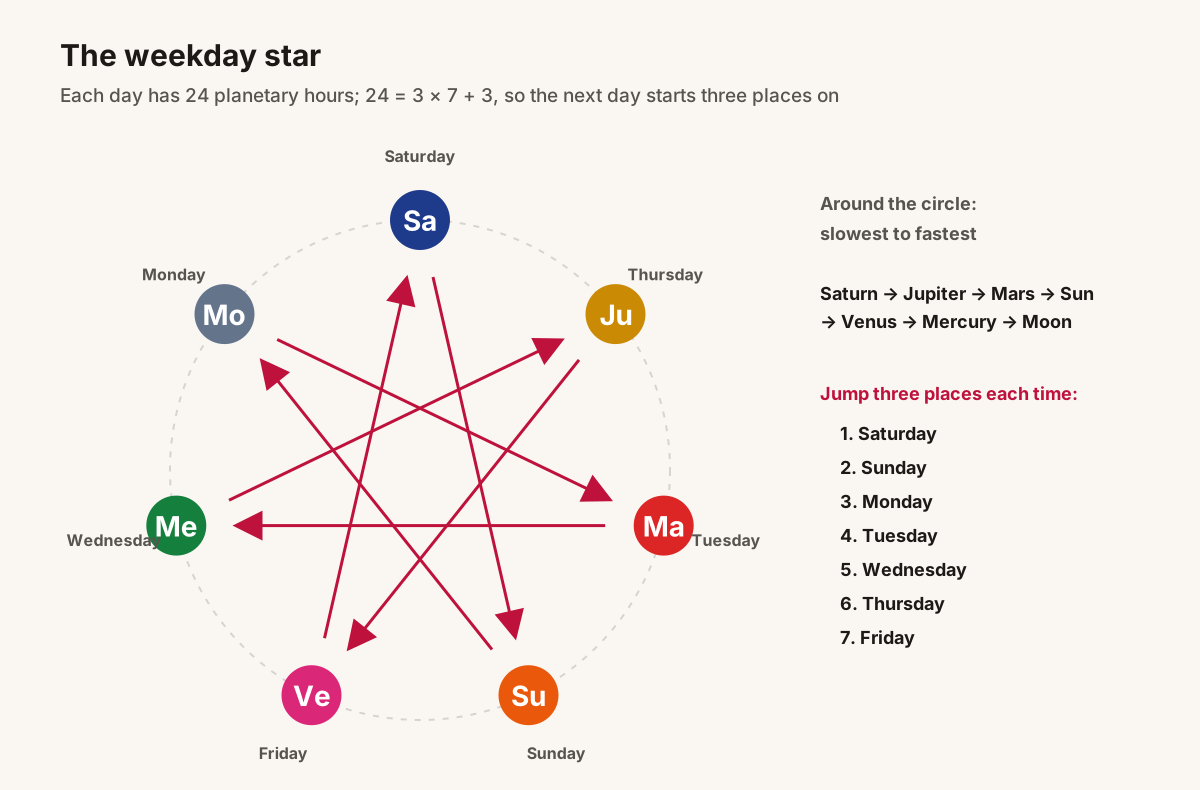
Saturn → Jupiter → Mars → Sun → Venus → Mercury → Moon
The great astronomer Aryabhata described this very sequence as layers of the sky: Saturn highest, then Jupiter, Mars, the Sun, Venus, Mercury and the Moon, "one below the other; beneath them all lies the earth." K.S. Charak quotes him in Elements of Vedic Astrology. Dr. S.C. Kursija's horary manual says the same thing plainly: these planets "are considered to be progressively faster in motion."
Step two: let them take turns, hour by hour
Now give each hour of the day to a planet, in that order, one after another. These are the horas. Aryabhata again:
"The seven planets beginning with Saturn, which are arranged in the order of increasing velocity, are the lords of the successive Horas. The planets occurring fourth in order of increasing velocity are the lords of the successive days, which are reckoned from sunrise."
That second sentence is the whole secret. Here's why.
Step three: count 24
A day has 24 horas. Seven planets go into 24 three full times (21), with 3 left over. So whichever planet rules the first hour of today, the first hour of tomorrow belongs to the planet three places further on, the fourth in the sequence counting from today's.
The Jyotisha Siddhanta Sara walks through it. Sunday's first hora belongs to the Sun. After three full rounds and three more horas (Sun, Venus, Mercury), "the next day starts with the fourth hora of the cycle, which is ruled by Moon and hence the day is called Monday."
Do it yourself, jumping three places forward each time:
- Saturn, then 3 places on → Sun. Saturday is followed by Sunday.
- Sun → Moon. Then Monday.
- Moon → Mars. Then Tuesday.
- Mars → Mercury. Then Wednesday.
- Mercury → Jupiter. Then Thursday.
- Jupiter → Venus. Then Friday.
- Venus → Saturn, and the week begins again.
Charak sums it up in one line: "From Saturn, the fourth in order is the Sun; therefore, the Sun is the lord of the day following the day of Saturn. That is, Sunday follows Saturday."
As one essay in The Astrologer's Apprentice puts it, we usually think the first hour of Monday belongs to the Moon because it's Monday. "In fact, it is the other way round: Monday is Monday because the first hour of that day is ruled by the Moon." The week is a by-product of the planetary hours.
Using the horas today
The horas aren't just a historical curiosity. Every Vedic almanac still lists them, and they're used in three ways.
1. Choosing a time (muhurta). Arun Kumar Bansal's Electional Astrology calls the hora "highly beneficial for success in work" because it gives a favourable window "even in unfortunate days." His pairings:
- Sun's hora: government work
- Moon's hora: all activities
- Mars's hora: competition and contests ("war" in the old texts)
- Mercury's hora: studies
- Jupiter's hora: marriage
- Venus's hora: travel
- Saturn's hora: collecting money
So if you have a difficult call with a government office, the Sun's hora on a good day is a classic choice.
2. Reading a birth chart. The Jataka Parijata gives the effect of being born in each planet's hour (kala hora). The Moon's hour brings prosperity, Mercury's learning and wealth, Jupiter's "possession of every kind of blessing" and Venus's a happy marriage. The Sun's hour brings "pain and fatigue", and the hours of Mars and Saturn are the hardest of all. And in the six-fold strength of planets (shadbala), the lord of your birth hour gets extra strength.
3. Night horas. The Jataka Parijata adds a rule for the night. The first hora after sunset is taken from the fifth day counting from the current day. For Monday night, that's Friday, so Venus rules the first hour of Monday's night.
Working out the hora right now
- Note today's weekday. Its planet rules the first hour after sunrise.
- Count the hours since sunrise.
- Move along the sequence Saturn → Jupiter → Mars → Sun → Venus → Mercury → Moon (and round again) by that many steps.
For example, on a Wednesday the first hora after sunrise is Mercury's, the second the Moon's, the third Saturn's, the fourth Jupiter's, and so on.
The takeaway
The seven-day week is a clock built from the sky. Order the planets by speed, give each hour to the next in line, and the 24-hour day pushes each new day three places forward. That's why Saturday hands over to the Sun, and the Sun to the Moon. Aryabhata knew it, the almanacs still use it, and you can use it to pick your hour.
Calculate your chart free to see the hora you were born in. For more on picking good times, read how to choose an auspicious time.
Discover Your True Planetary Placements
Calculate your true Sidereal Lagna, Chandra Rashi, Nakshatras, and 120-year Vimshottari Dasha timeline with verified astronomical precision.
Calculate Your Free Kundli