
Drishti: How Planets See Each Other
Planets 'look' at houses and other planets. All aspect the 7th; Mars, Jupiter and Saturn have special aspects; Jaimini adds sign aspects. A complete guide.
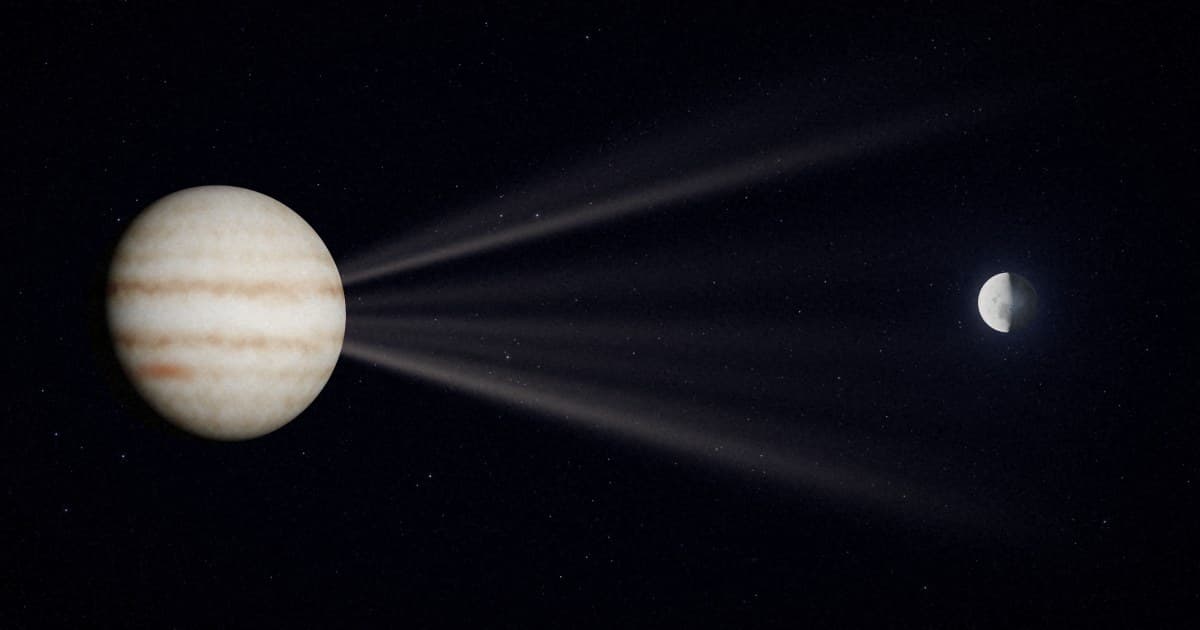
A planet doesn't just affect the house it sits in. In Vedic astrology it also looks at other houses, and whatever it looks at, it influences. That look is called drishti, "sight".
Understanding drishti is what turns a list of placements into a living chart. A Jupiter in one house can protect three others. A Saturn can press on a house from far across the chart.
The rule every planet follows: the 7th
The first rule is simple. Every planet aspects the house directly opposite it, the 7th from itself, with full strength. The Laghu Parashari opens its rules with it: "All the planets (beginning with the Sun) aspect the planets in the 7th House with a full sight."
So the Moon in your 4th house aspects your 10th. Venus in your 1st aspects your 7th, and so on.
The three special aspects
Three planets have extra reach. In the words of the Laghu Parashari:
"Saturn aspects those in the 3rd and 10th Houses with extra ordinary Drishti, so does Jupiter aspect them in the 5th and the 9th, and Mars in the 4th and the 8th Houses with a full sight."
- Mars aspects the 4th, 7th and 8th from itself.
- Jupiter aspects the 5th, 7th and 9th from itself.
- Saturn aspects the 3rd, 7th and 10th from itself.
Rahu and Ketu are often given Jupiter-like aspects (5th, 7th, 9th) by many astrologers, but practice varies.
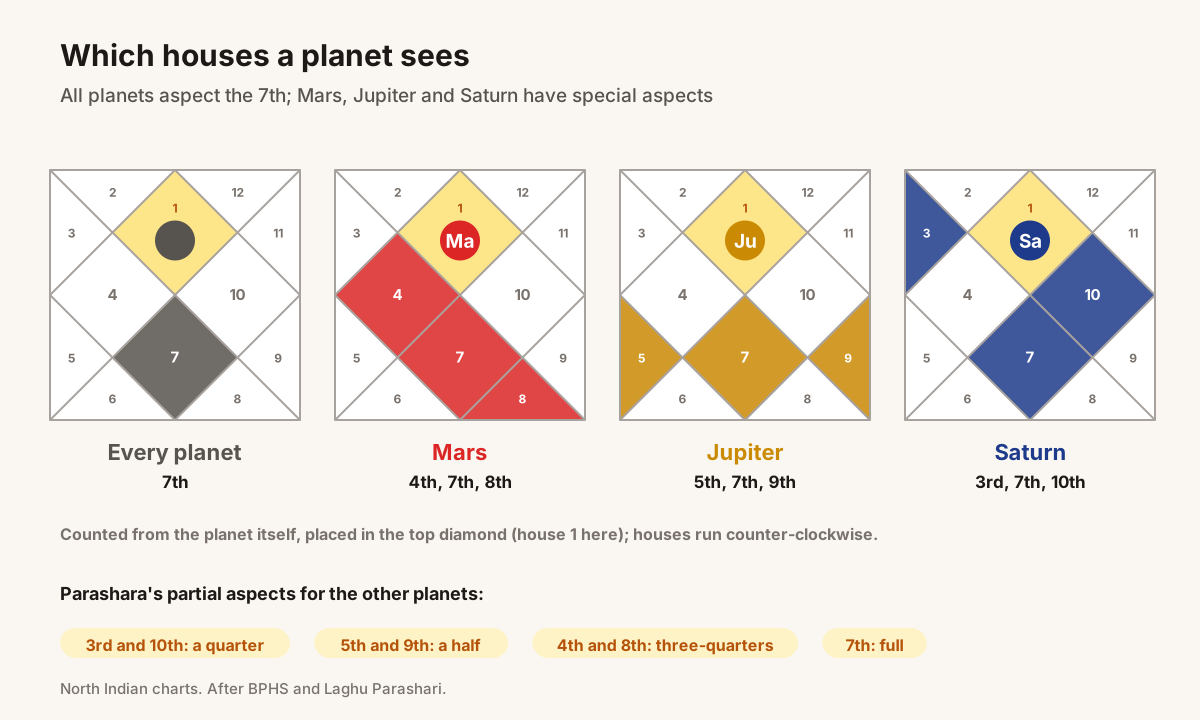
The special aspects suit each planet's nature. Jupiter, the guru, blesses the trines (5th and 9th), the houses of wisdom and fortune. Mars, the warrior, strikes at the 4th and 8th, home and hidden matters. Saturn, the taskmaster, presses on the 3rd and 10th, effort and career (Mars and Saturn compared).
Partial aspects: Parashara's quarters
The Brihat Parashara Hora Shastra (BPHS) adds a subtler layer. Every planet casts partial glances at certain houses, growing "gradually in slabs of quarters":
- 3rd and 10th: a quarter aspect (¼)
- 5th and 9th: a half aspect (½)
- 4th and 8th: three-quarters (¾)
- 7th: full
The special aspects are simply the cases where Saturn, Jupiter and Mars make those houses full. K.S. Charak summarises it in Elements of Vedic Astrology: the other planets "cast a quarter glance on houses 3 and 10, half an aspect on houses 5 and 9, and three-quarter aspect on houses 4 and 8."
In practice most astrologers work with the full aspects and keep the partial ones for fine judgement. BPHS itself grades results by them: when a configuration is formed by aspect, "if the Drishti is full, half, or one fourth, results will be in order full, medium and negligible."
A worked example
In our sample chart (14 March 1992, Delhi, Pisces ascendant):
- Saturn in the 11th (Capricorn) aspects the 1st (3rd from it), the 5th (7th from it) and the 8th (10th from it). The ascendant receives Saturn's sober, serious influence.
- Mars in the 11th aspects the 2nd (4th from it), the 5th (7th) and the 6th (8th). The 5th house receives both Mars and Saturn.
- Jupiter in the 6th (Leo) aspects the 10th (5th from it), the 12th (7th) and the 2nd (9th). So Jupiter, the ascendant lord, protects the house of career.
Count carefully, always including the house the planet sits in as "1".
Benefic and malefic sight
Whose sight it is matters as much as where it falls:
- Benefic aspects (Jupiter, Venus, a strong Moon, a well-associated Mercury) protect and improve. BPHS's test for a thriving house begins with being "yuti with, or drishtied by a benefic" (the 12 houses).
- Malefic aspects (Saturn, Mars, the Sun, Rahu) pressure and test. They aren't always harmful, though. Malefic aspects on the upachaya houses (3, 6, 10, 11) can fuel growth.
Jupiter's aspect is the most prized in Jyotish. A Jupiter aspect on a troubled house or planet is a classic softener.
Jaimini's sign aspects
The Jaimini system adds a completely different kind of aspect: signs aspect signs (rashi drishti). The Jaimini Sutras commentary sets out the rule:
"All the Chara Rasis or movable signs aspect all the Sthira Rasis or fixed signs excepting that which is next to it and all the fixed signs aspect the movable signs excepting that which is next to it. The double bodied signs aspect each other."
So Aries (movable) aspects Leo, Scorpio and Aquarius, but not neighbouring Taurus. Taurus (fixed) aspects Cancer, Libra and Capricorn, but not Aries. Gemini, Virgo, Sagittarius and Pisces all aspect one another. Planets in a sign share its aspects. These sign aspects drive Jaimini techniques such as the arudha padas and the sign-based dashas (the arudha lagna).
Checklist for reading aspects
- For each planet, mark its 7th and, for Mars, Jupiter and Saturn, the special houses.
- Note which houses receive Jupiter's aspect. They're protected.
- Note houses or planets aspected by two malefics. They're under strain.
- Look for mutual aspects (two planets aspecting each other). These form strong two-way links.
- If you use Jaimini, add the sign aspects.
The takeaway
Every planet looks across the chart to its 7th. Mars also strikes the 4th and 8th, Jupiter blesses the 5th and 9th, and Saturn presses on the 3rd and 10th. Parashara adds quarter, half and three-quarter glances, and Jaimini lets whole signs aspect each other. Read the aspects, and the chart's hidden connections appear.
Calculate your chart free and trace your Jupiter's aspects. They show where you're most protected.
Discover Your True Planetary Placements
Calculate your true Sidereal Lagna, Chandra Rashi, Nakshatras, and 120-year Vimshottari Dasha timeline with verified astronomical precision.
Calculate Your Free Kundli