
Ayanamsa: Why Your Vedic Sign Differs
Vedic astrology uses the zodiac of the real stars, so your sign often changes. Ayanamsa explained: the 24° gap, the Lahiri standard, why most signs shift.

You've been a Leo all your life. Then you look up your Vedic chart and it says your Sun is in Cancer. It's not a mistake. It's one of the deepest differences between Vedic and Western astrology, and it comes down to one number: the ayanamsa.
Two zodiacs
Both systems divide the sky into twelve signs of 30°. They disagree about where the zodiac starts.
- Western astrology uses the tropical zodiac (sayana, "with the ayana"). Aries begins at the spring equinox, wherever the Sun happens to be against the stars on that day.
- Vedic astrology uses the sidereal zodiac (nirayana, "without the ayana"). Aries begins at a fixed point among the stars.
Once, long ago, the two starting points coincided. They've been drifting apart ever since.
Why they drift: precession
The Earth's axis wobbles very slowly, like a spinning top, so the equinox point slides backwards against the stars by about 50 seconds of arc every year. Over a lifetime that's tiny. Over centuries it adds up. Today the gap is more than 24°.
That gap is the ayanamsa, literally "the portion of the ayana", the precessional distance between the two zodiacs. Sanjay Rath notes the average rate: a full circle in about 25,800 years, about 50.23″ per year. He adds that the Surya Siddhanta, which works with a 24,000-year cycle, "has been very close to the truth."
How big is the gap today?
Vedhora's engine, using the Lahiri standard, gives:
- 1956: 23°14′
- 2000: 23°51′
- 2026: 24°13′
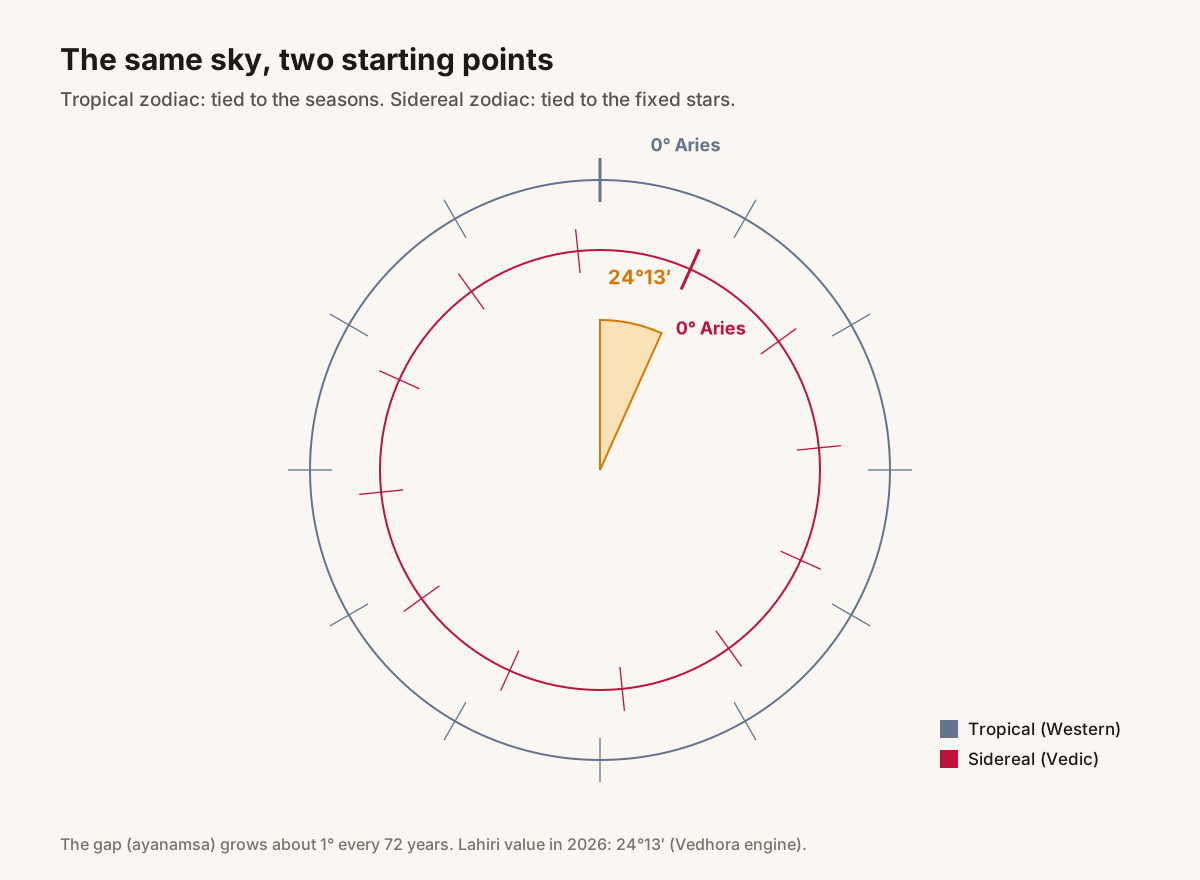
The ayanamsa grows by roughly a degree every 72 years, and it applies equally to your Sun, Moon, ascendant and every planet.
Why your sign changes, by the numbers
A planet is in the same sign in both systems only if it sits in the last part of a tropical sign, beyond the first 24°13′. Since 24°13′ is about 81% of a sign, about four out of five people find their Sun in the previous sign in a Vedic chart. Most Western Leos are Vedic Cancers, and most Western Pisceans are Vedic Aquarians.
You can see this in the calendar. The tropical Sun enters Aries at the March equinox, around 20–21 March. The sidereal Sun enters Aries (Mesha Sankranti) around 14 April, the date many Indian regional new years are still celebrated.
Which ayanamsa?
There's one honest complication. Astronomers and astrologers have never fully agreed on exactly when the two zodiacs coincided. B.V. Raman wrote in his Manual of Hindu Astrology (1935) that "the exact period when both the zodiacs coincided in the first point is not definitely known." In his day, ayanamsa values ranged across several degrees, with proposed coincidence dates of 361, 394, 397, 498 and 559 AD.
V.P. Jain's Elements of Astronomy and Astrological Calculations explains how India settled it:
- The Chitrapaksha (Lahiri) ayanamsa fixes the star Chitra (Spica) at exactly 180°, the opposite point to the start of Aries. By this standard the two zodiacs coincided on 22 March 285 AD.
- The Calendar Reform Committee, appointed by the Government of India in 1952 with Lahiri himself as its secretary, recommended this value for India's official calendar work.
- Raman's own ayanamsa puts the coincidence in 397 AD, 112 years later, which makes it about 1°33′ smaller.
The ancient authorities used different rates too. Jain lists Aryabhata at 46.3″ a year, Parashara 46.5″, Varahamihira 50.0″ and the Surya Siddhanta 54″, against the modern value of about 50.24″.
Today Lahiri is the most widely used standard in Vedic astrology. It's the one Vedhora uses.
Why Vedic astrology uses the stars
The sidereal choice isn't arbitrary. Jyotish is built on the nakshatras, the 27 lunar mansions defined by actual stars. Ashwini, Rohini and Chitra are star groups, not seasons (the 27 nakshatras explained). A zodiac tied to the stars keeps the signs and nakshatras aligned with the sky they're named after. Your Vedic Moon in Rohini is a Moon that really was in front of the Rohini stars when you were born.
The tropical zodiac follows the seasons. The sidereal zodiac follows the stars. Vedic astrology reads the stars.
The takeaway
Your Vedic sign differs because Vedic astrology measures the sky as it actually is, correcting for the slow wobble of the Earth's axis. Today that correction is about 24°13′, enough to move four out of five Sun signs back one sign. The tradition has measured it with remarkable care, from the Surya Siddhanta to the standard recommended by India's Calendar Reform Committee.
Calculate your chart free to see your true sidereal positions. For why Vedic astrology reads your Moon sign first, see why Vedic astrology uses the Moon sign.
Discover Your True Planetary Placements
Calculate your true Sidereal Lagna, Chandra Rashi, Nakshatras, and 120-year Vimshottari Dasha timeline with verified astronomical precision.
Calculate Your Free Kundli