
Rectification: Finding Your Birth Time
Birth times are often minutes out, and the ascendant moves a degree every four minutes. How astrologers correct a birth time, from shortcuts to life events.

The date of your birth is usually certain. The time often isn't. It might be "a few minutes after seven", a hospital clock that ran fast, or a parent's memory from decades ago. In Vedic astrology those minutes matter.
R. Santhanam puts it plainly in Essentials of Predictive Hindu Astrology: "difference in birth time is difference in destiny pattern." Correcting the time is called rectification, and it's one of the oldest problems in the craft. The classical texts even have a branch for rebuilding a chart when the time is lost altogether: Nashta Jataka, the "lost horoscope".
Why a few minutes matter
P.V.R. Narasimha Rao, in Vedic Astrology: An Integrated Approach, gives the rule of thumb: "Lagna moves by 1° in 4 min." From that:
- the ascendant changes sign about every two hours
- the navamsa (D9) ascendant changes about every 13 minutes
- the dashamsa (D10) ascendant, the career chart, about every 12 minutes
- the D24, the chart of learning, about every 5 minutes
The dashas move too. They're set by the Moon's exact position at birth, so a later birth time shifts every dasha date earlier.
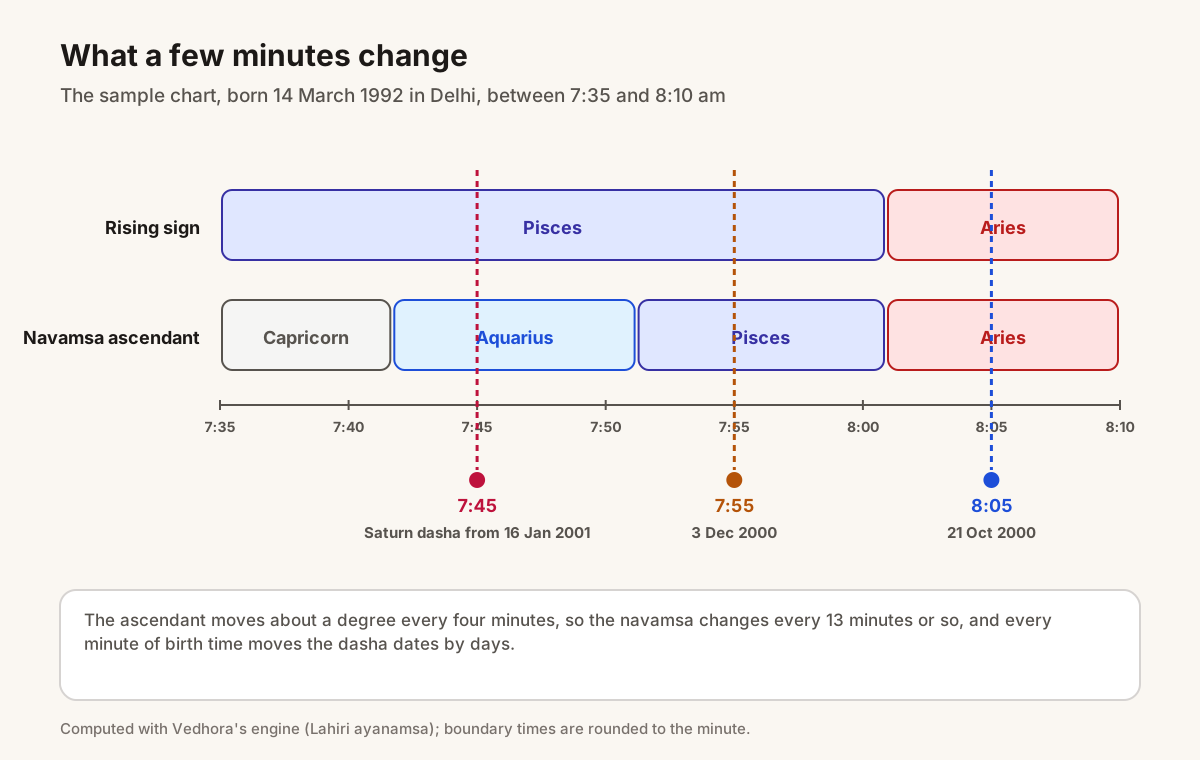
An example. Our sample chart is set for 14 March 1992, 7:45 am, in Delhi. Here's what happens if the real time was a little later:
- 7:45: ascendant Pisces 24°31′, navamsa ascendant Aquarius, Saturn's dasha begins 16 January 2001
- 7:55: ascendant Pisces 27°58′, navamsa ascendant Pisces, Saturn's dasha begins 3 December 2000
- 8:05: ascendant Aries 1°23′, navamsa ascendant Aries, Saturn's dasha begins 21 October 2000
Twenty minutes, and the whole chart turns: a different rising sign, a different navamsa, and dasha dates nearly three months earlier (twins: same minute, different lives).
What counts as "birth"?
Before correcting a time, it helps to know which moment you're after, and astrologers don't agree. Z. Ansari's Dasha Nirnay lists the views: when the head first appears, when the head is fully out, when the child is "completely out of the mother's womb and becomes an independent entity", or the first cry. Sanjay Rath argues for the cutting of the umbilical cord, drawing on the image of Brahma born on the lotus that rises from Vishnu's navel. V.P. Jain notes that these moments can differ "by 15 to 20 minutes". That's enough to change the navamsa.
The classical shortcuts
The old texts offer quick methods. Narasimha Rao names three: Tattva, Pranapada and Kunda. They assume a birth can fall only in certain "quanta" of time, and correct the reported time to the nearest one. He counts them among the more reasonable formulas, but says two of them "fail the acid test of twins". Twins born two minutes apart would come out with the same time, or times too far apart.
Two other classical checks are worth knowing:
- The Moon and Mandi check. M. Ramakrishna Bhat gives this rule in Fundamentals of Astrology: "The Lagna may be the 7th, 5th or 9th from the sign or Navamsa of Mandi or the Moon, whichever is stronger of the two" (Gulika and Mandi).
- The question chart. Santhanam favours prashna, horary astrology. Cast a chart for the moment the person sincerely asks. Take how far the rising sign has risen (say 20° of 30°, two-thirds), and apply that fraction to the length of the day or night of birth. Counted from sunrise or sunset, it gives the birth time. He calls horary "undoubtedly the best and free from confusions, provided the query is natural and honest", and warns that asking the same astrologer a second time spoils it.
The event method
The most trusted method is also the most patient. Narasimha Rao: "The only correct way to rectify a birthtime is to find a time in the neighborhood of the reported birthtime so that we can explain the nature, credentials, attitude and aptitude of the native and the known events from the native's past."
Here's how it runs:
- Set the window. If you were told "around 7:45", test 7:30 to 8:00.
- Check the person. If the window spans two ascendants, or two navamsa ascendants, which one describes the person's build, temperament and talents?
- Mark the boundaries. Note where the ascendant changes sign in the D9, D10 and other divisional charts inside the window, and any planet sitting on a border.
- Test life events against the right charts: marriage in the D9, career in the D10, moving home or abroad in the D4, education in the D24, parents in the D12, children in the D7.
- Check the timing. The candidate time must put major events into fitting dasha periods.
- Confirm with transits. Santhanam uses the slow movers, Saturn, Jupiter, Rahu and Ketu, crossing sensitive points of the chart at the time of major events.
Narasimha Rao calls it a "pyramid-like approach": a broad cut with the D9 and D10 first, then the finer charts.
A rectification in action
Narasimha Rao walks through a real case. A man's reported birth time was 10:36 am, with a Capricorn ascendant.
- D4 (residence): he moved to the USA in Jupiter's dasha, which the D4 supported. That kept the ascendant between 7°30′ and 15° of Capricorn.
- D9 (temperament): the reported time gave an Aries navamsa ascendant, which promised a dynamic speaker and artist. He wasn't. A Taurus navamsa, a hard-working, mild-mannered intellectual, fitted him far better, so the time had to be a little later.
- D10 (career): a software engineer, and the career chart agreed. No change.
- D24 (education): computer science fitted only with a Gemini D24 ascendant, which needed the ascendant above 13°45′.
- The marriage date: Kalachakra dasha, tested against the year he married, then fixed the exact minute.
The answer was about 10:42:30, six and a half minutes later than reported. The likely culprit, he suggests, was the clock.
Tips for your own rectification
- Use only events you're sure of, dated at least to the month. One wrong date can mislead the whole test.
- More events, firmer answer. Three is a minimum. Five or more is better.
- Choose clear events: marriage, a child's birth, a first job, a move abroad, a parent's passing, a serious accident.
- Aim for the navamsa first. Santhanam's minimum goal is the correct navamsa ascendant, "about 13 minutes of clock time".
- A record beats a rectification. If a hospital record exists, find it.
The takeaway
The ascendant moves a degree every four minutes, so a small error can change the navamsa, the career chart and every dasha date. Classical shortcuts exist (Tattva, Pranapada, Kunda, the Moon and Mandi check, the question chart), but the most reliable method tests candidate times against the person's nature and the dated events of their life, chart by chart.
Find your birth time with Vedhora's rectification tool. It tests every possible time in your window against the dates of big events in your life, using your dashas and the transits of Jupiter and Saturn.
Discover Your True Planetary Placements
Calculate your true Sidereal Lagna, Chandra Rashi, Nakshatras, and 120-year Vimshottari Dasha timeline with verified astronomical precision.
Calculate Your Free Kundli