
What Is Lagna? Your Ascendant and Why Birth Time Matters
Your lagna is the sign rising in the east at birth and the base of every house in your chart. What it means, and why minutes of birth time matter.

Ask a Western astrologer for your sign and you will be told your Sun sign. Ask a Vedic astrologer and they will usually ask for something else first: your lagna. It is the single most important point in a Vedic chart — and the one that depends most on knowing exactly when you were born.
The lagna is the sign rising in the east
As Earth turns, the whole zodiac wheels across the sky once a day. At any moment one sign is coming up over the eastern horizon, the way the Sun does at dawn. The sign — and the exact degree — rising in the east at the moment and place of your birth is your lagna, or ascendant.
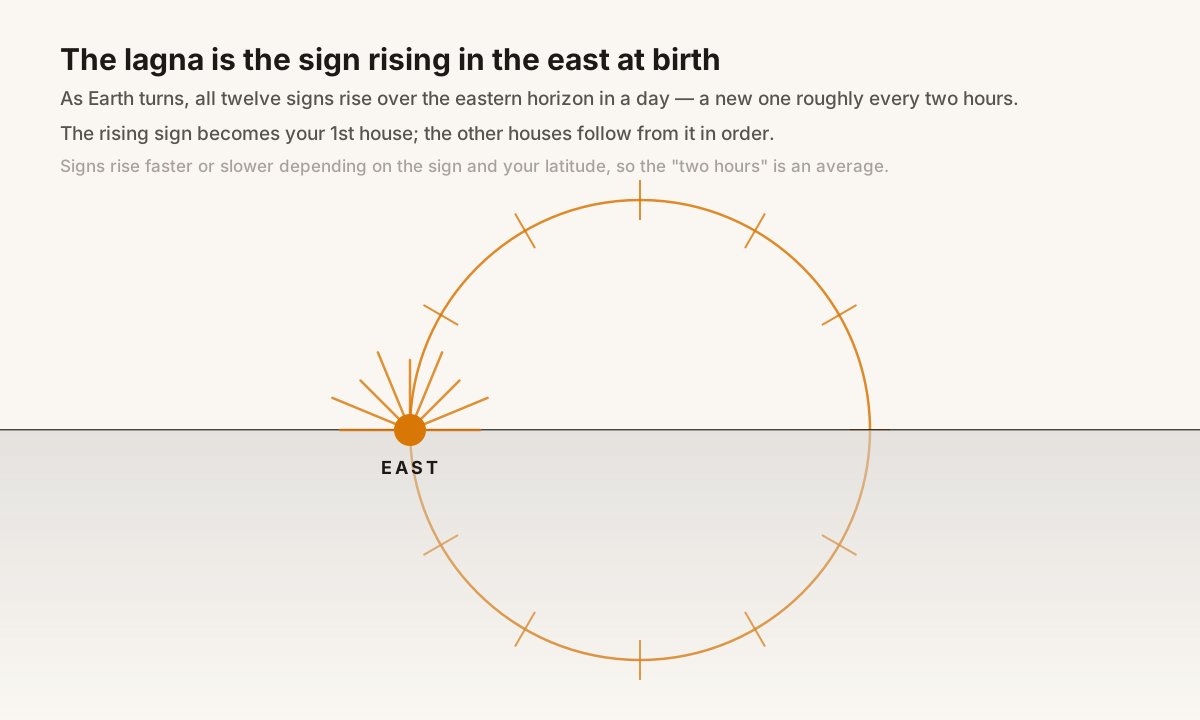
Because all twelve signs rise in about 24 hours, a new sign rises roughly every two hours on average. Some signs rise quickly and some slowly, and the speed depends on your latitude, so in practice a sign can rise in as little as an hour and a half or take closer to three.
Why it matters more than any other point
The lagna is the 1st house of your chart, and every other house is counted from it. Whatever sign is rising becomes your house of self; the next sign becomes your 2nd house of family and resources; the next your 3rd of effort and siblings — all the way round to the 12th.
That has a huge consequence. Two people born on the same day, a few hours apart, have the Sun, Moon and planets in the same signs — but in different houses. One might have Jupiter in the 10th house of career; the other, in the 7th house of partnership. Their charts can read like different lives.
This is also why the lagna decides which planets are especially helpful or difficult for you. In Vedic astrology a planet's role depends on the houses it rules from your ascendant. Saturn, a natural malefic, is the best friend of a Taurus or Libra ascendant, because for them it rules powerful houses. For other ascendants it can be the planet of hard lessons. Without the lagna, none of this can be read.
Lagna, Moon sign and Sun sign: three different things
- Lagna (ascendant): the sign rising at birth. It represents your body, temperament, the way you meet the world, and the overall direction of life. Depends on the exact time and place of birth.
- Moon sign (Chandra rashi): the sign the Moon was in. It represents your mind and emotional nature, and it is what Vedic horoscopes — including Vedhora's monthly horoscopes — are based on. It changes about every two and a quarter days. We explain why in Why Vedic astrology reads your Moon sign.
- Sun sign: the sign the Sun was in, which changes about once a month. In the sidereal (Vedic) zodiac it is usually one sign earlier than your Western Sun sign, because of the roughly 24° difference between the two zodiacs.
Vedic astrologers read all three. The traditional practice is to look at a chart from the lagna, and then again from the Moon (Chandra lagna) and the Sun (Surya lagna); a theme that repeats from all three points is one to take seriously.
What the lagna says about you
Classically, the lagna and the 1st house describe the self in its most physical sense: body, constitution, vitality, appearance, and the instinctive temperament you show the world. The lagna lord — the planet that rules your rising sign — is in many ways the captain of the whole chart. Where it sits, how strong it is, and which planets influence it say a great deal about health, confidence and the arc of life.
- A lagna lord placed well (in a kendra — the 1st, 4th, 7th or 10th house — or a trikona — the 1st, 5th or 9th), strong by sign, and supported by benefics tends to give resilience and the ability to make the most of whatever else the chart promises.
- A lagna lord in a difficult house (the 6th, 8th or 12th), or heavily afflicted, often points to a life where more effort goes into building health, stability or self-confidence — not a doomed life, but one with a clear area to strengthen.
- Planets sitting in the 1st house colour the personality strongly: Jupiter there tends to give optimism and generosity, Saturn seriousness and endurance, Mars energy and directness, Venus charm.
Why a few minutes can change everything
Because the lagna moves through a whole sign in about two hours, it moves through one degree in roughly four minutes. For most people, a birth time that is off by ten or fifteen minutes still gives the correct rising sign. But if you were born close to the boundary between two signs, a few minutes is the difference between two different charts.
The finer divisions are even more sensitive. The navamsa (D9) — the divisional chart Vedic astrologers rely on for marriage and for the true strength of each planet — divides each sign into nine parts of 3°20′. The navamsa lagna therefore changes on average every 13 minutes or so. The dasha balance at birth shifts with the Moon's exact position too. Precise timing is not pedantry; it is the foundation every prediction rests on.
What if you don't know your exact birth time?
Many people only know "early morning" or "around lunchtime". There are three things you can do.
- Look for a record. Hospital records and birth certificates are the most reliable source; family memories of "about 6" are often rounded.
- Use the time you have, and stay aware. If your time is approximate, check whether it puts you near a sign boundary. If it does, readings that depend on the ascendant should be held a little more loosely.
- Rectify it. Astrologers have long used birth-time rectification: testing every possible time against the dates of major events in your life — marriage, children, new jobs, moves — to find the time at which those events line up best with your dasha periods and transits. Vedhora has a free birth-time tool that does exactly this, and shows you how clearly one ascendant stands out.
Find your lagna
You need your date, time and place of birth. Calculate your chart free and your dashboard will show your lagna, its degree, your lagna lord and every house counted from it. Then ask the astrologer anything about what your ascendant means for your work, relationships or the period you are in now.
Your Sun sign tells you when in the year you were born. Your Moon sign tells you about your mind. Your lagna tells you where on Earth, and at what moment, you entered the world — and every house of your life is built on it.
Discover Your True Planetary Placements
Calculate your true Sidereal Lagna, Chandra Rashi, Nakshatras, and 120-year Vimshottari Dasha timeline with verified astronomical precision.
Calculate Your Free Kundli