
The 27 Nakshatras: Are They Real, and Are They Your Soul?
A clear guide to the 27 Vedic lunar mansions: the real stars behind them, their rulers and deities, and what your birth nakshatra says about you.
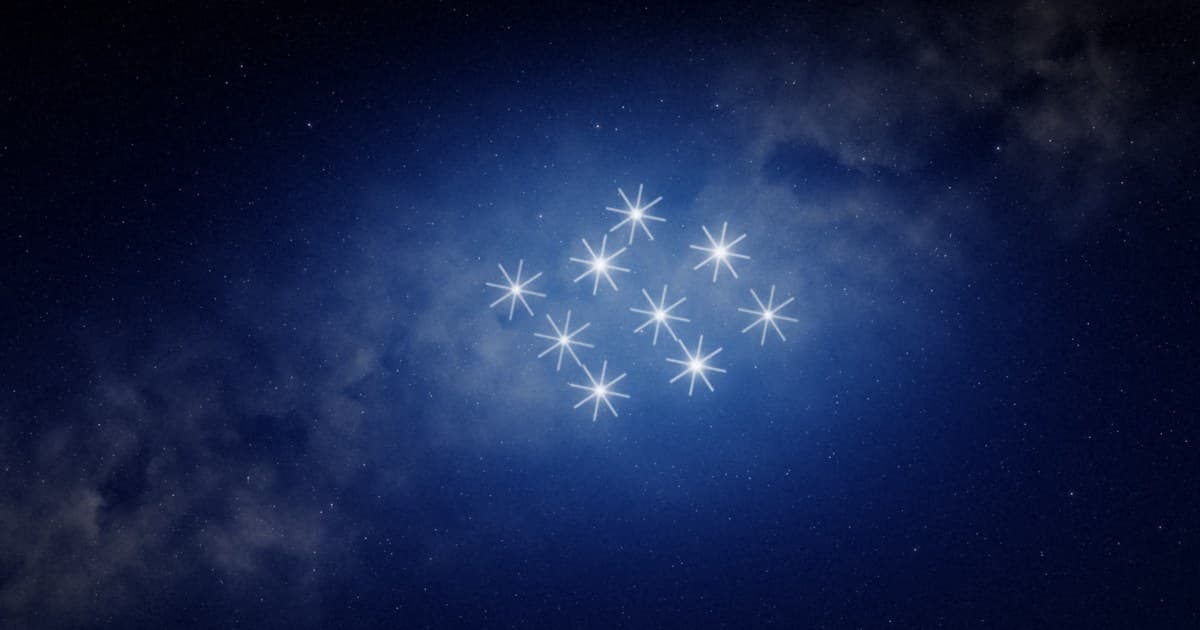
Long before the twelve zodiac signs became the familiar language of astrology, Vedic sky-watchers divided the heavens by the Moon. Every night the Moon sits among a different group of stars; in about 27 nights it returns to where it began. Those 27 star-stations are the nakshatras — the lunar mansions — and they are still the most personal layer of a Vedic chart.
This guide covers what they are, whether they are "real", how they are calculated, and what your birth nakshatra can and cannot tell you.
Are the nakshatras real?
Yes, in the most literal sense: each nakshatra is named after real stars you can see on a clear night. The Pleiades star cluster is Krittika. The red eye of Taurus, Aldebaran, is Rohini. The bright heart of Leo, Regulus, is Magha. Spica in Virgo is Chitra; Arcturus is Swati; the red giant Antares, the heart of the Scorpion, is Jyeshtha; Betelgeuse is Ardra; the twin stars Castor and Pollux are Punarvasu; Altair is Shravana.
These star groups are called yogataras — the "junction stars" each mansion is anchored to. The names are among the oldest astronomical records in India; nakshatra lists already appear in the Vedic hymns and the Taittiriya Samhita.
What is a convention, not a natural fact, is the equal division. In practice, astrologers do not draw the nakshatras around the stars' irregular shapes. They divide the sidereal zodiac — the zodiac fixed to the stars — into 27 equal parts.
The arithmetic of the sky
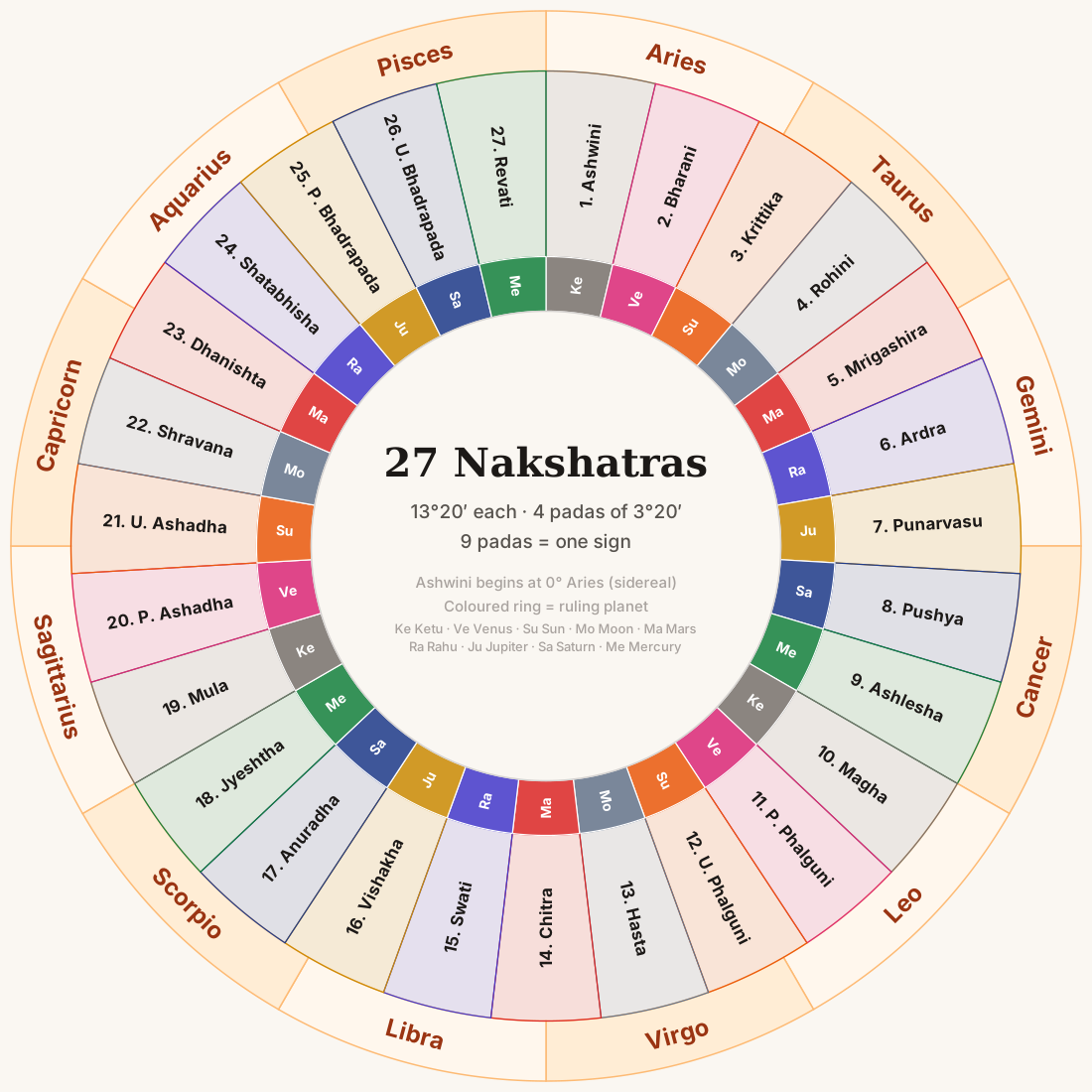
- The full circle of 360° is divided into 27 nakshatras of 13°20′ each.
- Each nakshatra has 4 padas (quarters) of 3°20′, so there are 108 padas in all — the sacred number of the mala.
- 9 padas make one zodiac sign (9 × 3°20′ = 30°). That is why the nakshatras and the signs fit together exactly every 2¼ nakshatras: Aries holds Ashwini, Bharani and the first quarter of Krittika.
- The count starts at 0° Aries in the sidereal zodiac, with Ashwini.
Why 27? The Moon takes about 27.3 days to circle the zodiac against the stars (the sidereal month), so it spends roughly one day in each mansion. A 28th mansion, Abhijit — near the bright star Vega — is still used in electional astrology (muhurta), squeezed between Uttara Ashadha and Shravana, but birth charts use 27.
The nine rulers and the dasha clock
Each nakshatra has a ruling planet, and the rulers repeat in a fixed sequence of nine — Ketu, Venus, Sun, Moon, Mars, Rahu, Jupiter, Saturn, Mercury — three times around the zodiac.
This matters far beyond symbolism. The nakshatra the Moon occupies at your birth decides which planet's Vimshottari dasha you were born in, and how much of it was left. Born with the Moon in Rohini (ruled by the Moon)? Your life began in a Moon period. In Magha (ruled by Ketu)? A Ketu period. Every later chapter of the 120-year dasha cycle follows from that single starting point — which is why Vedic timing depends so heavily on the Moon's exact position.
The 27, with their rulers and deities
Each nakshatra also has a presiding deity, whose myth colours its meaning.
- Ashwini — Ketu — the Ashvins, divine healers: speed, new beginnings, healing.
- Bharani — Venus — Yama, lord of death and restraint: bearing, endurance, transformation.
- Krittika — Sun — Agni, fire: sharpness, purification, cutting through.
- Rohini — Moon — Prajapati (Brahma), the creator: growth, beauty, fertility.
- Mrigashira — Mars — Soma: searching, curiosity, the gentle hunt.
- Ardra — Rahu — Rudra, the storm: upheaval, intensity, renewal through tears.
- Punarvasu — Jupiter — Aditi, mother of the gods: return, restoration, generosity.
- Pushya — Saturn — Brihaspati, teacher of the gods: nourishment, care, dharma.
- Ashlesha — Mercury — the Nagas, serpents: insight, entanglement, hidden knowledge.
- Magha — Ketu — the Pitris, ancestors: lineage, authority, tradition.
- Purva Phalguni — Venus — Bhaga, god of delight: pleasure, rest, romance.
- Uttara Phalguni — Sun — Aryaman, god of contracts: loyalty, partnership, patronage.
- Hasta — Moon — Savitar, the inspiring sun: skill of the hands, craft, cleverness.
- Chitra — Mars — Tvashtar, the divine architect: design, beauty, making.
- Swati — Rahu — Vayu, the wind: independence, movement, trade.
- Vishakha — Jupiter — Indra and Agni: ambition, determination, the forked path.
- Anuradha — Saturn — Mitra, god of friendship: devotion, cooperation, discipline.
- Jyeshtha — Mercury — Indra, king of the gods: seniority, protection, responsibility.
- Mula — Ketu — Nirriti: roots, uprooting, getting to the bottom of things.
- Purva Ashadha — Venus — Apas, the waters: invincibility, conviction, renewal.
- Uttara Ashadha — Sun — the Vishvadevas, universal gods: final victory, integrity.
- Shravana — Moon — Vishnu: listening, learning, connection.
- Dhanishta — Mars — the eight Vasus: wealth, rhythm, music.
- Shatabhisha — Rahu — Varuna, lord of cosmic waters: healing, secrecy, the hundred physicians.
- Purva Bhadrapada — Jupiter — Aja Ekapada, the one-footed goat: intensity, idealism, fire.
- Uttara Bhadrapada — Saturn — Ahir Budhnya, serpent of the deep: depth, wisdom, stability.
- Revati — Mercury — Pushan, guardian of travellers: nourishment, safe passage, completion.
The meanings above are traditional keynotes, not verdicts. A nakshatra describes a flavour that any person can express in a high or a low way.
Where nakshatras appear in your chart
- Janma nakshatra (birth star): the nakshatra of your Moon. It is the one most people mean by "my nakshatra", and the starting point of your dasha sequence.
- Every planet has one. Your Sun, your ascendant and each planet sits in a nakshatra too, which refines how that planet behaves. Two people with Mars in the same sign can have it in different nakshatras — and quite different temperaments.
- Padas and the navamsa. Each pada corresponds to one sign of the navamsa (D9) chart, the chart used for marriage and the deeper strength of each planet.
- Matching. Several of the 36 gunas in traditional kundli matching — tara, yoni, gana and nadi — are calculated from the two partners' birth nakshatras.
- Names and timing. Each pada has a sound, used for choosing a child's name (namakshar), and the daily nakshatra is central to muhurta.
- Gandanta. The three junctions where a water sign meets a fire sign — Ashlesha into Magha, Jyeshtha into Mula, Revati into Ashwini — are treated as sensitive points, knots that ask for care rather than fear.
Are the nakshatras your soul?
It is a beautiful idea, and it is often said. The more precise answer from the tradition is: not quite.
In Jyotish, the soul (atma) is signified by the Sun, and in the Jaimini system by your atmakaraka, the planet with the highest degree in your chart. The Moon is the mind (manas) — feeling, perception, the inner weather you live in each day. Your birth nakshatra is the star-station of your Moon, so it describes the colour of your mind: what soothes you, what you crave, how you respond.
That is not a lesser thing. The mind is the lens through which the soul meets the world. Knowing your nakshatra is like knowing the colour of your lens — it explains why the same events feel so different to different people. But you are not your lens. The tradition would say the soul looks through it.
Find your own nakshatra
You need your date, time and place of birth; the Moon moves about 13° a day, so even a few hours can change the nakshatra and almost always changes the pada. Calculate your chart free to see your birth nakshatra, pada and the dasha it set in motion — and if you are unsure of your birth time, our birth-time tool can help narrow it down from the events of your life.
Then, if you want to know what your nakshatra means for a particular question — your work, your relationships, the period you are in — ask the astrologer.
Discover Your True Planetary Placements
Calculate your true Sidereal Lagna, Chandra Rashi, Nakshatras, and 120-year Vimshottari Dasha timeline with verified astronomical precision.
Calculate Your Free Kundli