
Navamsa: The Chart Behind Your Chart
Why Vedic astrologers won't judge a planet without the navamsa (D9). How it's calculated, what it shows about strength and marriage, and the rules using it.

Show a birth chart to an experienced Vedic astrologer and, before saying much, they'll often ask to see one more: the navamsa. It's the most important of the divisional charts, and for many matters, especially marriage and the real strength of planets, the classics treat it as the final word.
What the navamsa is
Nava means nine, and amsa means part. The navamsa divides each 30° sign into nine parts of 3°20′. Each part is then assigned a sign of its own, and placing every planet in the sign of its part gives a second chart: the D9.
There's a beautiful link with the nakshatras. Each nakshatra has four padas (quarters) of 3°20′, so each navamsa is exactly one nakshatra pada. The 108 navamsas of the zodiac are the 108 padas of the 27 nakshatras. That's one reason 108 is a sacred number in this tradition.
How it's counted
Each sign starts its nine parts from a set point:
- Fire signs (Aries, Leo, Sagittarius) start from Aries
- Earth signs (Taurus, Virgo, Capricorn) start from Capricorn
- Air signs (Gemini, Libra, Aquarius) start from Libra
- Water signs (Cancer, Scorpio, Pisces) start from Cancer
Then you count forward, one sign per 3°20′.
Example: a planet at 17° Taurus. Taurus is an earth sign, so its navamsas begin from Capricorn. 17° falls in the 6th part (16°40′ to 20°00′). Count six signs from Capricorn: Capricorn, Aquarius, Pisces, Aries, Taurus, Gemini. The planet is in Gemini navamsa.
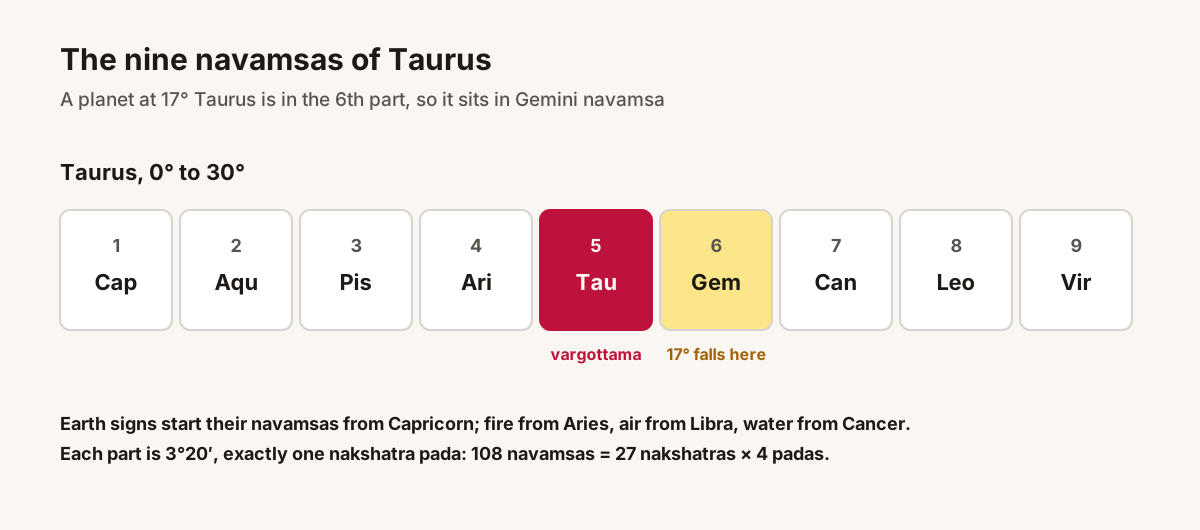
Notice that the 5th part of Taurus is Taurus itself. That's the vargottama navamsa, where a planet is in the same sign in both charts (why that's special).
Why astrologers insist on it
The birth chart shows what a planet promises. The navamsa shows what it can deliver. Astrologers often put it this way: if the birth chart is the tree, the navamsa is its fruit.
C.S. Patel quotes the Chandra Kala Nadi on this, and it's worth memorising:
"If an exalted planet in Rasi Chart is posited in debilitated Navamsa, the native is unhappy; if a debilitated planet in Rasi Chart is exalted in Navamsa, the native is happy."
He adds that planets "otherwise powerful and well situated in Rasi Chart do not give favourable results, if they are weak in Navamsa Chart."
K.N. Rao's Dasha Nirnay shows how astrologers use this in practice. He lines up each planet's dignity in both charts and marks the result: Venus debilitated in the birth chart but in its own sign in the navamsa, Improved. Mars in an enemy sign but debilitated in the navamsa, Worsens. Jupiter exalted and vargottama, Excellent.
The navamsa and marriage
The navamsa is the classic chart of marriage and partnership. Jataka Parijata (chapter 14) gives several rules built on it:
- When the 7th lord is in a benefic navamsa and aspected by a benefic, the spouse comes from a good family (III.24).
- When the 7th lord is in a kendra, aspected by a benefic, or in a benefic navamsa, the spouse is devoted and principled (III.22).
- For timing, take the lords of the sign and the navamsa occupied by the 7th lord. Marriage may come in the dasha of the stronger of the two, when Jupiter transits a trine of those signs (III.28).
- Another rule: union comes when Jupiter passes through a sign owned by the lord of the navamsa occupied by the lagna lord (III.45).
These rules show the navamsa doing what it does best: turning a promise into specifics.
The Moon's navamsa
The navamsa also colours temperament, especially through the Moon. Jataka Parijata gives a few examples. The Moon in a Sagittarius navamsa makes a person "liberal, devout and wealthy." In a Pisces navamsa it gives "a soft voice" with spirited speech, and a love of holy places. In a Capricorn navamsa, it describes someone who builds a family with wife and sons. The ancient Yavanajataka goes further, describing a person's nature from the Moon's navamsa and the planets aspecting it.
How to read yours
- Compare each planet across both charts. Stronger in the navamsa means it improves with time and effort. Weaker means its promise needs support.
- Look for vargottama planets. They're steady and reliable.
- Read the 7th house and its lord in the navamsa for partnership.
- Note the navamsa lagna. Many astrologers read it as the inner self that matures, especially after marriage.
- Don't read the navamsa alone. It refines the birth chart. It doesn't replace it.
One practical caution: the navamsa changes every 3°20′, which is about 13 minutes for the ascendant. An accurate birth time matters more for the D9 than for the main chart.
The takeaway
The navamsa is the chart behind your chart. It shows whether your planets can deliver what they promise, it carries the classical rules for marriage, and it reveals the steady planets you can rely on. No careful Vedic reading skips it.
Calculate your chart free. Vedhora computes your navamsa automatically, and you can ask its astrologer how your planets change between the two charts.
Discover Your True Planetary Placements
Calculate your true Sidereal Lagna, Chandra Rashi, Nakshatras, and 120-year Vimshottari Dasha timeline with verified astronomical precision.
Calculate Your Free Kundli