
How Vedic Astrology Actually Times Marriage
Not fate, but windows: how astrologers read the promise of marriage in a chart, narrow it with dashas and confirm it with Jupiter and Saturn's double transit.
"When will I get married?" is probably the most-asked question in Indian astrology. It's also one of the most misunderstood. People imagine the astrologer looking at the chart and seeing a date written there, like a ticket. That isn't how it works, and it isn't how it should work.
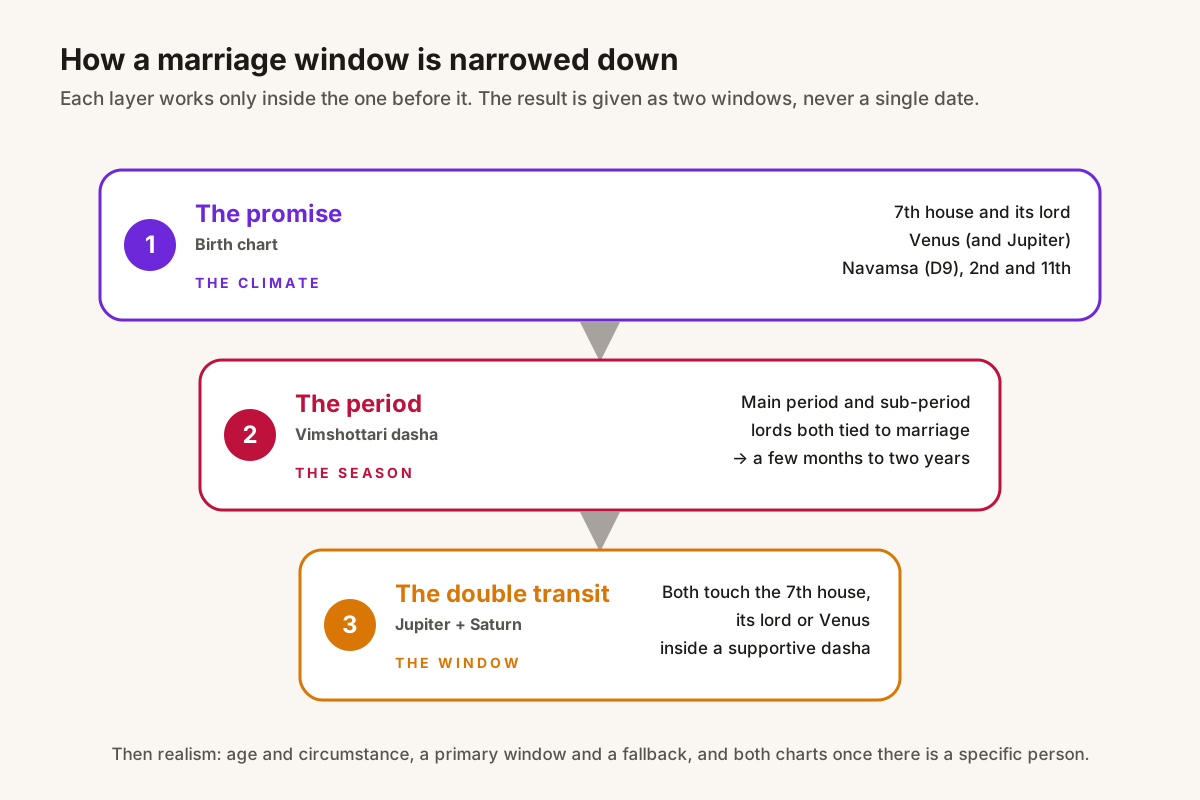
What a good astrologer actually does is closer to weather forecasting. The chart shows the climate — how strongly marriage is supported and what shape it tends to take. The planetary periods show the seasons when it becomes likely. Transits show the days of good weather inside those seasons. Whether you go out and meet someone, say yes, or wait — that part is yours.
Here is the method, step by step, the way it's done classically.
Step 1: Is marriage promised, and how?
Before any timing, the astrologer looks at the promise — what the birth chart says about partnership at all.
- The 7th house — the house of marriage and committed partnership. What sign is there, which planets sit in it, and which planets aspect it.
- The 7th lord — the planet that rules the 7th house. Where it sits, how strong it is (sign, dignity, combustion) and whom it associates with.
- The natural significators — Venus for marriage and love in every chart, and Jupiter traditionally for a husband in a woman's chart.
- The navamsa (D9) — the ninth divisional chart, read especially for marriage. A planet that looks weak in the birth chart but strong in the navamsa often delivers well in marriage, and vice versa.
- The 2nd and 11th houses — family and fulfilment. Marriage adds to the family (2nd) and fulfils a desire (11th), so these houses join in.
A strong, well-supported 7th house suggests marriage comes more easily. Saturn's involvement often points to later or more deliberate marriage. Rahu's can point to unconventional choices. Mars in certain houses gives the manglik question. None of these is a verdict on happiness. They describe the texture.
Step 2: Which periods can deliver it? (Dasha)
A promise sits quiet until a planetary period activates it. In the Vimshottari dasha system, your life runs through major periods (mahadashas), each divided into sub-periods (antardashas), and further into smaller ones.
Marriage typically happens in the period or sub-period of a planet connected to marriage:
- the 7th lord, or a planet sitting in the 7th house,
- Venus (and Jupiter, in many charts),
- planets connected to the 2nd or 11th houses,
- Rahu, which often brings sudden or unexpected unions,
- the lord of the sign holding the 7th lord in the navamsa.
The classical refinement: the event is most likely when both the main period lord and the sub-period lord are connected to marriage. Many astrologers also check the planet that dominates your chart, because its period colours everything.
This usually narrows the possibilities from "sometime in life" to a handful of periods lasting months to a couple of years.
Step 3: Which months? (The double transit)
The third layer is transit. The best-known rule is the double transit: an event of a house is classically expected when transiting Jupiter and transiting Saturn both influence that house or its lord, by occupation or aspect, at the same time.
For marriage, the astrologer looks for Jupiter and Saturn together touching the 7th house, the 7th lord, or Venus — inside a dasha period that already supports marriage. When the dasha says "yes, this season" and the double transit says "now", the window shrinks to a few months.
Other transit clues: Jupiter passing over the natal Venus or 7th lord, and the transit of the dasha lord itself.
Step 4: Realism
A responsible astrologer adds common sense:
- Age and circumstance. A chart doesn't override real life. Windows for a fifteen-year-old aren't read as marriage, and a window during a period of study or caregiving may show as a serious relationship rather than a wedding.
- Two windows, not one date. A careful reading gives a primary window and a fallback, because life has many moving parts.
- Both charts. Once there is a specific person, the two charts are read together — the Kundli matching score is one part of that, not the whole story.
So where is free will?
This is the right question to ask. Vedic astrology describes support and timing, not obligation. A window means doors open more easily: introductions happen, families agree, you feel ready. It doesn't mean marriage will happen whether you want it or not. It doesn't mean it can't happen outside that window either.
Think of it like sailing. The chart tells you when the wind is behind you. You still choose whether to sail, where to go, and with whom. Many people find that knowing the season takes the panic out of waiting. That may be astrology's most useful gift here.
What the method can't do
It can't give you a name or a face. It can't promise a particular person will choose you. It shouldn't be used to frighten anyone — "no marriage" readings based on a single placement are a misuse of the craft. Delays are common; denial is rare and should never be declared lightly.
See it in your own chart
Vedhora's astrologer reads marriage timing exactly this way: the promise, the dasha periods and the double transit, worked out from your real chart, and given as two windows in plain language. Calculate your chart free and ask your question. If there's already someone in your life, add their birth details for a full compatibility reading.
Discover Your True Planetary Placements
Calculate your true Sidereal Lagna, Chandra Rashi, Nakshatras, and 120-year Vimshottari Dasha timeline with verified astronomical precision.
Calculate Your Free Kundli