
Why 108? The Number in Your Chart
Mantras are chanted 108 times and malas have 108 beads. The reason is in the sky: 108 is where the Sun's 12 signs and the Moon's 27 nakshatras meet.
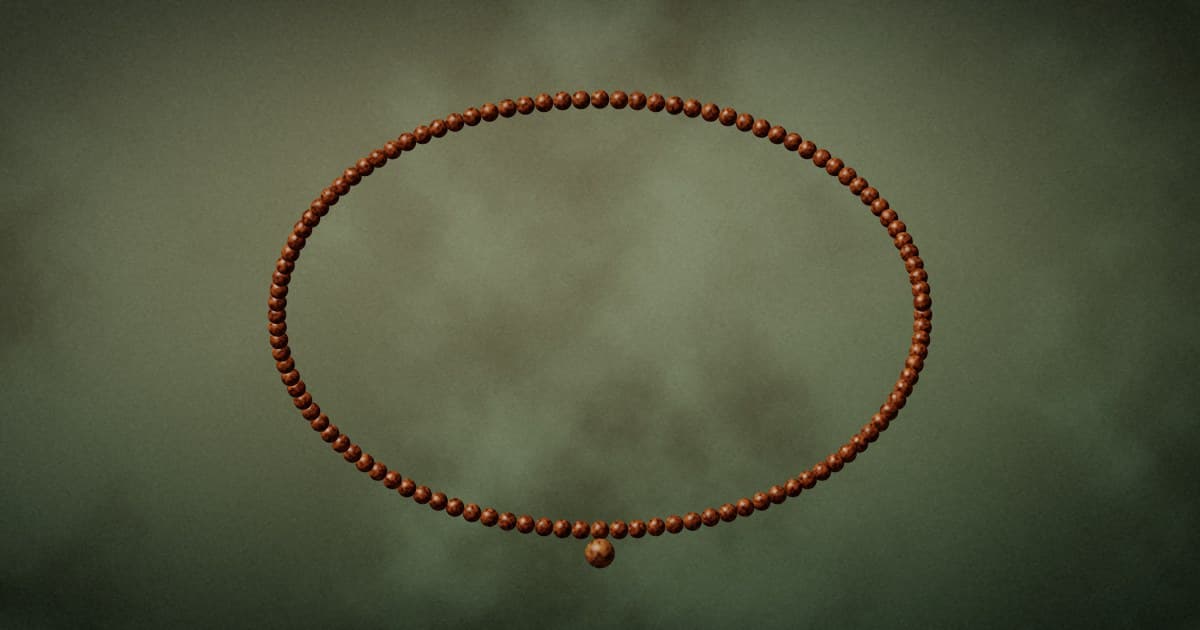
A mala has 108 beads. Mantras are chanted 108 times. Gemstone rituals call for a planet's mantra "108 times" before the ring goes on. Sanjay Rath, giving advice to a family in one of his case papers, writes simply: "Please continue to recite the Mrityunjaya Mantra everyday 108 times."
Why 108, and not 100 or 50? There are many answers in Indian tradition. But one of the most elegant is hiding in plain sight, in the structure of the Vedic zodiac.
Two zodiacs, one sky
Vedic astrology divides the sky in two ways at once.
- The Sun's way: 12 signs (rashis) of 30° each, from Mesha (Aries) to Meena (Pisces).
- The Moon's way: 27 nakshatras of 13°20′ each, from Ashwini to Revati.
These two grids don't fit neatly. Thirty doesn't divide evenly by 13⅓. A nakshatra will often start in one sign and end in the next. So where do they agree?
The meeting point: 3°20′
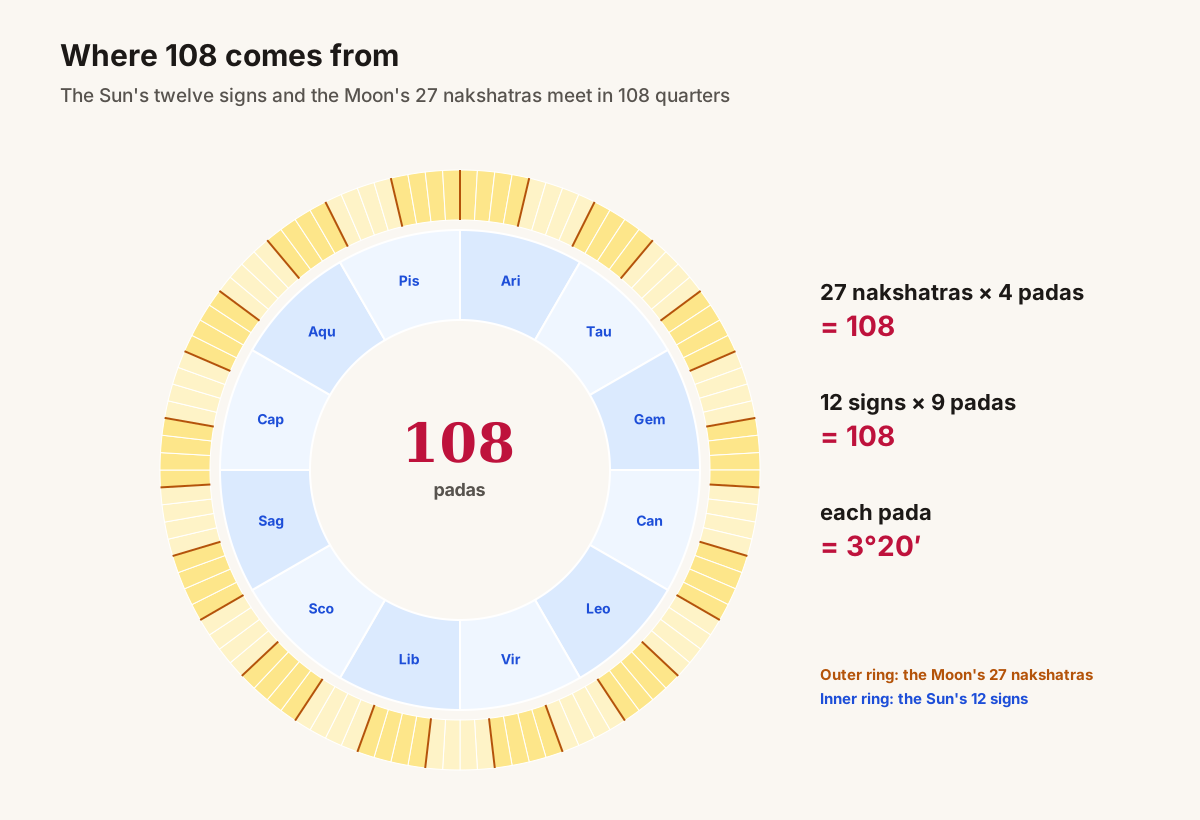
Split each nakshatra into its four quarters, the padas. Each pada is 3°20′. Now look at the numbers:
- 27 nakshatras × 4 padas = 108 padas
- Each sign of 30° holds exactly 9 padas (9 × 3°20′ = 30°)
- So 12 signs × 9 = 108 as well
As B.V. Raman puts it in his Manual of Hindu Astrology, "the whole zodiac consists of 108 padas." And each of those 108 slices is also a navamsa, the ninth part of a sign: "The Bhachakra is divided into 108 navamsas and each navamsa corresponds to a Nakshatra Pada."
3°20′ is the smallest slice of sky where the solar and lunar zodiacs line up perfectly. 108 is the number of those slices. It's the common language of the Sun and the Moon.
108 at work in your chart
This isn't just numerology. The number shapes real techniques.
The navamsa chart. Your D9, the most important divisional chart, is built from these 108 slices (how the navamsa works). The pada your Moon or ascendant falls in tells you its navamsa directly. Find the pada, and you've found the navamsa.
The Ashtottari dasha. Ashtottari literally means "one hundred and eight". It's a dasha system with a 108-year cycle. As the Jyotisha Siddhanta Sara describes it, it's "followed in certain parts of the country", uses eight planets and leaves Ketu out. (The more widely used Vimshottari runs 120 years.)
The Shoola dasha. In this Jaimini timing system, Sanjay Rath notes, each sign rules for 9 years. "9 years per dasa × 12 signs = 108 years" is taken as a full human span.
Longevity by navamsa. The Jataka Parijata describes a classical method that works out a lifespan from the number of navamsas between the start of Aries and the ascendant, "dividing the product by 108."
The D-108 chart. Among the finer divisional charts, Rath lists the Ashtottaramsa (D-108), used for the subtlest layers of a chart.
Another way to see it: 12 × 9
There's a second reading of the same number. Astrology has 12 signs and 9 grahas, and 12 × 9 is again 108. Picture every planet passing through every sign once: 108 possible meetings. The whole drama of the chart is contained in that grid.
Either way you slice it, 108 is the zodiac complete.
The mala as a map of the sky
This gives the 108-bead mala a beautiful meaning. When you chant a mantra 108 times, you move through the circle one bead at a time, and each bead is one pada, one navamsa, 3°20′ of the heavens. By the end of the round, you've walked once around the entire sky, through every sign and every nakshatra.
That's why the planetary remedies in the classical manuals keep asking for 108. In Vedic Astrology and Rasi Characteristics, the mantras of the Sun, Moon, Mars, Mercury and Jupiter are each to be recited 108 times (or, for some, many thousands) before a gem is worn. One full round of the zodiac is offered to the planet.
The takeaway
108 isn't arbitrary. It's the number of 3°20′ slices in the zodiac. These are the 108 padas of the 27 nakshatras and the 108 navamsas of the 12 signs, the exact point where the Sun's zodiac and the Moon's zodiac agree. It structures the navamsa chart, names the Ashtottari dasha and measures a lifetime in the Shoola dasha. And every time a mala turns through its beads, it traces a full circle of the sky.
Calculate your chart free to see which pada your Moon was born in. For the nakshatras themselves, start with the 27 nakshatras explained.
Discover Your True Planetary Placements
Calculate your true Sidereal Lagna, Chandra Rashi, Nakshatras, and 120-year Vimshottari Dasha timeline with verified astronomical precision.
Calculate Your Free Kundli