
North vs South Indian Charts
The same chart can be drawn as a diamond (North Indian) or a square of boxes (South Indian). How to read each, find the ascendant and follow the houses.
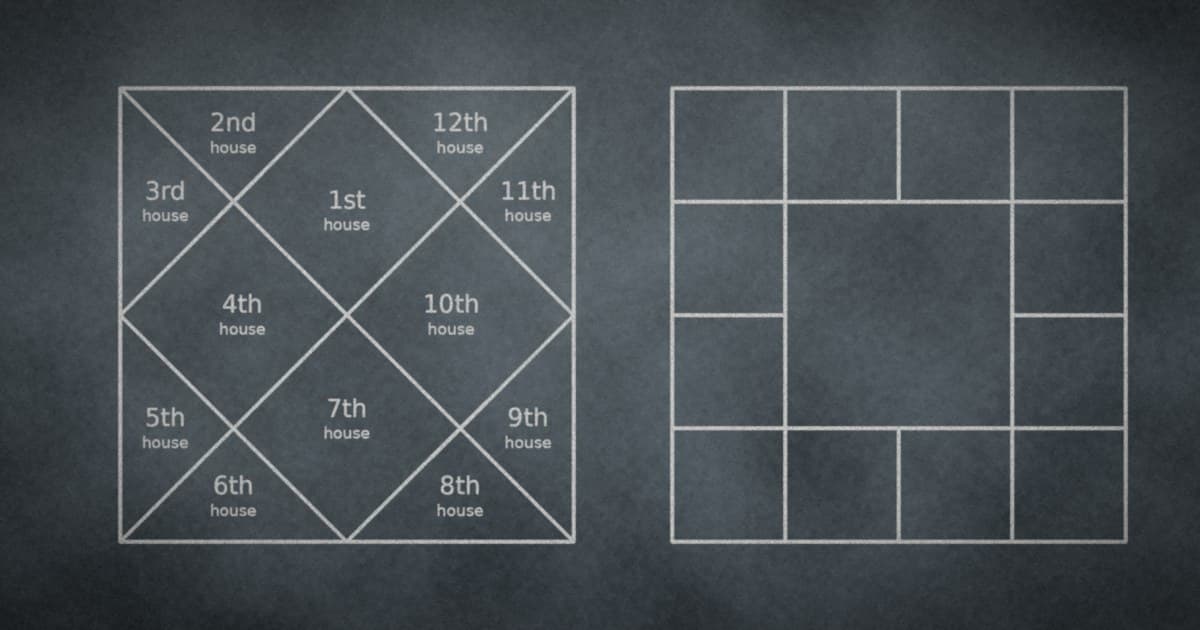
Show two Vedic astrologers the same birth chart and they might not recognise it. One draws a big square crossed with diagonals into diamonds and triangles: the North Indian chart. The other draws a ring of twelve boxes around an empty centre: the South Indian chart.
They contain exactly the same information. They just organise it differently. Learn both, and every kundli you'll ever see becomes readable.
The one key difference
Ronnie Gale Dreyer sums it up in Vedic Astrology: A Guide to the Fundamentals of Jyotish:
- The South Indian chart is sign-driven. "The signs are in stationary positions around the chart."
- The North Indian chart is house-driven. "The Ascendant and the houses remain in fixed positions around the chart."
Everything else follows from that.
Reading the North Indian chart
The North Indian chart is a square divided by two diagonals and an inner diamond, giving twelve cells.
- The top central diamond is always the 1st house, the ascendant.
- The houses run counter-clockwise from there. The 2nd is the triangle to the upper left, the 3rd below it, and the 4th is the left-hand central diamond. The 7th is the bottom diamond and the 10th the right-hand diamond.
- Signs are written as numbers inside each cell: 1 for Aries, 2 for Taurus and so on up to 12 for Pisces. The number in the top diamond tells you the ascendant sign.
- Planets are written into their cells.
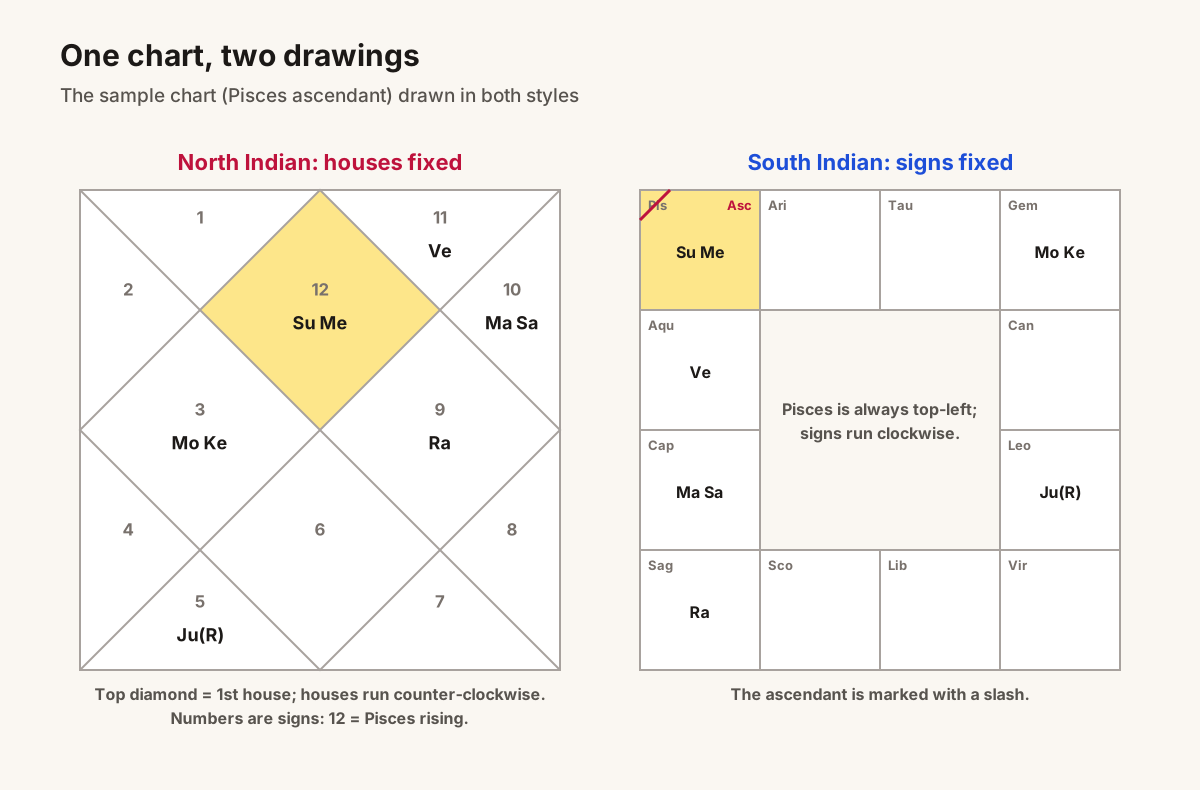
Example: for our sample chart (14 March 1992, Delhi), the top diamond carries 12, so Pisces rises. The left-central diamond (4th house) carries 3, Gemini, where the Moon sits. The bottom diamond (7th) carries 6, Virgo.
Why do so many astrologers love this format? Because the kendras (houses 1, 4, 7, 10) are the four central diamonds, and the dusthanas (6, 8, 12) sit in the outer triangles. As Dreyer notes, the North Indian chart "perfectly exemplifies the concept of the different types of houses." The structure of the chart is visible at a glance.
Reading the South Indian chart
The South Indian chart is a ring of twelve boxes around the edge of a square.
- The signs never move. Pisces is the top-left box, and Aries is "second from upper left", in Dreyer's words. The signs then run clockwise: Taurus, Gemini, and so on around the square.
- The ascendant is marked, usually with a diagonal line or the letters "Asc" or "La", in whichever box it falls.
- Count houses from that box, clockwise. The ascendant's box is the 1st house, the next box clockwise is the 2nd, and so on.
- Planets are written into their sign boxes.
Example: the same chart in South Indian style puts the ascendant mark, the Sun and Mercury in the Pisces box (top-left). The Moon goes in the Gemini box, and Mars and Saturn in the Capricorn box on the left side.
Its strengths are different. Because the signs are fixed, you can see sign-based patterns instantly, which helps with Jaimini techniques, aspects by sign and transits through the zodiac. Dreyer also notes it is "a useful tool for purposes of rectification, since a different Ascendant can be tested by merely readjusting the diagonal."
Side by side
- What stays fixed: in the North Indian chart, the houses. In the South Indian chart, the signs.
- Where the 1st house is: always the top diamond (North), or wherever the ascendant mark sits (South).
- Direction: houses run counter-clockwise (North). Signs run clockwise (South).
- Signs written as: numbers 1–12 (North), or implied by fixed box positions (South).
- Easiest to see: house structure, kendras and dusthanas (North). Sign patterns and transits (South).
Which one should you use?
Tradition and habit decide more than anything. The South Indian chart is used across Tamil Nadu, Kerala, Karnataka and Andhra Pradesh. Dreyer notes it was "originally used in the southwestern coastal province of Kerala". The North Indian chart dominates in the north. Dreyer learned Jyotish in Varanasi and uses it in her own practice.
Our advice: learn to read both. You'll meet both in books, apps and printed kundlis. Once you can find the ascendant and count the houses, the format stops mattering.
A quick self-test
Take your own chart in either format and answer:
- Which sign is rising?
- Which house holds your Moon, and which sign?
- Which planets sit in the kendras (1, 4, 7, 10)?
If you can answer all three, you can read the chart. Next, walk through the six steps of reading a chart.
The takeaway
North Indian charts fix the houses: the top diamond is always the 1st, and the houses run counter-clockwise, with signs written as numbers. South Indian charts fix the signs: Pisces is top-left and the signs run clockwise, with the ascendant marked in its box. Same chart, two views, so learn both.
Calculate your chart free to see your own chart drawn on Vedhora.
Discover Your True Planetary Placements
Calculate your true Sidereal Lagna, Chandra Rashi, Nakshatras, and 120-year Vimshottari Dasha timeline with verified astronomical precision.
Calculate Your Free Kundli