
Vedha: When a Good Transit Gets Blocked
Jupiter is in a lucky house, so why is nothing happening? The classical rule of vedha (obstruction) in transits, the table for every planet, how to check it.

Horoscope columns love to say "Jupiter is moving into a lucky house for you." Then the months pass and nothing much happens. Sometimes the reason is in the chart. But often it's a classical rule that the columns leave out: vedha, obstruction.
Transits are read from the Moon
In Jyotish, transits (gochara) are traditionally judged by counting houses from your natal Moon sign. Each planet gives good results when it moves through certain houses from the Moon. Dr. K.S. Charak, in Elements of Vedic Astrology, lists them:
- Sun: good in the 3rd, 6th, 10th and 11th
- Moon: good in the 1st, 3rd, 6th, 7th, 10th and 11th
- Mars: good in the 3rd, 6th and 11th
- Mercury: good in the 2nd, 4th, 6th, 8th, 10th and 11th
- Jupiter: good in the 2nd, 5th, 7th, 9th and 11th
- Venus: good in the 1st, 2nd, 3rd, 4th, 5th, 8th, 9th, 11th and 12th
- Saturn (and Rahu): good in the 3rd, 6th and 11th
The catch: vedha
For every good house there's a vedha house, a point of obstruction. If another planet is transiting the vedha house at the same time, it blocks the good result.
From Charak's table, each good house paired with its vedha house:
- Sun: 3rd (blocked from the 9th), 6th (12th), 10th (4th), 11th (5th)
- Moon: 1st (5th), 3rd (9th), 6th (12th), 7th (2nd), 10th (4th), 11th (8th)
- Mars, Saturn and Rahu: 3rd (12th), 6th (9th), 11th (5th)
- Mercury: 2nd (5th), 4th (3rd), 6th (9th), 8th (1st), 10th (8th), 11th (12th)
- Jupiter: 2nd (12th), 5th (4th), 7th (3rd), 9th (10th), 11th (8th)
- Venus: 1st (8th), 2nd (7th), 3rd (1st), 4th (10th), 5th (9th), 8th (5th), 9th (11th), 11th (3rd), 12th (6th)
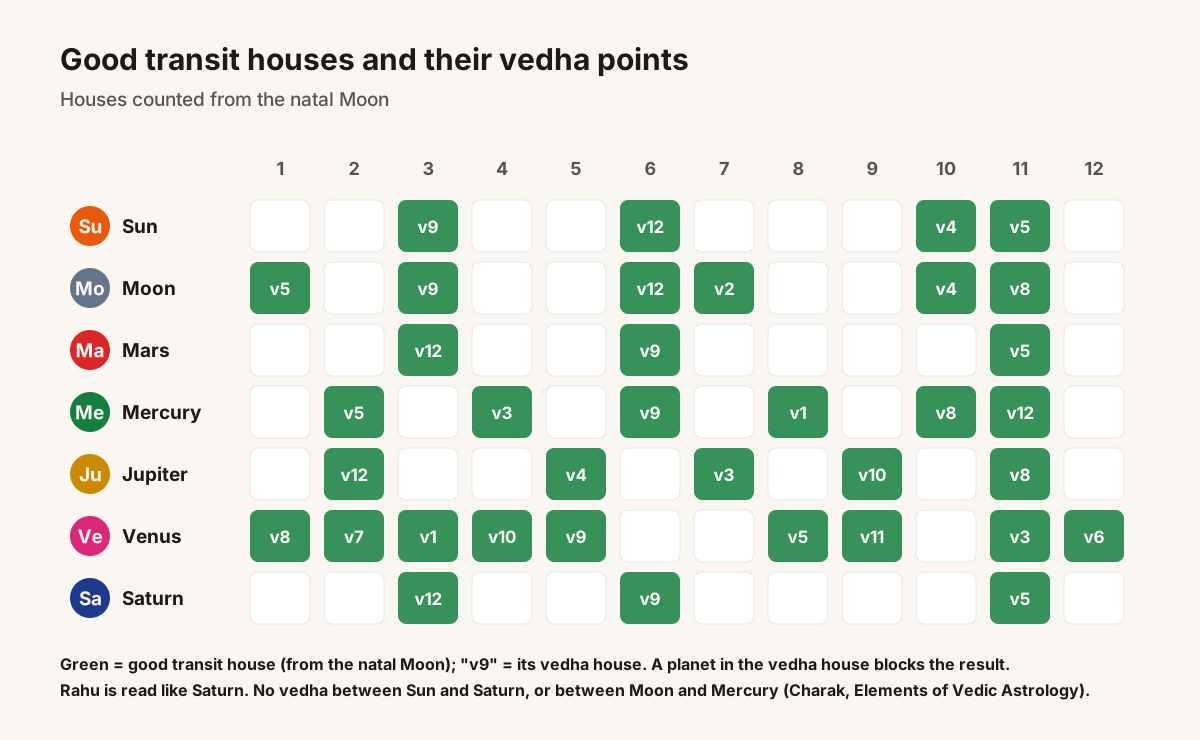
So Jupiter in your 5th from the Moon is excellent, unless some planet is passing through your 4th at the same time. Then the promise is held back.
Two important exceptions
Father and son don't block each other. Charak notes that the father–son pairs, the Sun and Saturn, and the Moon and Mercury, "do not cause Vedha to each other." Saturn transiting the Sun's vedha house doesn't block the Sun.
Vedha works both ways. A planet in the good house can also block the bad result of a planet transiting its vedha house. Charak's example: the Sun is good in the 3rd and bad in the 9th. If the Sun is transiting the 9th, its bad results "are obstructed" when another planet (other than Saturn) is transiting the 3rd at the same time. Vedha can protect as well as block.
A worked example from the texts
The commentary in Jataka Parijata gives a real case. The native's Moon is in Pisces. Will the Sun's transit through Capricorn in January–February 1933 be good?
- Capricorn is the 11th from Pisces, a good house for the Sun.
- The Sun's vedha house for the 11th is the 5th from the Moon, which is Cancer.
- No planet was in Cancer then. So the good effects of the Sun's transit through the 11th, "pecuniary gain", "will happen in their entirety."
The commentary adds a warning. If a planet had been in the vedha house, it "tries to nullify the original effect," and if it is strong, it may even bring "a quite contrary effect."
How to check your own transits
- Find your Moon sign (why Vedic astrology starts there).
- Count the house each slow planet is transiting from your Moon. Jupiter and Saturn matter most.
- If it's a good house, look up its vedha house in the lists above.
- See if any planet is transiting that vedha house (remember the Sun–Saturn and Moon–Mercury exception).
- Weigh the result with the transit planet's points in Ashtakavarga (the 337 points). A blocked transit through a low-scoring sign is doubly quiet. An unblocked transit through a high-scoring one is the real thing.
Fast planets like the Moon and Mercury move in and out of vedha houses within days, so vedha often explains why a promising month has one flat week. For Jupiter and Saturn, a slow planet sitting in the vedha house can hold back a good transit for months.
Why this matters
Vedha is one of the reasons Vedic transit readings can be more precise than sun-sign forecasts. A transit isn't judged alone. It's judged against the whole sky at that moment. When a Vedic astrologer says "this Jupiter transit will deliver" or "this one will be quiet," vedha is part of the reasoning.
The takeaway
A good transit is only good if nothing is standing in its way. Check the vedha house, remember the father–son exceptions, and weigh the points. You'll understand far better why some "lucky" transits deliver and others pass quietly.
Calculate your chart free and ask Vedhora's astrologer which of your current transits are clear and which are blocked.
Discover Your True Planetary Placements
Calculate your true Sidereal Lagna, Chandra Rashi, Nakshatras, and 120-year Vimshottari Dasha timeline with verified astronomical precision.
Calculate Your Free Kundli