
Guna Milan: The 36 Points Explained
Ashtakoota matching scores a couple out of 36 across eight tests. What each koota checks, the Nadi and Bhakoot doshas, and the exceptions few hear about.
In many Indian families, the first question about a marriage proposal is a number: "How many gunas match?" That number, out of 36, comes from Ashtakoota, the eight-fold matching of two birth charts.
It's useful, it's quick, and it's widely misunderstood. Here's what the 36 points actually measure, and how to read them wisely.
Everything starts from the Moon
Ashtakoota compares only one thing in each chart: the Moon, its sign (rashi) and its nakshatra. The Moon is the mind, and the test asks how two minds, temperaments and instincts will live together.
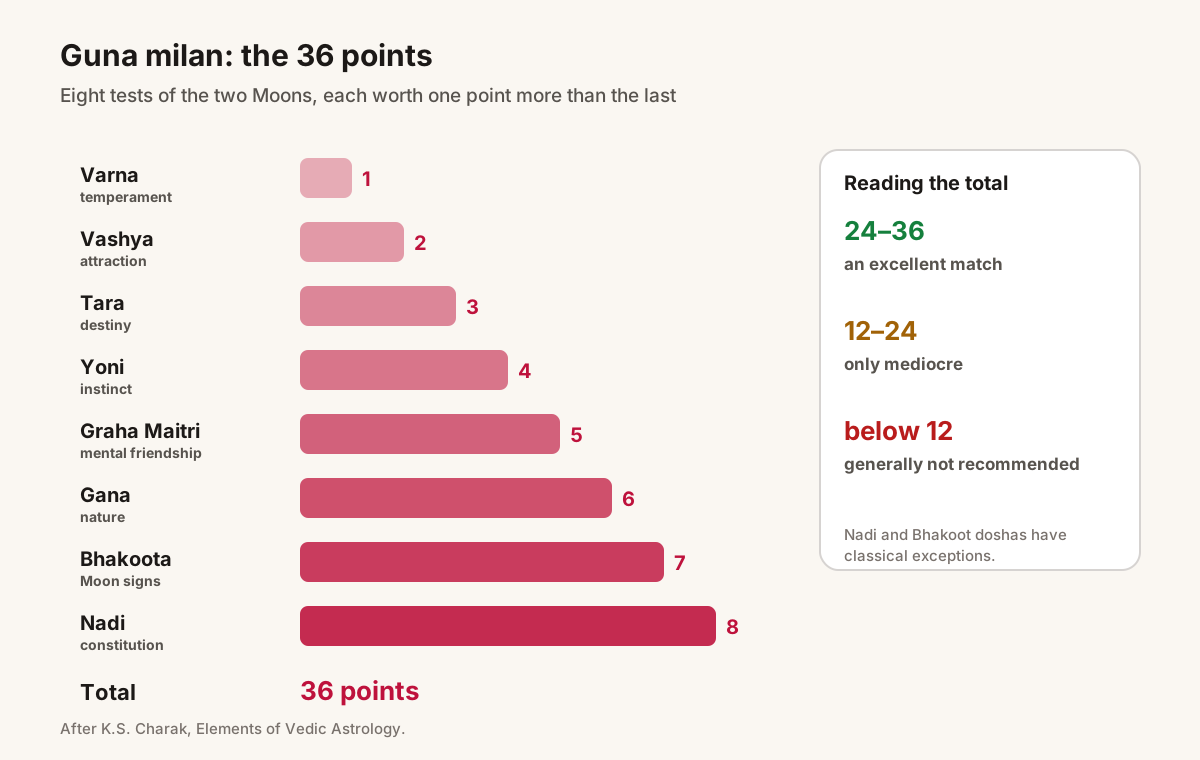
K.S. Charak, in Elements of Vedic Astrology, lists the eight tests in order, each worth one more point than the last:
- Varna: 1 point
- Vashya: 2 points
- Tara: 3 points
- Yoni: 4 points
- Graha Maitri: 5 points
- Gana: 6 points
- Bhakoota: 7 points
- Nadi: 8 points
That makes 36 in total.
The eight tests
1. Varna (1 point): temperament class. The Moon signs fall into four groups that echo the old social classes. Most modern astrologers treat this lightly.
2. Vashya (2 points): attraction and influence. Signs fall into groups (human, quadruped, water creatures and so on) that show which partner naturally "draws" the other.
3. Tara (3 points): destiny compatibility. Count from one partner's nakshatra to the other's, in both directions, and divide by nine. The remainders show whether the stars are mutually supportive, like the nine taras of daily muhurta (tara bala).
4. Yoni (4 points): instinctive and physical compatibility. Every nakshatra has an animal. The same animal scores 4, friendly ones 3, neutral 2, unfriendly 1, and sworn enemies (cat and rat, snake and mongoose) score 0 (your birth star's animal).
5. Graha Maitri (5 points): mental friendship. The friendship between the lords of the two Moon signs. If the lords are the same or friends, it scores full (planetary friends and enemies).
6. Gana (6 points): nature. The nakshatras fall into three ganas. Charak lists them:
- Deva (divine): Ashwini, Mrigashira, Punarvasu, Pushya, Hasta, Swati, Anuradha, Shravana, Revati
- Manushya (human): Bharani, Rohini, Ardra, the three Purvas and the three Uttaras
- Rakshasa (fierce): Krittika, Ashlesha, Magha, Chitra, Vishakha, Jyeshtha, Mula, Dhanishtha, Shatabhisha
The same gana scores best. Deva with Rakshasa scores worst.
7. Bhakoota (7 points): the Moon signs' relationship. Charak says that when the Moon signs fall "mutually in positions 2/12, 6/8 or 5/9, no gunas are earned. Under other situations, seven points are allotted." Tradition links a bad 6/8 to strain on the couple's well-being, 2/12 to financial difficulty and 5/9 to delays with children.
8. Nadi (8 points): constitution. The nakshatras fall into three nadis: Adya, Madhya and Antya. The couple's nakshatras "should not fall in the same Naadi." The same nadi scores zero out of eight. This is the famous Nadi dosha.
How to read the total
Charak's guide:
- 24 to 36: "an excellent match"
- 12 to 24: "only mediocre"
- Below 12: "adverse and generally not recommended for marriage"
And then the sentence that matters most: "Very strict adherence to these rules may not be necessary when the planetary disposition in both charts is otherwise favourable."
The exceptions nobody mentions
The two big doshas, Bhakoot and Nadi, have built-in cancellations in the classical texts. Charak lists several.
Nadi dosha doesn't apply when:
- the couple share the same Moon sign but different nakshatras
- the couple share the same nakshatra but different Moon signs
Bhakoot is softened when:
- the 6/8 is the favourable kind. The 6th from an even sign or the 8th from an odd sign gives lords who are friendly, and that "is not too bad".
- in a 2/12 placement, the two Moon-sign lords are friends, which greatly diminishes the blemish
- the Moon signs are the same but the nakshatras differ, which is considered favourable
So a "zero in Nadi" or "zero in Bhakoot" isn't automatically a rejection. It's a reason to look closer.
A score is not a marriage
Ashtakoota measures Moon-to-Moon compatibility. It says nothing directly about:
- the 7th house and its lord in each chart
- Venus (and Jupiter, in a woman's chart in traditional reading)
- the navamsa (D9), the chart of marriage (the navamsa)
- Mars placement, the manglik question (manglik dosha)
- the dashas each person will run in the early years of marriage (how astrology times marriage)
Couples with 18 points and well-matched charts often do beautifully. Couples with 30 points and difficult 7th houses can struggle. The number opens the conversation. It doesn't end it.
The takeaway
Guna milan scores two Moons across eight tests worth 1 to 8 points each, 36 in all. Above 24 is excellent, 12 to 24 average, and below 12 weak. The big doshas (Nadi and Bhakoot) carry classical exceptions, and the whole score is a first filter. The full charts decide.
Check your compatibility with Vedhora's kundli matching, which scores all eight kootas, or calculate your chart free to see your own Moon sign and nakshatra.
Discover Your True Planetary Placements
Calculate your true Sidereal Lagna, Chandra Rashi, Nakshatras, and 120-year Vimshottari Dasha timeline with verified astronomical precision.
Calculate Your Free Kundli