
Ashtakavarga: Your Chart's 337 Points
Every chart shares out exactly 337 points across its twelve signs, but no two alike. How Ashtakavarga works, what the scores mean and how it times transits.

Imagine giving every house of your chart a score out of a fixed budget, so you could see at a glance which areas are strong and which need support. That's essentially what Ashtakavarga does. It's one of the most practical tools in Jyotish, and one of the most underused.
Eight sources, one score
Ashta means eight. Each planet's strength in each sign is judged from eight reference points: the seven planets (Sun to Saturn) and the lagna. From each reference point, a planet receives a bindu (point) in certain signs and not in others, according to fixed classical tables.
Add up the points, and each planet gets its own chart of scores, called its Bhinnashtakavarga. Add all seven planets' scores together and you get the Sarvashtakavarga (SAV), the total score of each sign.
The magic number: 337
The tables are fixed, so the totals never change. Jataka Parijata (X.1–2) gives them: the Sun always has 48 points in total, the Moon 49, Mars 39, Mercury 54, Jupiter 56, Venus 52 and Saturn 39.
Together: 337 points. Every chart ever cast has exactly 337 points in its Sarvashtakavarga. What differs is how they're spread across the twelve signs. Since 337 ÷ 12 is about 28, a sign with 28 points is average.
What the scores mean
Jataka Parijata (X.53) gives the classic thresholds for the Sarvashtakavarga:
"The number of benefic dots up to 25 appearing in any bhava are void of effect. From 25 to 30 benefic dots in a bhava produce medium effect. More than 30 benefic dots in any bhava produce happiness, wealth and fame while serving to advance the bhava wherein they appear."
For each planet's own chart, the same text says (X.3): a sign with all 8 points makes its house prosper. 5 to 7 are beneficial. 4 is mixed. 1 to 3 are not auspicious. A sign with no points at all brings disease, slander and fear in matters of that house.
A real example
Here's the Sarvashtakavarga of one chart calculated by Vedhora's engine: someone born on 14 March 1992 at 7:45 am in Delhi, with Pisces rising. The 337 points fall like this:
- Capricorn (11th house): 37, the highest
- Scorpio (9th): 33
- Leo (6th): 32
- Sagittarius (10th): 30
- Gemini 29, Taurus 28, Cancer 28, Pisces 28, Aries 27, Libra 26
- Virgo (7th): 20
- Aquarius (12th): 19, the lowest
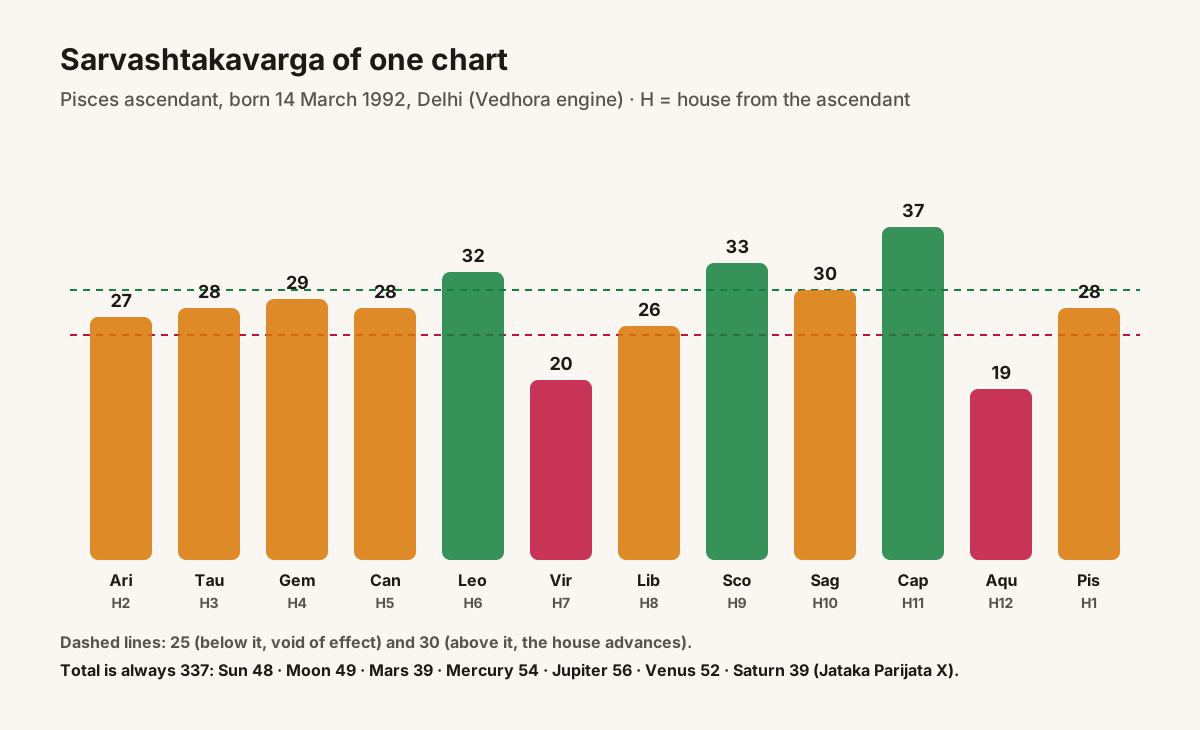
At a glance, this chart is strongest in the 11th (gains and networks), the 9th (fortune and teachers), the 10th (career) and the 6th (overcoming competition). The 7th of partnership scores well below average. That's an area where good results come with more effort and patience, the kind of insight that's hard to get from planets alone.
Where Ashtakavarga really shines: transits
Ashtakavarga's biggest strength is judging transits. A transit through a sign with many points delivers. A transit through a sign with few points disappoints, even if it's a "good" transit on paper.
Jataka Parijata's commentary gives the example of Saturn. Saturn transiting the 3rd, 6th or 11th from the Moon is traditionally good, but only if those signs have more than 4 points in Saturn's own Ashtakavarga. With fewer, "much cannot be expected of him."
C.S. Patel, in his classic book on the subject, states the general rule: transits through signs with 4 or more points in that planet's own Ashtakavarga bring good results, and those with fewer bring adverse ones. He adds a sobering point. Even a favourable dasha delivers only feebly if the signs involved have few points.
This is also how Vedhora weighs transits when it times your periods: a Jupiter transit through a high-scoring sign counts for more than one through a low-scoring sign.
Kakshya: timing to the week
Ashtakavarga goes one level finer. Each sign is cut into eight slices of 3°45′, called kakshyas, and each slice is ruled in turn by one of the eight contributors. The usual order is Saturn, Jupiter, Mars, the Sun, Venus, Mercury, the Moon and the lagna, though Patel notes that some texts give a different order.
When a planet transits a sign, it passes through these slices one by one. Patel explains: "Out of the total duration of a transit, the periods of transit through Kakshyas having bindus produce auspicious results and the remaining periods inauspicious ones." A two-and-a-half-year Saturn transit can be read slice by slice, a few months at a time.
Ashtakavarga and other strengths
Points interact with everything else in the chart:
- Patel notes that a vargottama planet in a house with 30 or more points "advances the happiness of that Bhava to the greatest extent" (vargottama planets).
- Even a combust or debilitated Mercury still gives the results of its house if it has 4 or more points in its own Ashtakavarga (combust planets).
So Ashtakavarga can confirm a strong placement, or rescue a weak one.
The takeaway
Every chart has the same 337 points. Your story is in how they're spread. High-scoring signs are where life gives back readily. Low-scoring signs are where effort and patience count. And when planets transit, the points tell you whether a "good" transit will actually deliver.
Calculate your chart free and ask Vedhora's astrologer which of your houses score highest, and what's coming as the planets move through them.
Discover Your True Planetary Placements
Calculate your true Sidereal Lagna, Chandra Rashi, Nakshatras, and 120-year Vimshottari Dasha timeline with verified astronomical precision.
Calculate Your Free Kundli