
Gaja Kesari Yoga: The Fine Print
Gaja Kesari is the most celebrated yoga in Vedic astrology, and a third of all charts have it. What it really promises, what makes it strong, how to read it.

If one yoga makes people smile when they hear it, it's Gaja Kesari. Gaja is the elephant and Kesari the lion: two images of royal strength, joined in one name. It's the first yoga in B.V. Raman's famous Three Hundred Important Combinations, and it appears in nearly every classical text.
Here is the fine print. About one person in three has it. So the useful question isn't do I have Gaja Kesari? but how strong is mine?
How it forms
The core definition is short. Raman puts it simply: "If Jupiter is in a kendra from the Moon, the combination goes under the name of Gajakesari."
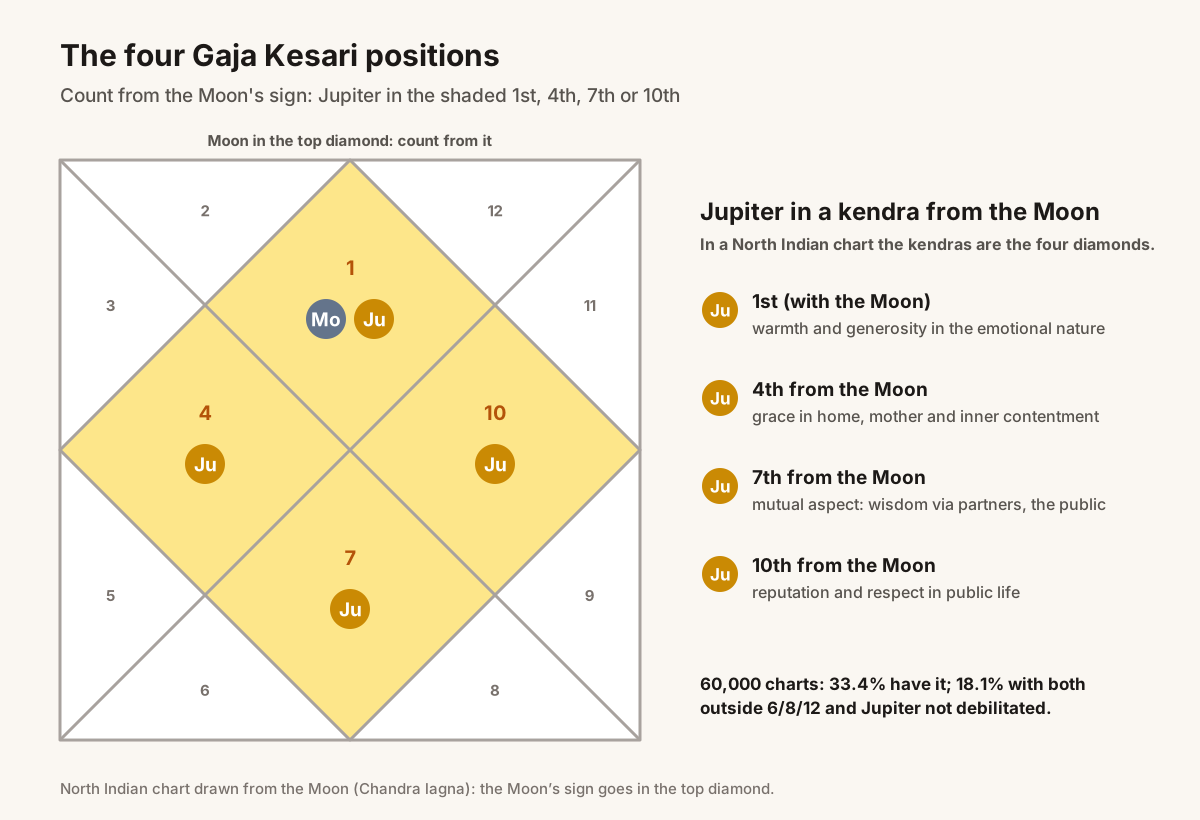
Count from the Moon's sign. If Jupiter is in the 1st (the same sign as the Moon), the 4th, the 7th or the 10th, you have it.
Jataka Parijata (VII.116) adds a second, rarer form. The Moon is aspected by Venus, Jupiter and Mercury, none of them debilitated or combust. That version is about the mind being supported by all three benefics, not only Jupiter.
Why Jupiter and the Moon?
The Moon is the mind and its feelings. Jupiter is wisdom, faith, growth and grace, the great benefic. When Jupiter stands in an angle from the Moon, the mind is held steady by good judgment. People with a strong Gaja Kesari tend to keep their dignity under pressure, attract goodwill, and recover from setbacks with their reputation intact.
That is why Jataka Parijata (VII.117) promises someone who is brilliant, prosperous, intelligent, virtuous and favoured by those in power. Raman's version adds many relations, politeness, generosity, a lasting reputation "even long after death", and someone who builds or presides over villages and towns.
Raman's warning about reading it literally
Raman, who knew a thousand charts, pushed back on reading the texts literally:
"The original writers say that the person born in this yoga will build villages and towns. A literal interpretation of the results leads one nowhere. They have to be adapted to suit modern conditions."
For him, a modest Gaja Kesari might give a member of the municipality or an engineer. A powerful one might give a mayor. "From a builder of a small shrine to the builder of a large and rich temple there is much difference." The same yoga gives very different results depending on the strength of the planets, the houses and the nakshatras involved.
The numbers
We checked 60,000 birth charts with Vedhora's engine:
- 33.4% of charts have Jupiter in a kendra from the Moon.
- Only 18.1% have it with both Jupiter and the Moon outside the 6th, 8th and 12th houses and Jupiter not debilitated.
A third of the population can't all be destined for greatness. Strength decides what the yoga actually delivers.
What makes a Gaja Kesari strong
Use this checklist:
- Jupiter's dignity. Exalted in Cancer, in its own Sagittarius or Pisces, or in a friend's sign is excellent. Debilitated in Capricorn is weak, unless the debilitation is cancelled (how that works).
- The Moon's light. A bright, waxing Moon carries the yoga far better than a dark one near new moon.
- The houses from the lagna. M. Ramakrishna Bhat warns in Fundamentals of Astrology that the yoga's effects are not good if the pair combine in the "forbidden houses", the 6th, 8th and 12th. In angles and trines from the lagna, it shines.
- No combustion or heavy affliction. Jupiter close to the Sun, or the pair hemmed in by malefics, dims the result.
- The dashas. The yoga shows most fully in the periods of Jupiter and the Moon.
A famous example
In his Collected Papers in Vedic Astrology, Sanjay Rath studies the chart of Swami Vidyaranya, the sage associated with the founding of the Vijayanagara empire. He notes a Gaja Kesari yoga of Jupiter and the Moon as part of what showed "greatness as an author." Vidyaranya also refused to keep the vast lands the emperors offered him and gave them to the Sringeri matha for learning instead.
That fits the yoga's real meaning. Gaja Kesari isn't about wealth for its own sake. It's about stature: a name people trust.
Positions compared
Each kendra gives a slightly different flavour:
- Jupiter with the Moon (1st): warmth, optimism and generosity are part of your emotional nature.
- Jupiter 7th from the Moon: they face each other with a full mutual aspect. Wisdom comes through partners, advisers and the public.
- Jupiter 4th from the Moon: grace around home, mother, property and inner contentment.
- Jupiter 10th from the Moon: reputation, visible work and respect earned in public life.
The takeaway
Gaja Kesari is real, classical and beautiful, and common. Read it like Raman did: check Jupiter's dignity, the Moon's light, the houses involved and the dashas before you decide how big the elephant and the lion really are.
Calculate your chart free and ask Vedhora's astrologer how strong your Gaja Kesari is. If you'd like to see the opposite situation, a Moon with no support at all, read Kemadruma Yoga: when the Moon stands alone.
Discover Your True Planetary Placements
Calculate your true Sidereal Lagna, Chandra Rashi, Nakshatras, and 120-year Vimshottari Dasha timeline with verified astronomical precision.
Calculate Your Free Kundli