
Abhijit: The Hidden 28th Star
There are 27 nakshatras, except when there are 28. Abhijit, Brahma's 'victorious' star, why it exists, where it sits and the midday muhurta named after it.
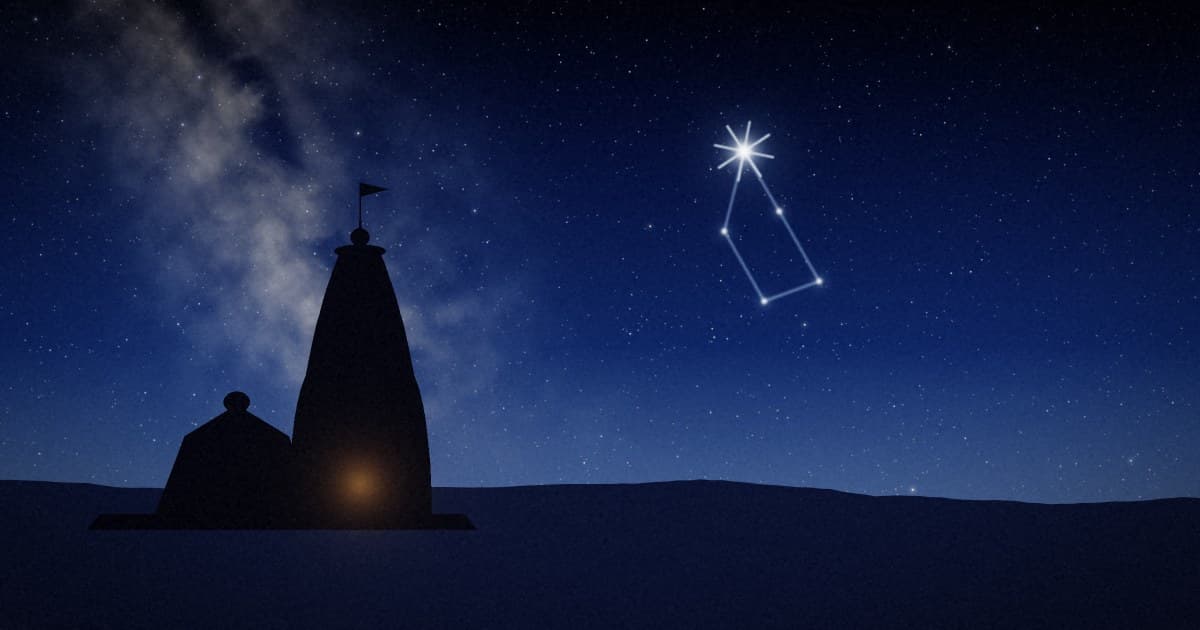
Ask any Vedic astrologer how many nakshatras there are and you'll hear "27". It's built into everything: the Vimshottari dasha, the 108 padas, the Moon's monthly round.
But there's a 28th. It doesn't appear in the dasha system, and it has no regular slot in most birth charts. Yet it turns up in muhurta, in the Ashtottari dasha and in the great chakras of transit astrology. Its name is Abhijit, "the victorious".
The leftover hours of the Moon
Why would anyone need a 28th star? The answer is in the Moon's actual orbit. Sanjay Rath explains it in his Collected Papers. The Moon doesn't take exactly 27 days to circle the stars. It takes 27 days, 7 hours, 43 minutes and 11.5 seconds. Divide the sky into 27 equal mansions, one per day, and you're left with about seven and three-quarter hours unaccounted for.
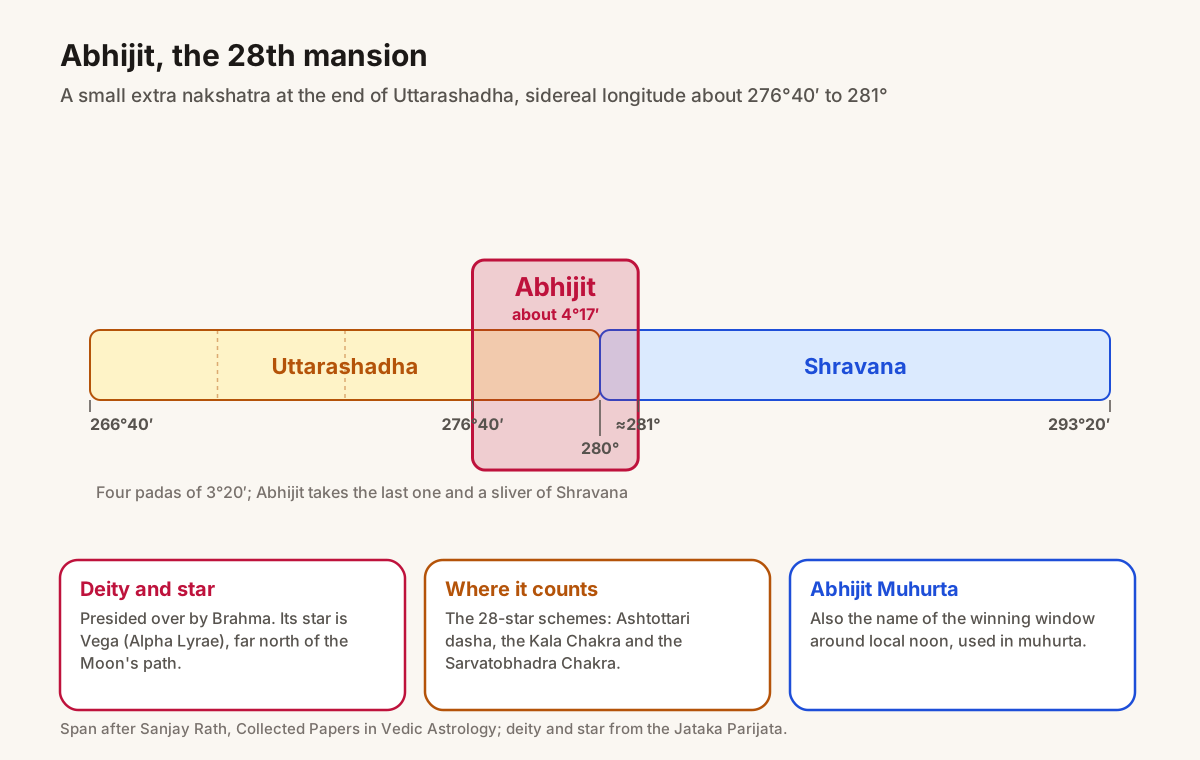
That leftover was given its own small mansion, "a short-span intercalary (hypothetical) Nakshatra called Abhijit." Rath works out its size in proportion: about 4°17′, running from 276°40′ to about 281° of the zodiac. That overlaps the end of Uttarashadha in Capricorn, just before Shravana begins.
So Abhijit is the Moon's remainder: the extra time it takes to close its circle, turned into a star.
The star itself
The Jataka Parijata's nakshatra table gives Abhijit's identity: its deity is Brahma, and its star is Alpha Lyrae, which astronomers call Vega. It's one of the brightest stars in the northern sky, a brilliant blue-white point high overhead on summer nights.
Vega lies far north of the Moon's path, so the Moon never actually passes it. That's another reason Abhijit sits a little outside the regular system. It's a star you look up to rather than along the zodiac. The Brihat Samhita even groups it with the far-north stars. A comet "touching the Seven Sages, Abhijit, the Pole Star" is a single, dramatic omen.
Where Abhijit still counts
Abhijit is left out of the Vimshottari dasha, but it's very much alive elsewhere:
- The Ashtottari dasha. The 108-year system uses 28 nakshatras including Abhijit, as C.S. Patel and the Jyotisha Siddhanta Sara both explain. Abhijit is placed "after Uttarashada and before Sravana" (why 108 matters).
- The great chakras. Rath notes that Abhijit is used in the Kala Chakra and the Sarvatobhadra Chakra, the 28-star grid used to judge transits, names and events. In his worked examples it appears again and again, as when "Saturn transits Abhijit star".
- Muhurta and omens. Varahamihira classes Abhijit with Hasta, Ashwini and Pushya as a swift (kshipra) nakshatra. These are good for "trade, sensual sports, education, decorations ... fine arts, skilled labour ... medical treatment, journey". He also says an omen under Abhijit bears fruit "the same day", faster than under any other star.
Abhijit Muhurta: victory at noon
The most practical legacy of Abhijit is a daily window that anyone can use. A day (sunrise to sunset) is divided into fifteen muhurtas, and the eighth, the one around local noon, is called Abhijit Muhurta.
Essentials of Predictive Hindu Astrology describes it with devotion: "Abhijit Muhurta is named after Lord Maha Vishnu, and is said to counter myriad evils. From the moment the Sun is on meridian, this Muhurta operates for two Ghatikas when the Lord with His Sudarsana Chakra destroys all evils."
So when no perfect muhurta can be found for an urgent task, astrologers often fall back on Abhijit. It's the midday window of "victory", when the Sun stands at its highest.
For example, on 1 January 2027 in New Delhi, Vedhora's panchanga engine puts Abhijit Muhurta at 12:03–12:45 (see the full panchanga). The exact time shifts with your location and the season, because it follows the length of the day. Texts draw its edges slightly differently, but most almanacs centre it on local noon.
The same book adds a note of care: even in this muhurta, according to Shukracharya, the other factors of the day still have to be weighed. Abhijit is powerful, but not a blank cheque (how to choose a good time).
What if your Moon is "in Abhijit"?
Because Abhijit overlaps the last part of Uttarashadha, people born with the Moon between about 276°40′ and 281° sometimes wonder if they're "Abhijit-born". In ordinary chart reading and in the Vimshottari dasha, you're simply Uttarashadha (or early Shravana). Abhijit comes into play in the special systems above, where the 28-star scheme applies.
The takeaway
Abhijit is the hidden 28th nakshatra. It's the Moon's extra seven and three-quarter hours turned into a small mansion at the end of Uttarashadha, presided over by Brahma and marked in the sky by brilliant Vega. It drops out of the Vimshottari dasha, but it lives on in the Ashtottari dasha, the Sarvatobhadra Chakra, the swift stars of muhurta and the daily Abhijit Muhurta at noon, the hour of victory.
To find your own birth star, calculate your chart free. For all 27 regular mansions, read the 27 nakshatras explained.
Discover Your True Planetary Placements
Calculate your true Sidereal Lagna, Chandra Rashi, Nakshatras, and 120-year Vimshottari Dasha timeline with verified astronomical precision.
Calculate Your Free Kundli