
Panchanga: The Five Limbs of Time
Every Hindu calendar day has five limbs: tithi, vara, nakshatra, yoga and karana. What each means, how it's worked out, and an example for 1 January 2027.
A Western calendar tells you the date. A Hindu panchanga tells you what kind of time it is.
Pancha means five, and anga means limb. Every day in the panchanga is described by five astronomical facts, each with its own character. Together they're the foundation of muhurta, the art of choosing the right moment, and they're still printed in almanacs across India every year.
1. Tithi: the lunar day
A tithi is each 12° that the Moon pulls ahead of the Sun. As the Moon moves from new to full, it gains 180° on the Sun, which makes 15 tithis of the bright half (Shukla paksha). From full back to new are another 15 of the dark half (Krishna paksha), 30 tithis in all.
V.P. Jain's Elements of Astronomy and Astrological Calculations sets it out: Pratipada is 0–12°, Dwitiya 12–24°, and so on to the full moon at 180°.
Tithis fall into five repeating groups, used throughout the classical texts:
- Nanda (joy): the 1st, 6th and 11th
- Bhadra (good): the 2nd, 7th and 12th
- Jaya (victory): the 3rd, 8th and 13th
- Rikta (empty): the 4th, 9th and 14th
- Purna (full): the 5th, 10th and 15th
Jataka Parijata notes that the chhidra ("gapped") tithis, the 4th, 6th, 8th, 9th, 12th and 14th, "are generally avoided for any auspicious function."
2. Vara: the weekday
Each day is ruled by a planet: Sunday the Sun, Monday the Moon, and so on. The Hindu day runs from sunrise to sunrise, not midnight to midnight. K.N. Rao gives the example in Dasha Nirnay: a birth at 1 am in the night after Friday is still a Friday birth.
3. Nakshatra: the Moon's star
The nakshatra is the lunar mansion the Moon is passing through, one of 27 segments of 13°20′ (the 27 nakshatras). The Moon spends about a day in each. It's the most personal limb, because your own birth nakshatra decides how each day's star treats you (tara bala).
4. Yoga: the sum of the lights
The panchanga yoga (not the same as a birth-chart yoga) comes from adding the longitudes of the Sun and Moon and dividing the total into 27 parts of 13°20′. Jyotisha Siddhanta Sara lists all 27, from Vishkambha, Preeti and Ayushman through Siddhi, Shiva and Siddha to Brahma, Indra and Vaidhriti. Some, such as Vyatipata and Vaidhriti, are traditionally avoided. Parashara lists a birth in Vyatipata among the times that call for a remedy.
5. Karana: half a tithi
A karana is half a tithi, 6° of the Moon's lead over the Sun. There are 11: seven "movable" ones that repeat eight times through the month (Bava, Balava, Kaulava, Taitila, Garaja, Vanija and Vishti) and four "fixed" ones around the new moon (Shakuni, Chatushpada, Naga and Kimstughna).
Vishti, also called Bhadra, is the one almanacs warn about. Jyotisha Siddhanta Sara says Vishti and the fixed karanas "are supposed to be unfavourable." The same text adds a lovely personal rule: "Any undertaking initiated in one's birth Karana is likely to become successful."
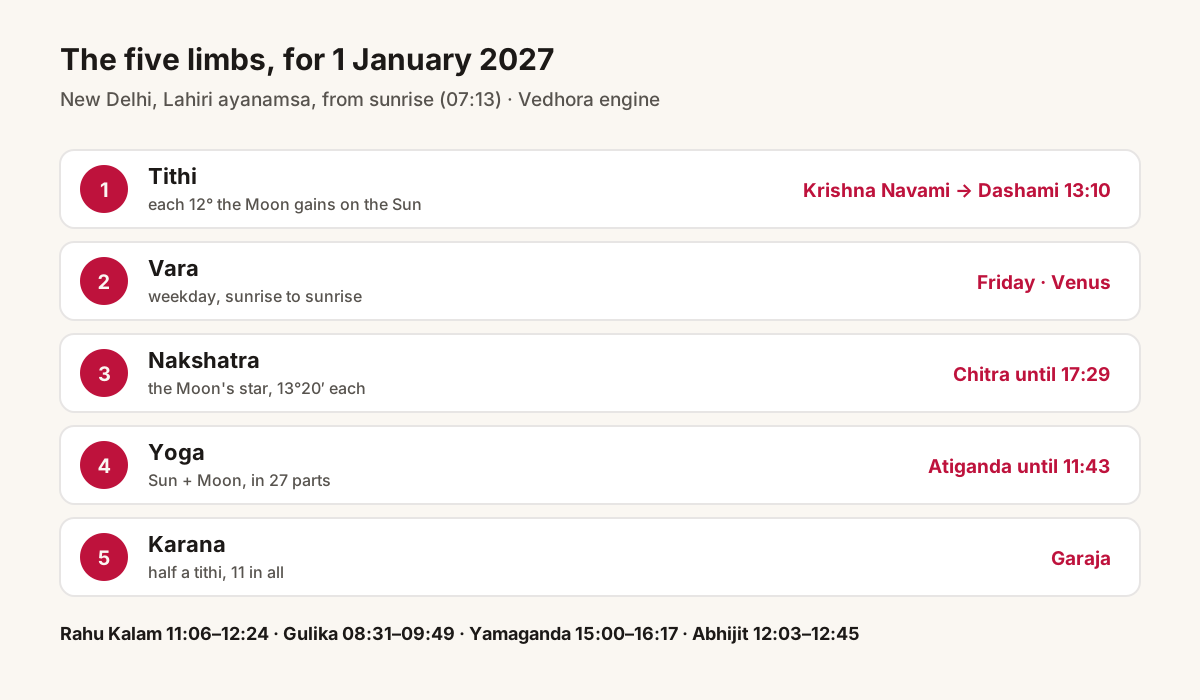
A worked example: 1 January 2027
Here's the panchanga for New Delhi on Friday, 1 January 2027, calculated by Vedhora's engine (Lahiri ayanamsa, at sunrise):
- Vara: Friday (Shukravara), ruled by Venus. Sunrise 07:13, sunset 17:35.
- Tithi: Krishna Navami, the 9th of the dark half, a Rikta tithi, until about 13:10, then Dashami.
- Nakshatra: Chitra until about 17:29.
- Yoga: Atiganda until about 11:43.
- Karana: Garaja.
Reading it simply: the morning combines a Rikta ("empty") tithi with Atiganda yoga, whose name means "great obstacle". That's not a moment the tradition would pick for a big beginning. By the afternoon the tithi turns to Dashami, a Purna tithi, and the yoga has changed. Someone choosing a time on this day would look later in the day.
Inauspicious hours of the day
Panchangas also mark periods within each day. Jataka Parijata explains the classical idea: the daytime is divided into eight parts, and the planets rule them in weekday order starting from the day's lord. The eighth part has no lord. Saturn's part is Gulika, and Jupiter's part is Yamakantaka (often called Yamaganda). These are traditionally avoided for new undertakings, as is the widely used Rahu Kalam.
For 1 January 2027 in Delhi:
- Rahu Kalam: 11:06–12:24
- Gulika: 08:31–09:49
- Yamaganda: 15:00–16:17
- Abhijit muhurta (the auspicious period around local noon): 12:03–12:45
Using the panchanga
You don't need to master all five limbs to benefit. A simple approach:
- For important beginnings, avoid Rikta tithis, Vishti karana and the inauspicious hours of the day.
- Check the day's nakshatra against your own with tara bala.
- Prefer days and hours where several limbs agree. One weak limb in a good day is normal. Several weak limbs together is a day to wait.
- For big life events (marriage, griha pravesha, surgery), ask an astrologer to set a full muhurta. It combines the panchanga with the chart of that moment.
The takeaway
The panchanga describes each day by five limbs: the Moon's phase (tithi), the planetary ruler (vara), the Moon's star (nakshatra), the joined light of Sun and Moon (yoga) and the half-phase (karana). It's ancient astronomy you can use every day.
Calculate your chart free to find your birth nakshatra and tithi, and ask Vedhora's astrologer to choose good days for what you're planning. For timing based on your birth star, read Tara Bala: the nine stars of your day.
Discover Your True Planetary Placements
Calculate your true Sidereal Lagna, Chandra Rashi, Nakshatras, and 120-year Vimshottari Dasha timeline with verified astronomical precision.
Calculate Your Free Kundli