
The Star Body: Nakshatra Purusha
The Brihat Samhita pictures the 27 nakshatras as one divine body, Mula at the feet and Bharani at the head. The star-body map and your birth star's place.
Most people know the zodiac as a circle of twelve signs. Fewer know that Vedic tradition also sees it as a body. The twelve signs form Kalapurusha, Time as a person, stretched from Aries at the head to Pisces at the feet (your body in the birth chart).
There's a second, older-feeling map, made of stars rather than signs. Near the end of the Brihat Samhita, Varahamihira describes the Nakshatra Purusha, the Stellar Deity, whose body is built from the 27 nakshatras.
The map of the star body
Here it is, from the feet up, exactly as Varahamihira gives it:
- Feet: Mula
- Shanks: Rohini
- Knees: Ashwini
- Thighs: Purva and Uttara Ashadha
- Private parts: Purva and Uttara Phalguni
- Hips: Krittika
- Sides: Purva and Uttara Bhadrapada
- Stomach: Revati
- Breast: Anuradha
- Back: Dhanishtha
- Arms: Vishakha
- Hands: Hasta
- Fingers: Punarvasu
- Nails: Ashlesha
- Neck: Jyeshtha
- Ears: Shravana
- Mouth: Pushya
- Teeth: Swati
- Laughter: Shatabhisha
- Nose: Magha
- Eyes: Mrigashira
- Forehead: Chitra
- Head: Bharani
- Hair: Ardra
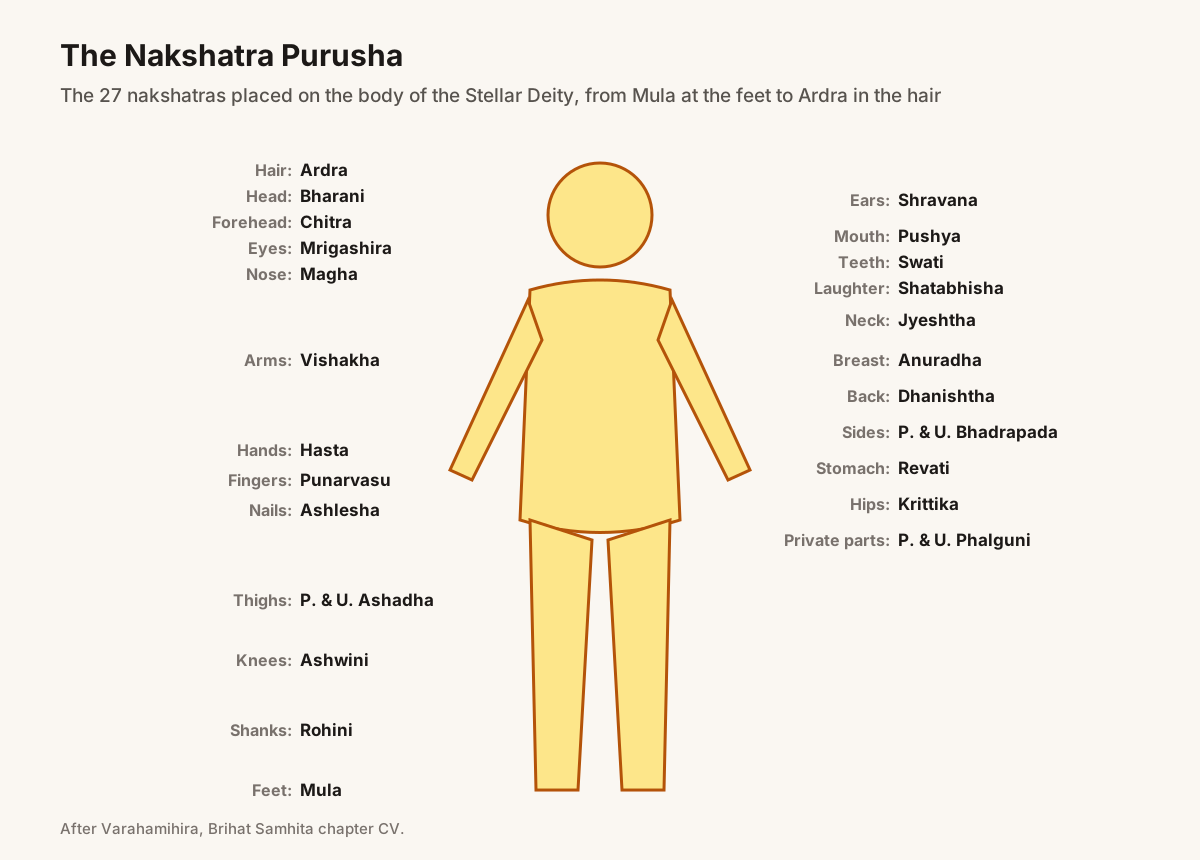
Notice how different this is from the zodiac body. Kalapurusha runs in order, sign by sign, from head to foot. The star body is scattered. Ashwini, the first nakshatra, is the knee, Mula the feet, Bharani the head. Some placements seem to follow a nakshatra's own nature: Hasta ("the hand") is the hands, Shravana (linked to hearing) is the ears and Mrigashira ("the deer's head") is the eyes. And one entry isn't a body part at all. Shatabhisha is the Stellar Deity's laughter.
The vow of the star body
Varahamihira doesn't present the map as a curiosity. It's the basis of a vow, the Nakshatra Purusha vrata, which he says is for "those who wish for good physical features."
- Begin on the eighth day of the dark fortnight of Chaitra, when the Moon is in Mula (the feet) and the day is a Monday.
- Worship Lord Vishnu and the Stellar Deity, and fast.
- Continue up the body. Fast and worship again each time the Moon reaches the next nakshatra in the order of the limbs: Rohini, then Ashwini, and so on, all the way to Ardra, the hair.
- Complete the vow by giving a vessel filled with ghee, with gold, gems and cloth according to one's means, to a Brahmin learned in astrology. Feed guests dishes made with milk, ghee and jaggery.
The vow is a slow climb up the body of the sky, one nakshatra at a time. It takes many months, following the Moon.
What it promises
The promised fruit is poetic. A man who keeps the vow is reborn with "long arms ... broad and muscular breast, moon-like face, white and beautiful teeth ... long eyes resembling the lotus." A woman is reborn with "a face as bright and lustrous as the autumnal full Moon, eyes like the petals of lotus ... a voice as sweet as that of an intoxicated cuckoo." And Varahamihira adds that the same results "accrue, pari passu, to men as well."
Then comes the most striking promise in the whole book. Such a person "will become a star and move with the stars in the firmament, as long as the rows of stars move in the sky ... till the end of the Creator's day." After the universe is remade, they return as a wise ruler or a learned, prosperous Brahmin.
To honour the body of the stars is to be woven into it.
Vishnu through the year
The same chapter closes with a second devotional calendar. Each of the twelve lunar months, starting from Margashirsha, has a name of Vishnu: Keshava, Narayana, Madhava, Govinda, Vishnu, Madhusudana, Trivikrama, Vamana, Shridhara, Hrishikesha, Padmanabha and Damodara. One who fasts on the Ekadashi of each month and worships Vishnu by that month's name, the text says, reaches Vishnu's world, beyond rebirth.
What your birth star's place suggests
The tradition doesn't prescribe a technique for reading your birth nakshatra through the star body. But it's a lovely way to meditate on your own star. If you were born in Hasta, you're part of the Deity's hands. In Pushya, the mouth. In Chitra, the forehead. In Shatabhisha, the laughter. It invites a question: what does this part of the cosmic body do, and how can I do it well?
And on a practical level, many people honour their birth star each month when the Moon returns to it, with a small fast, a prayer or an act of charity. It's a gentle way to keep the vow's spirit.
The book that churned the ocean
This chapter is the last real teaching in the Brihat Samhita. In his conclusion, Varahamihira describes his whole work with an image from the Puranas:
"Having churned the ocean of astrology with the Mandara mountain of my intelligence, I have taken out the Moon of Science (this work) that affords light (enlightenment) to the world."
It's fitting that he ends with the star body. After a hundred chapters of comets, rain, gems, omens and planets, the last image is of the sky as a single divine person, and of a human being who, by honouring it, becomes a star.
The takeaway
The Nakshatra Purusha turns the 27 lunar mansions into one divine body, with Mula at the feet, Bharani at the head and Ardra as the hair. The vow built on it climbs that body one nakshatra at a time, and promises beauty, honour and a place among the stars. It's one of the most tender ideas in Jyotish: the sky is not just a map to be read, but a body to be revered.
To find which nakshatra you belong to, calculate your chart free, and read the 27 nakshatras explained.
Discover Your True Planetary Placements
Calculate your true Sidereal Lagna, Chandra Rashi, Nakshatras, and 120-year Vimshottari Dasha timeline with verified astronomical precision.
Calculate Your Free Kundli