
How to Choose an Auspicious Time
A practical muhurta guide: the five panchanga checks, the right star for each task, personal checks, periods to avoid and the muhurta chart, with an example.

A muhurta is the birth chart of an action. Just as the moment of your birth colours your life, the moment you begin something (a marriage, a business, a journey, moving into a house) is believed to colour what follows. Choosing that moment well is muhurta, or electional astrology.
The full art is vast, but the core is a clear sequence of checks. Here it is.
Check 1: The five limbs of the day
Every day is described by its panchanga: tithi, weekday, nakshatra, yoga and karana (the five limbs explained). Each one can help or harm.
Tithi (lunar day). K.S. Charak groups the tithis into five kinds: Nanda (1, 6, 11), Bhadra (2, 7, 12), Jaya (3, 8, 13), Rikta (4, 9, 14) and Poorna (5, 10, 15 and the new moon). The Rikta tithis, the 4th, 9th and 14th, are the ones to avoid for anything auspicious. Charak lists them for "cruel deeds ... use of fire, poison and weapons" and says to "avoid all auspicious pursuits." Poorna tithis suit marriage, travel and ceremonies.
Weekday (vara). Each day carries its planet's nature. Some tithi–weekday pairs are especially lucky: Nanda tithis on Friday, Bhadra on Wednesday, Jaya on Tuesday, Rikta on Saturday and Poorna on Thursday.
Nakshatra. This is the heart of muhurta, covered below.
Yoga. Some of the 27 yogas are inauspicious, among them Vishkambha, Atiganda, Shula, Ganda, Vyaghata, Vajra, Vyatipata, Parigha and Vaidhriti.
Karana. One karana is avoided above all: Vishti, also called Bhadra. B.V. Raman's Muhurta is blunt: "Vishtikarana must invariably be discarded."
Check 2: The right star for the job
The nakshatras are grouped by nature, and each group suits certain tasks. Varahamihira's Brihat Samhita and K.S. Charak give the classical scheme:
- Fixed (dhruva): Rohini and the three Uttaras. Good for foundations, houses and anything meant to last.
- Movable (chara): Punarvasu, Swati, Shravana, Dhanishtha and Shatabhisha. Good for travel, vehicles and starting to move.
- Swift (kshipra): Ashwini, Pushya, Hasta (and Abhijit). Good for trade, education, arts, medicine and journeys (Abhijit).
- Soft (mridu): Mrigashira, Chitra, Anuradha and Revati. Good for arts, friendship, romance, clothes and ornaments.
- Fierce (ugra): Bharani, Magha and the three Purvas. Kept for hard, confrontational work.
Charak adds a lovely detail. Some nakshatras "face upward", like Rohini, Ardra, Pushya and Shravana, and suit raising buildings and coronations. Some face down and suit digging and foundations. Some face forward and suit travel, ploughing and business.
Check 3: Personal fit
A good day in general isn't necessarily a good day for you. Two personal checks matter:
- Tara bala: the day's nakshatra counted from your birth nakshatra should be a favourable tara, not Vipat, Pratyak or Vadha (the nine taras).
- Chandra bala: the Moon's transit sign counted from your natal Moon should be favourable. In particular, avoid the Moon passing through the 8th from your Moon sign.
Check 4: Periods to avoid within the day
Even a good day has windows to skip:
- Rahu Kalam, Yamaganda and Gulika: an eighth of the daylight each, rotating through the week.
- The Panchaka: the Moon's passage from the second half of Dhanishtha to the end of Revati. Charak lists activities to avoid then, including travel to the south and thatching a roof.
Check 5: The muhurta chart itself
Finally, cast a chart for the chosen moment. A good muhurta has:
- a strong ascendant, with benefics in the kendras and trikonas
- the 8th house empty. Raman's Muhurta says that for a wedding "the 8th house should be occupied by no planet," and Charak adds that the 8th from both the ascendant and the Moon should be free from affliction.
- the Moon strong, not in the 8th and not badly afflicted
When nothing is perfect
You'll rarely find a moment that passes every test. Classical texts accept this. The aim is to remove the serious faults and keep as many strengths as possible. For urgent matters, two fallbacks are widely used:
- Abhijit Muhurta, the window around local noon, said to remove many faults
- The right hora for the task, such as the Sun's hora for government work (planetary hours)
A worked example: 1 January 2027, New Delhi
Vedhora's panchanga engine gives this for the day:
- Weekday: Friday
- Tithi: Krishna Navami until 13:10, a Rikta tithi, then Dashami, a Poorna tithi
- Nakshatra: Chitra (soft) until 17:29, then Swati (movable)
- Yoga: Atiganda (inauspicious) until 11:43, then Sukarma
- Karana: Garaja, not Vishti, so fine
- To avoid: Gulika 08:31–09:49, Rahu Kalam 11:06–12:24, Yamaganda 15:00–16:17
- Abhijit Muhurta: 12:03–12:45
Reading it: the morning carries a Rikta tithi and the inauspicious Atiganda yoga, so it isn't the time for anything important. After 13:10 the tithi turns Poorna, the yoga is Sukarma and the nakshatra is still soft Chitra, so the early afternoon, about 13:10 to 15:00 before Yamaganda, is the strongest window of the day for an auspicious start. You'd then cast the chart for your exact start time to check the ascendant and the 8th house, and confirm the tara and Chandra bala for the people involved.
The takeaway
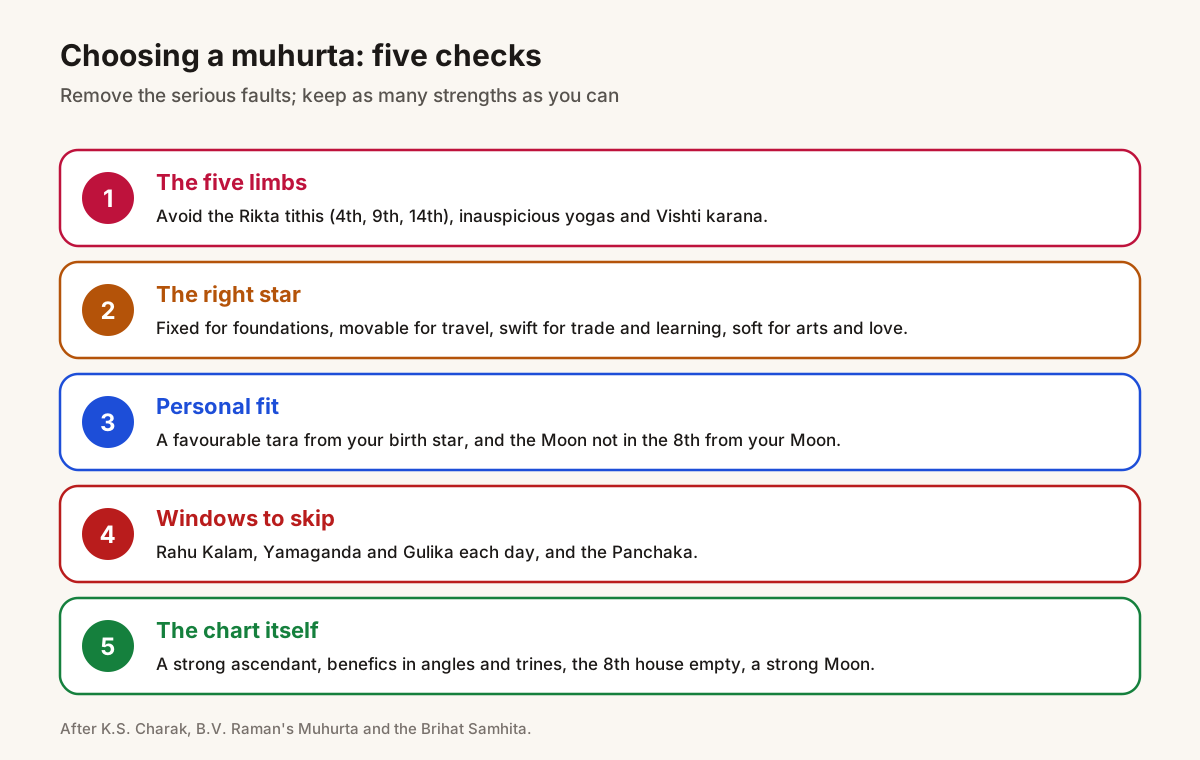
Choosing a muhurta runs in five checks. First the five limbs (avoid Rikta tithis, inauspicious yogas and Vishti karana). Then the right nakshatra for the job: fixed for foundations, movable for travel, swift for trade and learning, soft for arts and love. Then the personal tara and Chandra bala, then the daily windows to avoid, and finally a strong muhurta chart with the 8th house empty. Perfection is rare, so remove the big faults.
Calculate your chart free to find your birth nakshatra and Moon sign, the starting points of your personal checks.
Discover Your True Planetary Placements
Calculate your true Sidereal Lagna, Chandra Rashi, Nakshatras, and 120-year Vimshottari Dasha timeline with verified astronomical precision.
Calculate Your Free Kundli