
Nadi Astrology: Jupiter's Secret Rule
In Bhrigu Nadi the ascendant hardly matters. Jupiter's yearly journey across your natal planets does. The rule, the twelve-year rounds and a worked example.

Most Vedic astrology starts from the ascendant. One famous school almost ignores it. In Bhrigu Nadi astrology, said to come from the sage Bhrigu, the planets are read by their relationships to each other, and timing comes from one simple, elegant rule about Jupiter.
Jupiter as the life force
Dr. N. Srinivasan Shastry's Brighu Naadi Sangraha sets out the principle clearly:
"In Naadi, Jupiter which is considered as life force takes 1 year to travel from one sign to another, and while in transit Jupiter will touch all the other planets like Sun, Moon, Mars, Mercury, etc., so when the so called life force touches other planets, the life of an individual would experience the qualities of that planet which is in touch with Jupiter."
In this system Jupiter is jiva, the living self. As it moves through the zodiac, one sign a year, it switches on each natal planet it reaches:
- Jupiter touching Venus: money, comforts, relationships
- Jupiter touching the Sun: name, fame, recognition, authority
- Jupiter touching Mars: property, courage, siblings, action
- Jupiter touching Mercury: learning, trade, communication
- Jupiter touching Saturn: work, responsibility, karma ripening
- Jupiter touching Ketu or Rahu: periods that need care, the book warns
Counting the years
The timing rule is just as direct: "The number of signs in between Jupiter and the particular significator is the number of years of fructification."
Since Jupiter moves about a sign a year, the distance from natal Jupiter to a natal planet tells you roughly how many years until Jupiter first reaches it, and the same theme returns every twelve years after that.
The twelve-year rounds
Shastry adds a layer that makes the rule practical. Each 12-year circuit of Jupiter, a "round", has its own main theme:
- First round (birth to 12): the development of the individual
- Second round (12–24): family and finances
- Third round (24–36): travel and the progress of brothers and sisters
- Fourth round (36–48): house and landed property
- Fifth round (48–60): children, their progress or setbacks
- Sixth round (60–72): dangers to the person themselves, a time for care
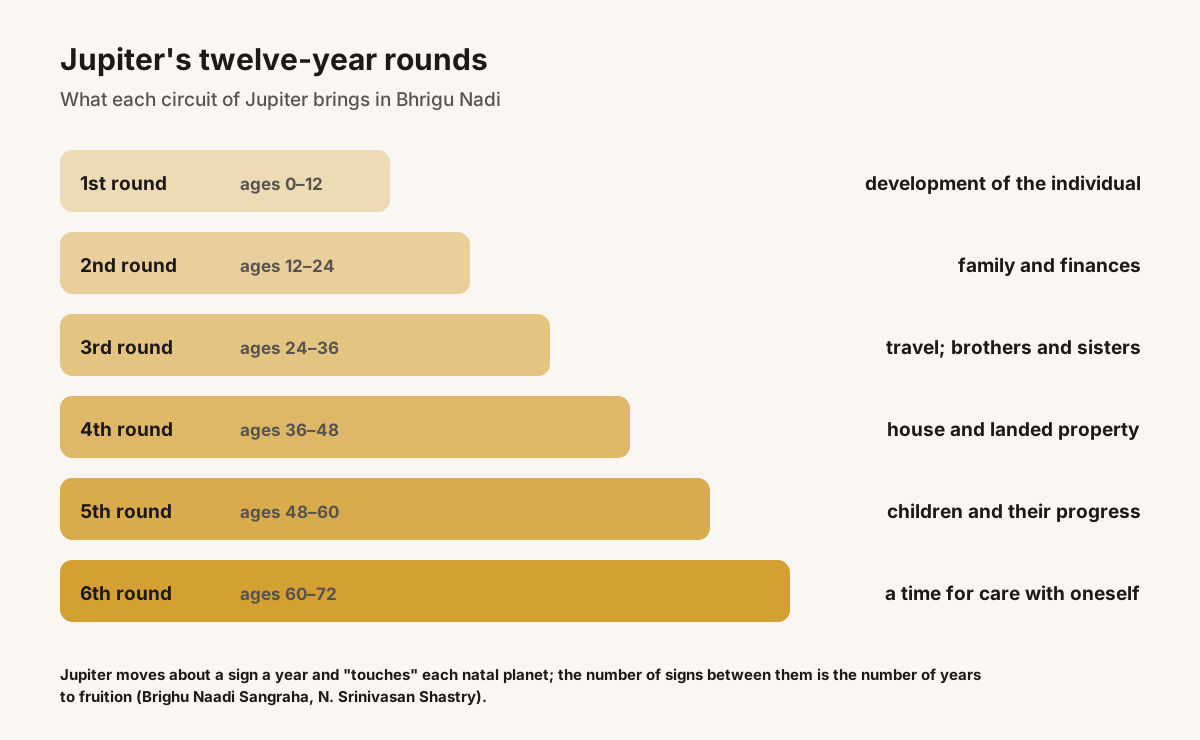
So "Jupiter touches Venus" means something different at 20 (a family or financial gain) than at 40 (a home or property linked to Venus).
Saturn and the start of a career
Saturn plays the same game more slowly: two and a half years per sign, thirty years per round. In Nadi, Saturn signifies profession, karma and challenge, and its key moment is reaching Rahu:
"When Saturn touches/sees Rahu in his 1st round of transit, that is the age of beginning of the profession/business for the individual."
The book's shortcut: count the signs from natal Saturn to natal Rahu (or sometimes Venus) and multiply by 2½ to estimate the age.
A worked example
Take a real chart from Vedhora's engine: someone born on 14 March 1992. Natal Jupiter is in Leo, Venus in Aquarius, Saturn in Capricorn and Rahu in Sagittarius. Tracking the actual transits:
- Jupiter reached natal Venus (Aquarius) in 1998, again in 2009–10, and again from April 2021. That last pass fell in the third round. By the Nadi rule, it was a likely window for money and relationships, coloured by travel and siblings.
- Saturn reached natal Rahu (Sagittarius) in January 2017, when this person was about 25. By the Nadi rule, that's when a profession or business takes root.
- Jupiter came back to its own natal sign, Leo, on 31 October 2026, a fresh start of Jupiter's themes for this person at age 34. It dips back into Cancer in January 2027 and settles in Leo from late June 2027.
The count-by-2½ shortcut gives roughly 27 for the Saturn–Rahu meeting. The real transit came at 25, because Saturn's speed varies and it started in the later part of Capricorn. The shortcut is a guide, and the actual transit is the clock.
The signs speak too
Bhrigu Nadi also gives each sign its own significations, used when reading what a planet will bring:
- Aries: the head, chemicals, ancient scripts, machinery
- Taurus: the face, fortune, medicine, the fine arts and music
- Gemini: intellect, law, trade
- Cancer: the mother, milk, hotels, foreign lands
- Leo: the father, the capital city, government headquarters
- Libra: banking, gold and jewellery, vehicles, luxury
- Scorpio: iron and machinery, police and army, mantras
- Sagittarius: teaching, religion, banking, accountancy
So Jupiter touching a planet in Libra may bring gain through finance or luxury goods, and touching a planet in Gemini through law or trade.
Why it works so well with other methods
Bhrigu Nadi timing is easy to cross-check. Many astrologers use it alongside the Vimshottari dasha: when the dasha points to a theme and Jupiter is touching the natal planet of that theme, the event is far more likely. Vedhora's timing engine uses the same kind of transit confirmation, looking for Jupiter's support on the houses and planets of your question.
The takeaway
Bhrigu Nadi gives Jupiter a simple job: to walk through your chart one sign a year, waking up each planet it meets. Count the signs, note the round you're in, and you'll see why certain years bring money, others a home, and others a new career.
Calculate your chart free to see where your natal planets sit, then ask Vedhora's astrologer which of them Jupiter is touching now. For the classical side of timing, read how your dasha clock is set at birth.
Discover Your True Planetary Placements
Calculate your true Sidereal Lagna, Chandra Rashi, Nakshatras, and 120-year Vimshottari Dasha timeline with verified astronomical precision.
Calculate Your Free Kundli