
The Palm-Leaf Mystery of Nadi
Palm leaves said to hold your life story, written by sages long ago. What Nadi astrology really is, the great Nadi texts, and how to approach a reading.
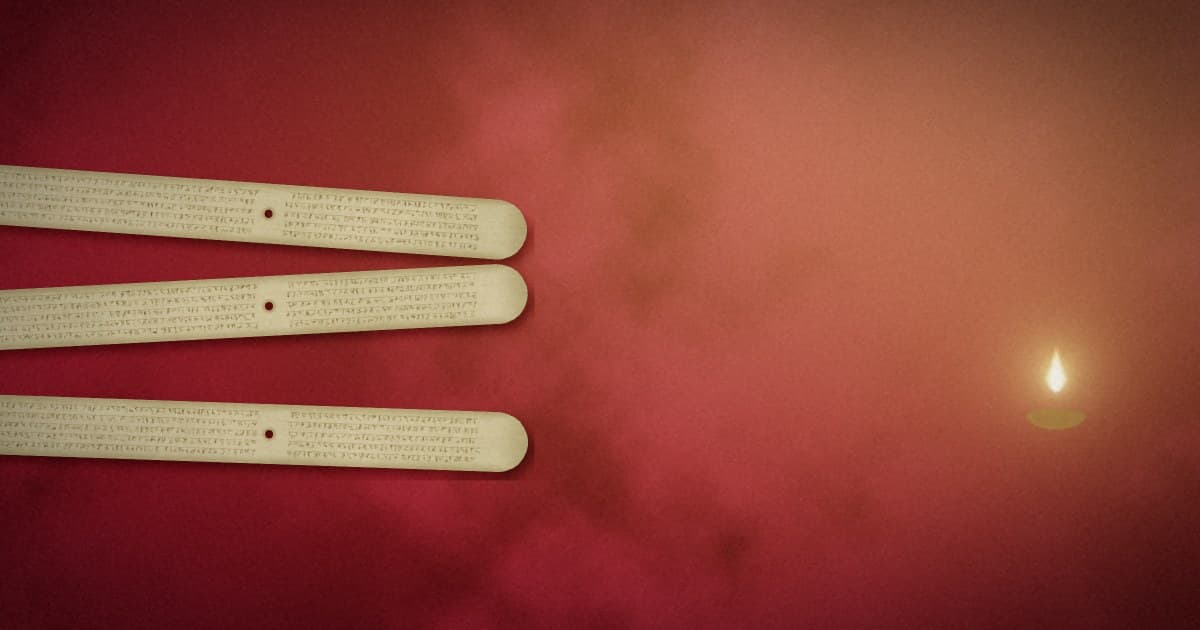
You walk into a small room in Tamil Nadu. A reader pulls out a bundle of narrow, brown palm leaves covered in tiny old script. He asks you a few yes-or-no questions, leafing through the bundle. Then he stops, and begins to read your name, your parents' names and the story of your life, written, he says, by a sage thousands of years ago.
This is the world of Nadi astrology, the most mysterious branch of Jyotish. What is actually going on?
Two meanings of "Nadi"
The word works on two levels.
First, Nadi texts are a family of works attributed to great sages: Agastya Nadi, Bhrigu Nadi, Sapta Rishi Nadi, Shuka Nadi, Chandra Kala Nadi (also called Deva Keralam) and others. Many survive as palm-leaf manuscripts.
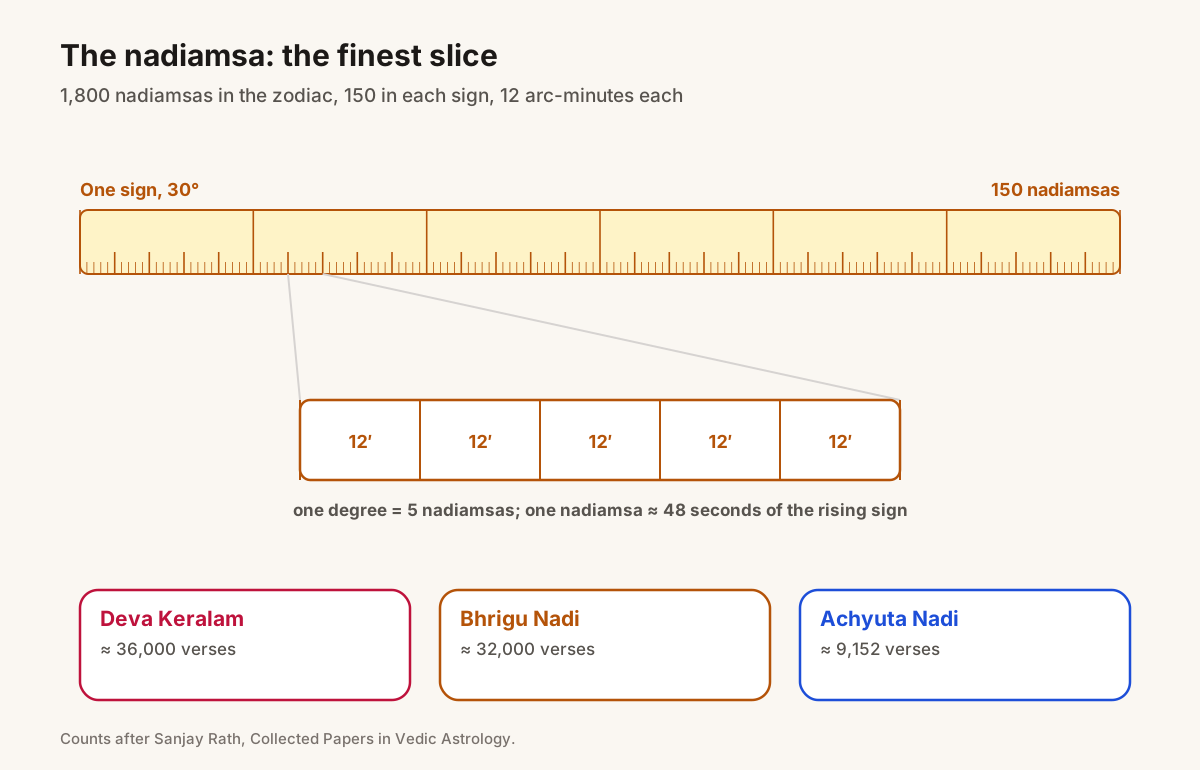
Second, there's a precise astronomical meaning. A nadiamsa is a tiny slice of a zodiac sign. Sanjay Rath explains in his Collected Papers: "there are 1800 nadiamsa in the zodiac with each sign having 150 nadiamsa." Each slice is just 12 minutes of arc wide. The ascendant crosses one in under a minute of clock time.
That's the secret ambition of Nadi astrology. It aims to describe lives at the resolution of the nadiamsa, finer than any ordinary chart. Two people born a minute apart, even twins, could fall in different nadiamsas (why twins differ).
The great Nadi texts
Some Nadi works are not mysterious at all. They sit in libraries and have been studied for generations. In his Arudha System of Prediction, C.S. Patel describes:
- Deva Keralam (Chandra Kala Nadi): about 36,000 verses
- Bhrigu Nadi: about 32,000 verses, with an original palm-leaf manuscript in Grantha script at the Adyar Library, Chennai. One volume alone holds about 8,250 Sanskrit verses.
- Achyuta Nadi: about 9,152 verses, which he says is "only one fourth" of the original that covered all 150 nadiamsas
Patel combed these texts for rules on the Arudha system (what the arudha shows). He found principles "not located elsewhere in the standard texts." The Nadis are a working archive of technique.
Then there's the Sapta Rishi Nadi, published by the Government Oriental Manuscripts Library in Madras. J.N. Bhasin's commentary describes it as a collection of "horoscopes from actual life": complete charts with the ascendant, nakshatra and dasha balance at birth, followed by the events of each life. It's essentially an ancient casebook, and students still use it to test principles against real charts.
Bhrigu Nadi has also given astrology one of its most elegant timing rules: Jupiter "touching" each natal planet in turn (Jupiter's secret rule).
The leaves of fate
The famous palm-leaf readings are a different thing: bundles held by hereditary families of readers, said to contain the lives of specific individuals. Rath records the traditional account given by one Chennai Nadi family. Their bundles are "2000 year old" and written by the seven seers, and they detail a person's life and give Vedic remedies for past-life sins.
How could a leaf be written for you thousands of years in advance? Rath notes two theories. One is that the sages wrote prophecies only for the souls destined to come for a reading. The readers say, "Whoever is destined to look into the leaves will come to us on his own accord." The other is that every possible chart combination was recorded. That second claim, he notes, "is strongly disputed by many Vedic astrologers."
Other traditions use different methods. In Puri, Rath describes a Durga Nadi practitioner who draws a chakra on the floor. The client places a stone in one of its boxes, and a leaf is chosen from that. Even B.V. Raman, Rath notes, "spent many years trying to unravel the mystery."
An insider's warning
Here the tradition is refreshingly honest about itself. Rath warns that palm-leaf copies are now manufactured, with "a whole industry on this based in a village in Tamil Nadu". Some readers even sell clients their leaves. This, he says, raises "considerable doubt on the genuineness of the copy, ability of interpretation of the nadi reader and also the authenticity," and "the indiscriminate copying and creation of palm leaf manuscripts ... is going to end up ruining the whatever little faith people have on these Agastya nadi readers."
That's not an outsider dismissing Nadi. It's a respected Vedic astrologer protecting it.
How to approach a Nadi reading
If you're drawn to try one, a few sensible principles:
- Give as little information as possible up front, and notice how much the reading depends on your own answers.
- Look for specifics you can check, not generalities that fit anyone.
- Be cautious with costly remedies urged on you through fear. Classical remedies are simple: prayer, charity, mantra and right conduct.
- Cross-check with your own chart. The Nadi principles don't contradict ordinary Jyotish. They refine it.
The takeaway
Nadi astrology is two things at once. One is a living tradition of palm-leaf readings, wrapped in mystery and, by its own experts' admission, in need of care. The other is a great scholarly archive. Deva Keralam, Bhrigu Nadi and the Sapta Rishi Nadi preserve thousands of verses and real horoscopes, and push the chart down to 150 slices per sign. Both share the same vision: that a life can be read from the sky at the finest possible scale, if the reader is skilled and honest enough.
Calculate your chart free to see your ascendant to the degree, the first step toward reading at Nadi resolution.
Discover Your True Planetary Placements
Calculate your true Sidereal Lagna, Chandra Rashi, Nakshatras, and 120-year Vimshottari Dasha timeline with verified astronomical precision.
Calculate Your Free Kundli