
Retrograde Planets: Strong, Not Broken
Forget the Mercury retrograde panic. In Vedic astrology a retrograde planet gains strength. What the classics say, benefics versus malefics, and how common.
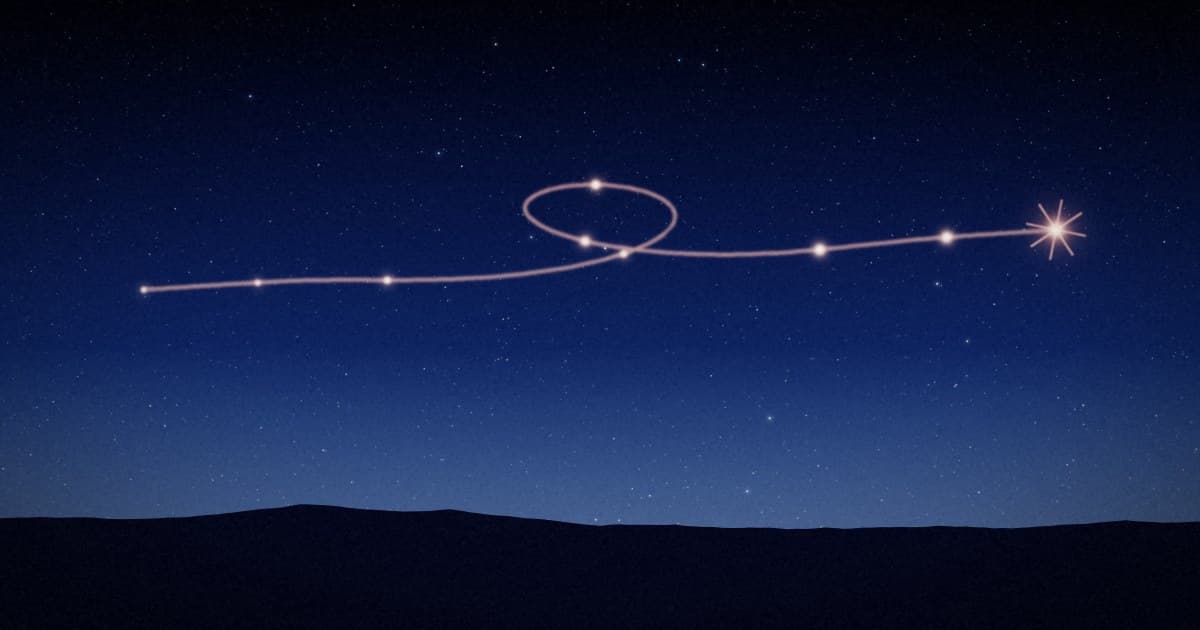
Every few months the internet panics about "Mercury retrograde." Phones break, emails go missing, and plans fall apart, or so the memes say. Then someone looks at their birth chart, sees an R next to a planet, and wonders if something is wrong with them.
The classical texts of Jyotish take a very different view. In Vedic astrology a retrograde planet is not weak. In most cases it is strong.
What retrograde actually is
No planet ever really moves backwards. Seen from a moving Earth, though, a planet can appear to stop and reverse against the stars for a while, the way a slower car seems to roll back when you overtake it on the highway.
The classics tracked this carefully. K.N. Rao explains in Dasha Nirnay that for the outer planets (Mars, Jupiter, Saturn), retrogression begins when they are about five signs from the Sun and ends when they are about nine signs away. In other words, it happens around the time they stand opposite the Sun. B.V. Raman's Bhavartha Ratnakara turns this into a rule of thumb: planets in the 7th and 8th from the Sun move retrograde, while those in the 11th and 12th from it move very swiftly.
The Sun and Moon never go retrograde. Rahu and Ketu, the lunar nodes, move backwards almost all the time.
The classical verdict: strength
In Jyotish, a planet's motion gives it a kind of strength called cheshta bala, motional strength. Saravali states it plainly: the planet "that is in its retrograde motion... become[s] strong." Jataka Parijata adds that retrograde planets are the ones that win in planetary war (what graha yuddha is).
The longevity rules make the point unmistakable. In Satyacharya's method, a planet's contribution is trebled when it is retrograde, the same multiplier given for exaltation.
There is a sound astronomical reason. Mars, Jupiter and Saturn go retrograde when Earth passes between them and the Sun, which is when they are closest to us and shine at their brightest. The ancients saw a bright planet as a strong one.
But strong in which direction?
Here Saravali (5.39) gives the most useful line on the subject:
"A benefic, if retrograde, is strong and is capable of conferring kingdom. If a malefic is retrograde, it causes grief and purposeless wandering."
Retrogression amplifies a planet's nature. A retrograde Jupiter or Venus has more of its grace. A retrograde Saturn or Mars has more of its weight. The planet speaks louder, and what it says depends on what it is and what it rules in your chart (functional benefics and malefics).
The texts note some special cases too:
- Retrograde in exaltation. Saravali records a view that a planet retrograde in its exaltation sign gives no good effect, and the same is said if it re-enters its exaltation by moving backwards. Jupiter slipping back into Cancer from Leo is the example given.
- Retrograde in debilitation. Some say a debilitated planet that is retrograde behaves as if exalted. The Horasara of Prithuyasas mentions this view and does not accept it. So treat that popular claim with caution.
How common is it?
We checked 60,000 birth charts with Vedhora's engine:
- Saturn is retrograde in 36.4% of charts
- Jupiter in 30.8%
- Mercury in 20.4%
- Mars in 9.1%
- Venus in 7.2%
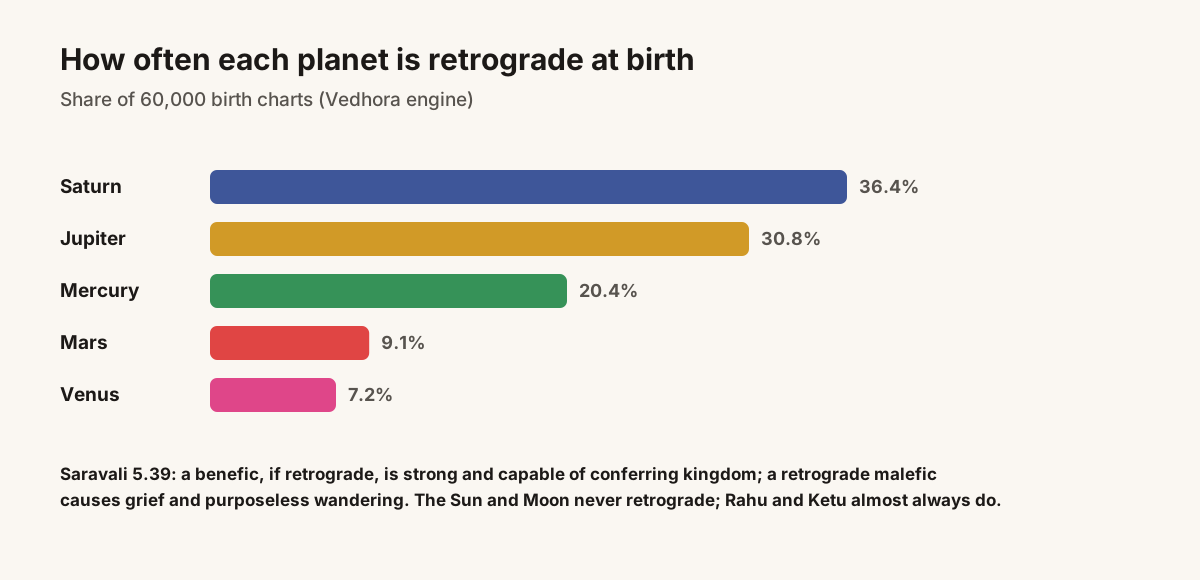
More than a third of all people are born with Saturn retrograde. Something that common can't be a curse. It is a style of expression.
What it feels like in a life
Astrologers commonly read a retrograde planet as working inward and again:
- Revisiting: returning to the planet's themes, such as a second career, a second marriage, finishing old study.
- Inwardness: the planet's qualities are felt intensely inside before they show outside.
- Unexpected timing: Charak notes that a retrograde planet "produces unexpected results." Things arrive late, early, or by a route you didn't plan.
- Mastery through repetition: what is reworked tends to be done better than what was done once.
A retrograde Mercury might make a careful thinker who rewrites everything. A retrograde Saturn might take duty unusually seriously and carry responsibility early. A retrograde Jupiter might question inherited beliefs until they become personally true.
Retrograde in transit
The current motion of planets matters in timing too. In Prashna Tantra, the classic of horary astrology, one way to time the return of a person who is away is "the time of the lord of the 7th becoming retrograde." A planet turning back can bring back what had gone (how Prashna works).
That's a better way to think about transiting retrogrades than the internet panic. They are times to review, repair and return, not to fear.
The takeaway
A retrograde planet is bright, close and loud. The classics give it strength, trebling its years in longevity calculations and calling it victorious in war, and they ask one more question: is it a benefic or a malefic for your chart? Read it that way and the R next to a planet stops being a warning and becomes a clue.
Calculate your chart free and ask Vedhora's astrologer what your retrograde planets are emphasising. For the opposite case, planets weakened by the Sun's glare, read combust planets: too close to the Sun.
Discover Your True Planetary Placements
Calculate your true Sidereal Lagna, Chandra Rashi, Nakshatras, and 120-year Vimshottari Dasha timeline with verified astronomical precision.
Calculate Your Free Kundli