
How Your Dasha Clock Is Set at Birth
Your Vimshottari dasha timeline is fixed by one number: where the Moon stood in its nakshatra at birth. The 120-year cycle, the formula and a worked example.
Ask a Vedic astrologer when something will happen and they'll reach for the dasha, the system of planetary periods that divides your life into chapters. The most widely used is the Vimshottari dasha, and the surprising thing is how simple its starting point is.
Your entire timeline, decades of periods and sub-periods, is set by one measurement: how far the Moon had travelled through its nakshatra when you were born.
Why 120 years?
Parashara gives the reason in Brihat Parashara Hora Shastra (chapter 46). There are many dasha systems, he says, "amongst them Vimshottari is the most appropriate for the general populace." And then: "In Kali Yuga the natural life-span of a human being is generally taken as 120 years. Therefore Vimshottari Dasha is considered to be the most appropriate and the best of all Dashas."
Vimshottari literally means "one hundred and twenty." The full cycle of nine planetary periods adds up to exactly that.
The nine periods
In order, with their lengths:
- Ketu: 7 years
- Venus: 20 years
- Sun: 6 years
- Moon: 10 years
- Mars: 7 years
- Rahu: 18 years
- Jupiter: 16 years
- Saturn: 19 years
- Mercury: 17 years
Total: 120 years.
Each of the 27 nakshatras is ruled by one of these nine planets, in this same order, three times around the zodiac. Ashwini, Magha and Mula belong to Ketu. Bharani, Purva Phalguni and Purva Ashadha belong to Venus, and so on.
Parashara gives the counting rule from Krittika: "if the Nakshatras from Kritika to the Janma Nakshatra are divided by nine, the remainder will signify the Lord of the commencing Dasha."
Step one: your first period
Your first dasha belongs to the lord of the nakshatra the Moon occupied at birth. Born with the Moon in Rohini? Your life begins in the Moon's period. Born in Punarvasu? In Jupiter's.
Step two: how much was left
You weren't born at the start of your nakshatra, but somewhere inside it. The part of the nakshatra the Moon had already crossed counts as dasha time already used up. Parashara's formula (46.16): the expired portion of the dasha equals the full dasha length multiplied by the expired part of the Moon's stay in the nakshatra, divided by the whole.
In plain terms:
Balance at birth = dasha years × (portion of the nakshatra still ahead of the Moon)
A nakshatra is 13°20′ wide, so astrologers usually work in degrees.
A worked example
From Vedhora's engine: someone born in Delhi on 14 March 1992 at 7:45 am.
- The Moon is at 85°58′ of the sidereal zodiac, in Punarvasu (which runs from 80°00′ to 93°20′). Punarvasu is ruled by Jupiter, a 16-year period.
- The Moon had crossed 5°58′ of Punarvasu's 13°20′, which is 44.7%.
- So 55.3% of Jupiter's period was still to run: 0.553 × 16 = 8.85 years.
- That's about 8 years, 10 months. This person's Jupiter period ended in January 2001, around age 8 years 10 months, exactly as the engine computes.
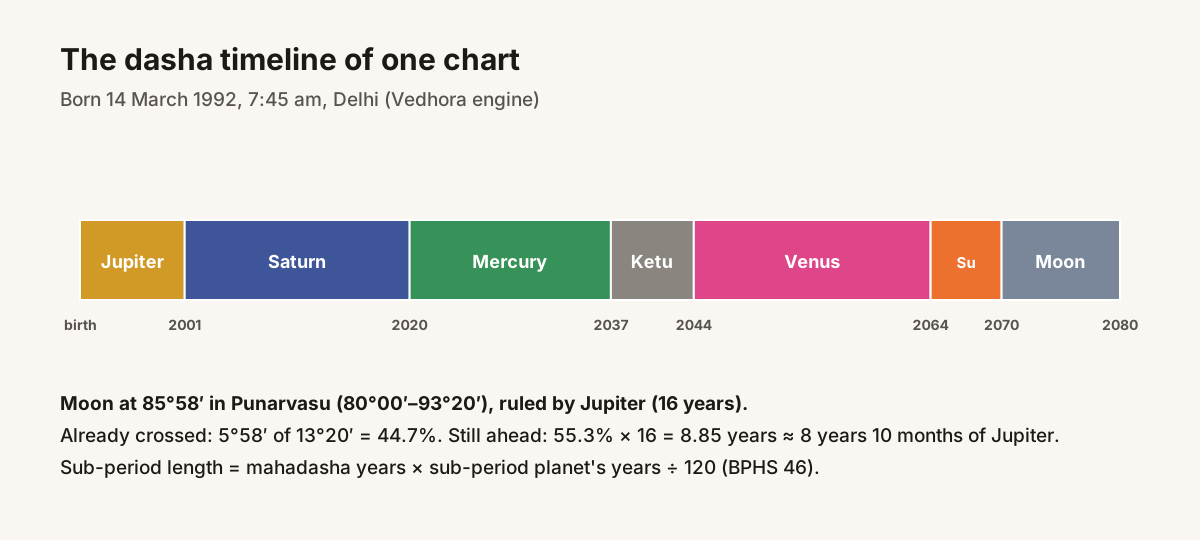
From there, the periods simply follow in order: Saturn (19 years, to 2020), Mercury (17, to 2037), Ketu (7, to 2044), Venus (20, to 2064), and on.
Step three: the sub-periods
Each major period (mahadasha) is divided into nine sub-periods (antardashas), starting with its own planet and following the same order. Each sub-period's length is:
Mahadasha years × sub-period planet's years ÷ 120
Example: Jupiter's sub-period within Jupiter's own period is 16 × 16 ÷ 120 = 2.13 years, about 2 years, 1½ months. Saturn's sub-period in Jupiter's dasha is 16 × 19 ÷ 120 = 2.53 years. Parashara uses the same rule one level deeper for the pratyantar (sub-sub) periods.
Why your birth time matters so much
The Moon moves about 13° a day, a little over half a degree an hour. That changes the balance:
- An hour's error in birth time moves the Moon about 0.55°.
- In a 16-year Jupiter period, that shifts every date by about 8 months.
- In a 20-year Venus period, by about 10 months.
That's why astrologers who time events closely care so much about an accurate birth time, and why birth-time rectification exists.
What the dasha means
The calculation is mechanical, but the meaning isn't. Each period brings forward the planet that rules it: its nature, the houses it rules in your chart, its strength, and its relationship to the other planets. Two people both "in Saturn dasha" can have completely different experiences (how a dasha unfolds).
The takeaway
Your dasha timeline isn't a mystery. It's a clock set by the Moon's position at your birth: nine planets, 120 years, one simple proportion. Once you know the starting balance, every period of your life can be worked out to the day.
Calculate your chart free. Vedhora computes your full Vimshottari timeline from your exact birth time, and its astrologer can tell you what your current period is bringing.
Discover Your True Planetary Placements
Calculate your true Sidereal Lagna, Chandra Rashi, Nakshatras, and 120-year Vimshottari Dasha timeline with verified astronomical precision.
Calculate Your Free Kundli