
Eclipses: Rahu, Ketu and the Shadow
The myth says Rahu swallows the Sun. Varahamihira explained eclipses by the Earth's shadow and still kept Rahu. How Jyotish holds both, and the 2027 eclipses.
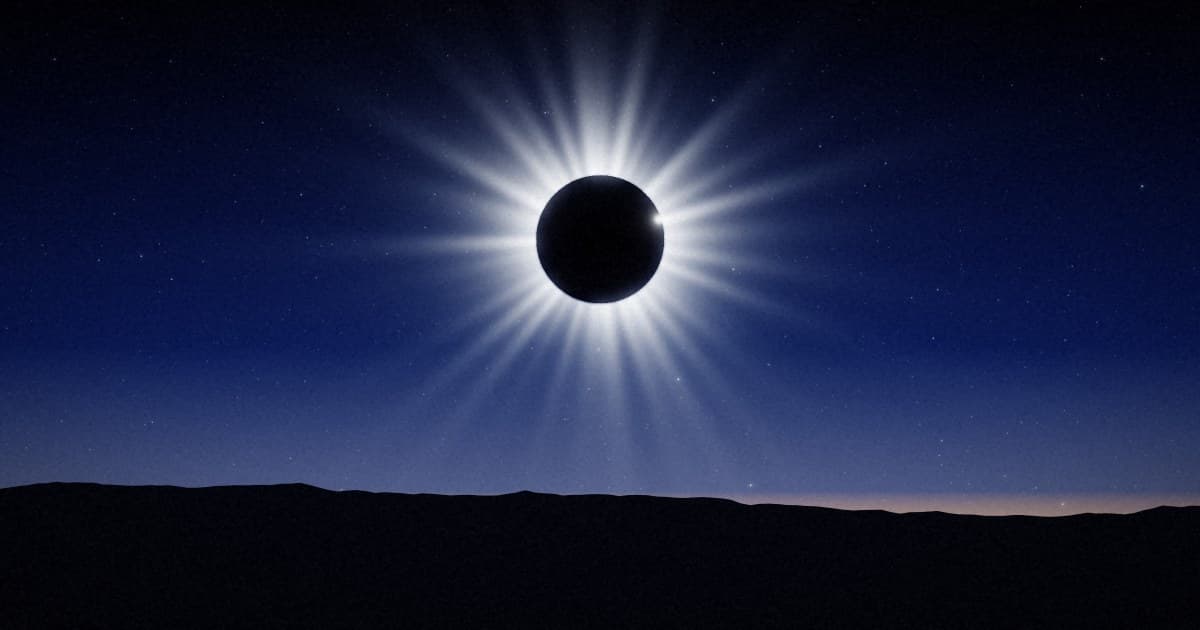
Every Indian child hears the story. During the churning of the ocean, the demon Rahu slipped in among the gods and drank a sip of the nectar of immortality. The Sun and Moon spotted him and raised the alarm. Vishnu hurled his discus and cut off Rahu's head, but the nectar had already touched his throat. The head lived on as Rahu, the body as Ketu, and ever since they've chased the Sun and Moon across the sky, now and then catching and swallowing them for a few minutes.
That's an eclipse, according to the myth. And here's the surprise: the great astronomer-astrologer Varahamihira, writing about fifteen hundred years ago, told the story faithfully, and then explained exactly why it wasn't the cause.
Varahamihira's questions
In the chapter on "Rahu's Course" in the Brihat Samhita, Varahamihira first records the Puranic account. Then he starts asking questions, and they're sharp:
"In case Rahu has a body, moves in the zodiac, possesses only the head and a circular shape, how is it that he seizes the luminaries who are separated from him by 180°, when his own movement is fixed and uniform? If, on the other hand, his motion is not fixed, how is it that his exact position is determined by calculation?"
If Rahu is a giant serpent, he asks, why doesn't he block out half the sky between his head and tail? Why does he strike only at new and full moon?
The answer: the Moon and a shadow
Then he gives the real mechanism, plainly:
"At a lunar eclipse the Moon enters the shadow of the earth, and at a solar eclipse she enters the Sun's disc."
He backs it up with observations anyone could check:
- A lunar eclipse never begins on the Moon's western edge, and a solar eclipse never begins on the Sun's eastern edge, because of the direction the Moon moves.
- The Moon passes "below" the Sun and "obstructs the solar disc like a cloud", which is why a solar eclipse looks different from different countries.
- Earth's shadow is large and the Moon is small, so the "horns" of a partly eclipsed Moon look blunt and those of a partly eclipsed Sun look sharp.
His conclusion is unambiguous: "Rahu is not at all the cause of eclipses." He even dismisses popular tricks for forecasting eclipses. You can't predict one from omens or earthquakes, he says, or from a drop of oil on water a week before. Eclipses are computed, from the Moon's motion and parallax.
So where does Rahu fit?
Here's the beautiful part. Varahamihira didn't throw Rahu away. He found Rahu's true place:
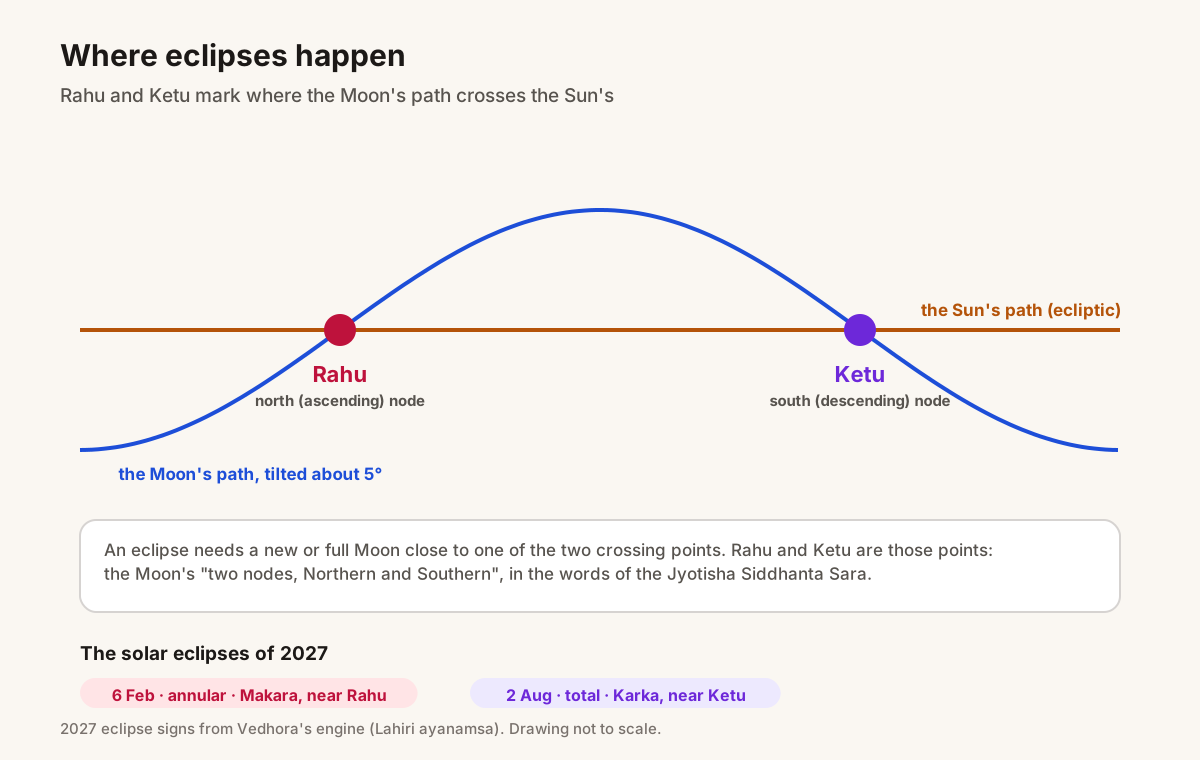
"The Moon has two nodes, Northern and Southern, as a result of her declination ... The Ascending Node is called Rahu."
The Moon's orbit is tilted against the Sun's path. The two cross at two points, the nodes. An eclipse can only happen when a new or full Moon falls close to one of them. So Rahu (the north node) and Ketu (the south node) really are where eclipses happen. They're the places in the sky where light can be swallowed. The myth was pointing at the right spot all along. It just gave it a face.
He also keeps the ritual meaning. By a boon of the Creator, Rahu is said to be nourished by the offerings made at an eclipse, "hence Rahu's presence is assumed at that time."
That's the Jyotish way of holding both truths. The mechanism is astronomy, and the meaning is Rahu and Ketu.
Eclipses in your chart
Astrologically, eclipses are moments when the Sun or Moon, the soul and the mind, are briefly overpowered by the nodes. They matter most when they fall:
- On your natal Sun or Moon, or on your ascendant degree
- In the sign of your Moon, or in the nakshatra of your birth
- Along your natal Rahu–Ketu axis, which reactivates the karmic story of that axis
Traditional guidance during an eclipse is about restraint. Avoid starting new ventures, and spend the time in prayer, mantra, fasting and charity. Bathing and giving after the eclipse are classic ways to "close" it.
The eclipses of 2027
We ran the coming eclipses through Vedhora's engine (sidereal positions, Lahiri ayanamsa). Two stand out:
- 6 February 2027: annular solar eclipse, in Makara (Capricorn), nakshatra Dhanishtha. It falls close to Rahu, which is transiting Capricorn in 2026–27 (read about the transit).
- 2 August 2027: total solar eclipse, in Karka (Cancer), nakshatra Pushya, around 15:36 IST at its greatest. Its path of totality runs across North Africa, with greatest eclipse near Egypt. It falls on the Ketu side of the axis.
There are also three faint penumbral lunar eclipses in 2027, on 21 February (in Simha), 18 July and 17 August (both in Makara). Then comes a partial lunar eclipse on 12 January 2028 in Mithuna (Punarvasu). Penumbral eclipses are subtle, and the Moon barely dims. Most astrologers give them less weight than total or partial ones.
If your Moon, Sun or ascendant sits in Capricorn or Cancer, especially near the eclipse degrees, 2027 is a year to watch your rhythms and avoid forcing big launches near those dates.
The takeaway
The eclipse story shows the maturity of Jyotish. Varahamihira honoured the myth, asked hard questions, explained the mechanism (the Moon and the Earth's shadow) and then gave Rahu and Ketu their proper home as the Moon's two nodes, where every eclipse must happen. Astronomy tells you when and how. Astrology asks what it means for you.
For the deeper story of the two nodes, read Rahu and Ketu: desire and detachment. To see where the 2027 eclipses fall in your chart, calculate your chart free.
Discover Your True Planetary Placements
Calculate your true Sidereal Lagna, Chandra Rashi, Nakshatras, and 120-year Vimshottari Dasha timeline with verified astronomical precision.
Calculate Your Free Kundli