
Varshaphala: Your Birthday Chart
Each year, when the Sun returns to its birth position, a new chart is born: the Varshaphala. How it's cast, what the Muntha shows, and the Lord of the Year.

Your birth chart is fixed for life. But every year, at a precise moment, the sky draws a second chart just for that year: the Varshaphala, the "fruit of the year". It's cast for the instant the Sun returns to the exact degree it held at your birth, and it describes the twelve months that follow.
The method comes from the Tajika system of annual horoscopy. M.S. Mehta's Annual Horoscope (Varshaphala) calls it one of the three branches of Indian astrology, alongside Parashari and Jaimini.
The birth chart still rules
Before anything else, the golden rule. Mehta is emphatic: "All systems of Astrology are subordinate to the main birth chart. The birth chart contains the limitations imposed on our destiny by the laws of karma." He quotes the old saying, "what is not in Parashara is not anywhere else."
So the annual chart can't promise what the birth chart denies. It shows how and when the birth promise plays out this year, and through which doors.
Step 1: Cast the chart for the solar return
Find the moment the Sun's sidereal longitude equals its birth value. As Mehta puts it, the time "when Sun attains the same degrees of longitude every year as it was in the birth horoscope is taken as the nodal point and horoscope erected." Then cast a chart for that moment, usually for the place where you're living that year.
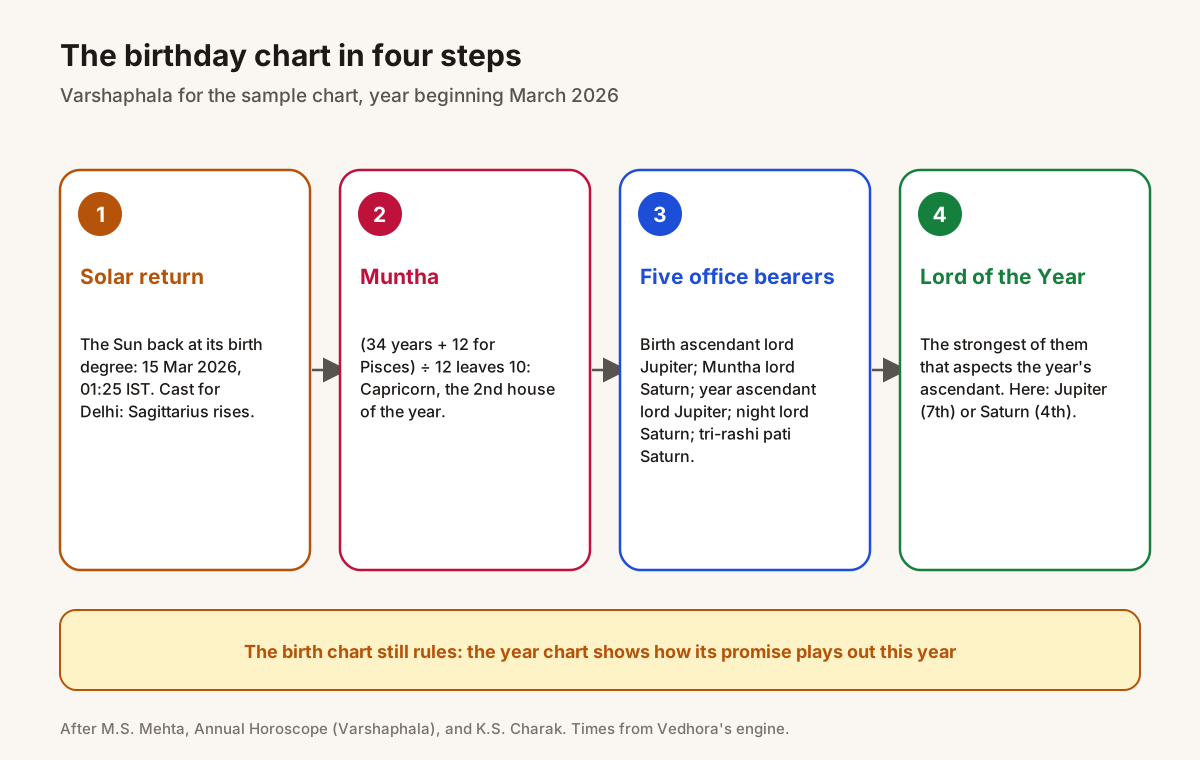
Example: our sample native was born on 14 March 1992 at 7:45 am in Delhi, with the Sun at Pisces 0°01′. Vedhora's engine finds the 2026 solar return at 15 March 2026, 01:25 IST. Cast for Delhi, that gives an annual ascendant of Sagittarius.
Step 2: Locate the Muntha
The Muntha is the special point of the annual chart. K.S. Charak explains it in Elements of Vedic Astrology: "The Muntha is essentially the birth lagna in transit. At the time of birth, the Muntha is at the lagna. Every year it moves by one sign."
The formula: (completed years + birth ascendant sign number) ÷ 12. The remainder is the Muntha's sign, and a remainder of 0 means Pisces.
Example: in March 2026 the native completed 34 years, and the birth ascendant is Pisces (12). (34 + 12) ÷ 12 leaves a remainder of 10, so the Muntha is in Capricorn, the 2nd house of the annual chart.
How to read it, per Charak:
- Houses 9, 10 and 11: "particularly auspicious"
- Houses 1, 2, 3 and 5: good results "through the personal efforts of the native"
- Houses 4, 6, 7, 8 and 12: "particularly inauspicious", and the Muntha's lord suffers there too
Our example's Muntha in the 2nd promises gains through the person's own effort: money, family and speech. That's a year to earn and save.
Step 3: The five office bearers
Each year a planet is appointed Lord of the Year, the Varshesha. Mehta calls it "the engine of the train of events for the particular year." It's chosen from five candidates, the Panchadhikaris or "five office bearers". As Mehta notes, all five are really ascendant lords of one kind or another:
- The lord of the birth ascendant
- The lord of the Muntha sign
- The lord of the annual ascendant
- The day or night lord: the lord of the Sun's sign for a daytime solar return, or the Moon's sign for a night-time one
- The Tri-rashi pati: a special lord from a fixed table for each annual ascendant, different for day and night
The Lord of the Year is the strongest of these that also aspects the annual ascendant (by Tajika aspect). A candidate in the 2nd/12th or 6th/8th position from the ascendant doesn't aspect it, so it can't hold the office.
Example: the birth ascendant lord is Jupiter. The Muntha lord is Saturn (Capricorn). The annual ascendant lord is Jupiter (Sagittarius). The return falls at night, so the night lord is the Moon's sign lord, Saturn (the Moon is in Capricorn). And the Tri-rashi pati for a Sagittarius ascendant at night is Saturn. So the contest is between Jupiter, in the 7th, and Saturn, in the 4th. Both aspect the annual ascendant, and their strength decides who runs the year.
Step 4: Read the year
With the chart, Muntha and year lord in hand, Charak gives guidelines for a good year:
- the lagna lord, the Muntha lord and the year lord are strong
- the Moon and Jupiter are strong and well placed
- natural benefics sit in kendras and trikonas, and malefics in 3, 6 and 11
And a warning: "When the sign identical with the 6th or the 8th house of the birth chart becomes the ascendant in the annual chart, it proves inauspicious, and particularly adverse for health."
In our example the annual ascendant, Sagittarius, is the 10th sign of the birth chart, not the 6th or 8th. It turns the year's focus toward career and public standing.
The annual chart also has its own fast dasha, the Mudda dasha. It's the Vimshottari sequence compressed into a single year, used to time events month by month.
Tips for using your birthday chart
- Check the birth chart's dasha first. The Varshaphala colours it but never overrides it.
- Use the place you actually live. The annual ascendant depends on location.
- Watch the year lord's dignity and aspects. A strong, benefic year lord smooths the whole year.
- Note the Muntha's house. It points to the year's main theme.
The takeaway
The Varshaphala is a second chart, cast each year for the moment the Sun returns to its birth degree. Read it through the Muntha (your ascendant progressing one sign a year), the Lord of the Year (chosen from five office bearers) and the strength of the Moon and Jupiter. It describes the year ahead, always within the limits of the birth chart.
Calculate your chart free to see your natal Sun's exact degree, the anchor of every birthday chart. For the main timing system, read how a dasha unfolds.
Discover Your True Planetary Placements
Calculate your true Sidereal Lagna, Chandra Rashi, Nakshatras, and 120-year Vimshottari Dasha timeline with verified astronomical precision.
Calculate Your Free Kundli