
Rahu and Ketu - Planets of Desire and Detachment
What Rahu and Ketu really are, the myth behind them, why Rahu drives desire and obstacles, why Ketu brings mastery and letting go.
Every other planet in a Vedic chart is a body you could, in principle, point a telescope at. Rahu and Ketu are not. They are points in space — and yet few placements in a chart are felt as strongly. Rahu is the hunger you cannot explain; Ketu is the thing you are strangely good at and strangely indifferent to. Together they draw the line along which a life seems to be pulled.
What Rahu and Ketu actually are
The Moon's orbit around Earth is tilted by about 5° to the ecliptic — the Sun's apparent path through the sky. The two orbits cross at two opposite points: the lunar nodes.
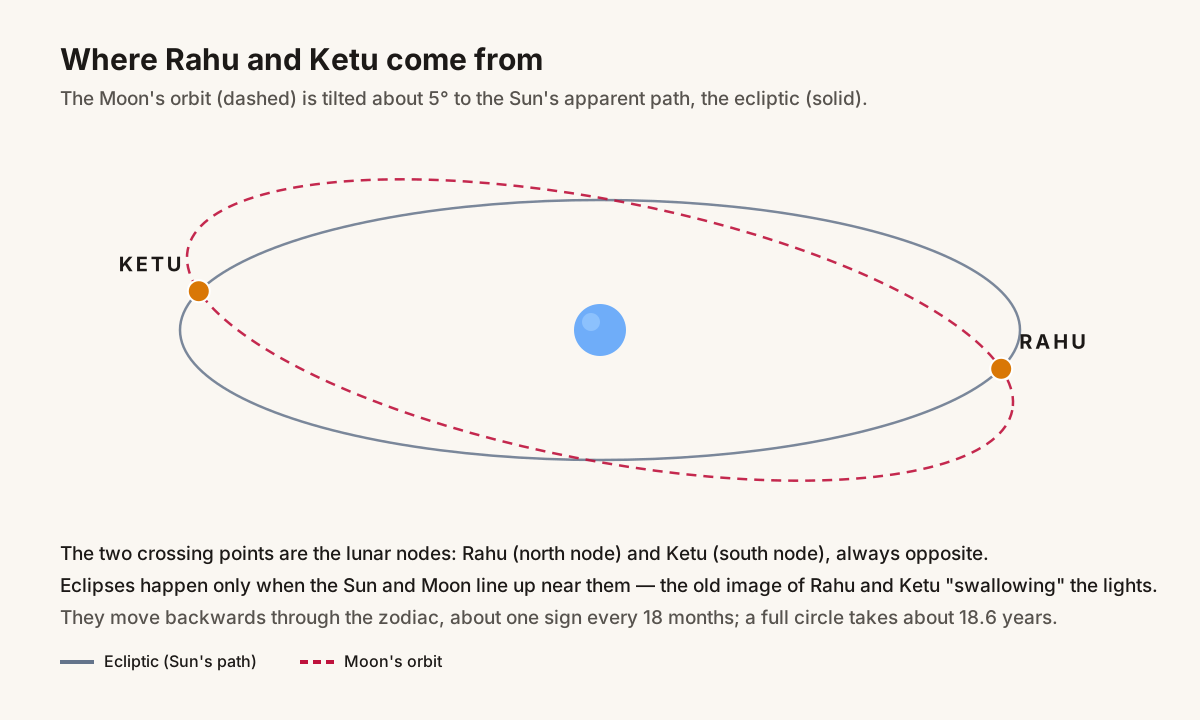
- Rahu is the north node, where the Moon crosses the ecliptic heading north.
- Ketu is the south node, exactly opposite.
Eclipses can only happen when the Sun and Moon line up near these points. That is the astronomy behind one of India's oldest images: the nodes as the ones who swallow the Sun and Moon.
The nodes move backwards (retrograde) through the zodiac, spending about 18 months in each sign and completing the circle in about 18.6 years. They are always exactly opposite: if Rahu is in Taurus, Ketu is in Scorpio.
The myth: one demon, two halves
The Puranas tell the story of the churning of the ocean (samudra manthan), when gods and demons together churned the cosmic ocean for amrita, the nectar of immortality. When it appeared, Vishnu took the form of Mohini to distribute it — only to the gods. One demon, Svarbhanu, disguised himself and sat among them. The Sun and the Moon recognised him and cried out, but he had already taken a sip. Vishnu's discus cut off his head.
Because of the nectar, both halves lived on. The head, which tasted immortality but has no body to digest it, became Rahu. The body, which has no head and so no craving, became Ketu. And they have pursued the Sun and Moon ever since — the eclipses.
The myth is the whole interpretation in miniature:
- Rahu is appetite without satisfaction. A head that keeps swallowing because nothing ever reaches a stomach. Desire, ambition, obsession, the hunger for more.
- Ketu is action without wanting. A body that knows how to move but has no head to want anything. Skill, instinct, detachment, letting go.
Rahu: the engine of desire
Classical texts say Shanivat Rahu — Rahu acts like Saturn. But in practice Rahu is less about delay than about amplification: it magnifies the matters of the house and sign it occupies until they become a fixation.
Rahu signifies:
- strong worldly desires, ambition and the drive to break boundaries;
- the unfamiliar: foreign lands, foreign people, new technology, unconventional paths;
- illusion and smoke — confusion, anxiety, the fear of missing out;
- sudden rises and sudden falls.
How Rahu creates obstacles. Here is the paradox people feel: the very area Rahu fixates on is also where life feels most uncertain. Rahu in the 10th can give a remarkable career drive — and a restless sense that no achievement is enough. Rahu in the 7th draws you to partners who are different, exciting, from another world — and can make relationships intense and unsettled. The obstacle is rarely an external wall. It is the hunger itself, which can make us overreach, chase the wrong target, or never feel arrived.
Rahu at its best is the innovator, the person who goes where their family never went, and the courage to want something new. Many people who rise far from their origins have a strong Rahu.
Ketu: the wisdom of letting go
The texts pair Kujavat Ketu — Ketu acts like Mars: sharp, sudden, cutting. Ketu is also the moksha karaka, the significator of liberation, and its symbol is the flag (dhvaja) — something that points upward.
Ketu signifies:
- mastery carried in from before — an instinctive skill that came too easily to value;
- detachment, disinterest, the feeling of "I have done this already";
- spirituality, intuition, research, the hidden and the subtle;
- sudden separations and losses that, in hindsight, free us.
In the house Ketu occupies, you often have real ability and surprisingly little hunger. Ketu in the 2nd can give a natural way with words or money, yet little attachment to wealth. Ketu in the 4th can bring a sense of not quite belonging at home — and an inner home found elsewhere.
The axis: from what you know to where you are going
Because they are always opposite, Rahu and Ketu are best read as a pair, across six axes of the chart:
- 1st–7th: self and others — learning to balance independence with partnership.
- 2nd–8th: what you own and what you share — security versus transformation.
- 3rd–9th: your own efforts and beliefs versus higher learning, teachers and faith.
- 4th–10th: home and inner life versus career and public role.
- 5th–11th: personal creativity, children and joy versus networks, gains and goals.
- 6th–12th: service, work and health versus release, rest and the inner world.
A traditional way of seeing it: Ketu shows the direction you are coming from — comfortable, known, already mastered. Rahu shows the direction you are being pulled towards — unfamiliar, magnetic, where growth lies. Life tends to ask us to integrate both ends rather than run to one.
Rahu and Ketu periods
In the Vimshottari dasha system, Rahu's period lasts 18 years and Ketu's 7. These are often turning points.
- A Rahu mahadasha frequently brings ambition, change of environment, foreign connections, new fields — and with them restlessness. The best way through is to give the hunger a worthy target and keep your footing: routine, honest advice, a clear head before big leaps.
- A Ketu mahadasha frequently brings simplification: endings, a turning inward, a loss of interest in what once mattered, a pull towards spirituality or deep study. The best way through is to let go gracefully, and use the clarity it brings.
Neither period is "good" or "bad". Their results depend entirely on the house and sign of the node, its dispositor (the lord of the sign it sits in), and the planets it joins or aspects.
Strength, signs and transits
Traditions differ on where the nodes are strongest. In the Parashari convention followed by B.V. Raman and many modern astrologers, Rahu is exalted in Taurus and debilitated in Scorpio, with Ketu the reverse; other schools prefer Gemini and Sagittarius. In practice, astrologers look more at the lord of the sign the node occupies: Rahu and Ketu give the results of their dispositor, coloured by their own amplifying or detaching nature.
Their transit matters too, because it lasts about a year and a half per sign and always activates a pair of houses together. We covered the Rahu–Ketu move into Capricorn and Cancer separately.
Working with Rahu and Ketu
The traditional remedies — mantras to Durga or Ganesha, charity, fasting on particular days — are best understood as practices of attention. A practical version:
- For Rahu: name what you are actually hungry for. Give ambition a concrete, worthwhile target. Be careful with shortcuts, intoxicants and people who promise too much. Ground yourself in routine.
- For Ketu: honour the skill you take for granted — someone else needs it. Let go of what has run its course without bitterness. Make room for quiet, study or meditation.
To see where your own nodes sit, which houses they activate, and whether a Rahu or Ketu period is running for you, calculate your chart free. For a reading of your nodal axis in the context of a specific question, ask the astrologer.
Rahu and Ketu have no bodies, but they shape the direction of a life more than almost anything else in the chart. One hungers, one releases — and wisdom, as so often in Jyotish, lies in learning to hold both.
Discover Your True Planetary Placements
Calculate your true Sidereal Lagna, Chandra Rashi, Nakshatras, and 120-year Vimshottari Dasha timeline with verified astronomical precision.
Calculate Your Free Kundli