
Comets: The Sky's Uninvited Guests
In Jyotish, comets are ketus: banners of light that can't be calculated, only read. How Varahamihira sorted them, which were welcome and their link to Ketu.
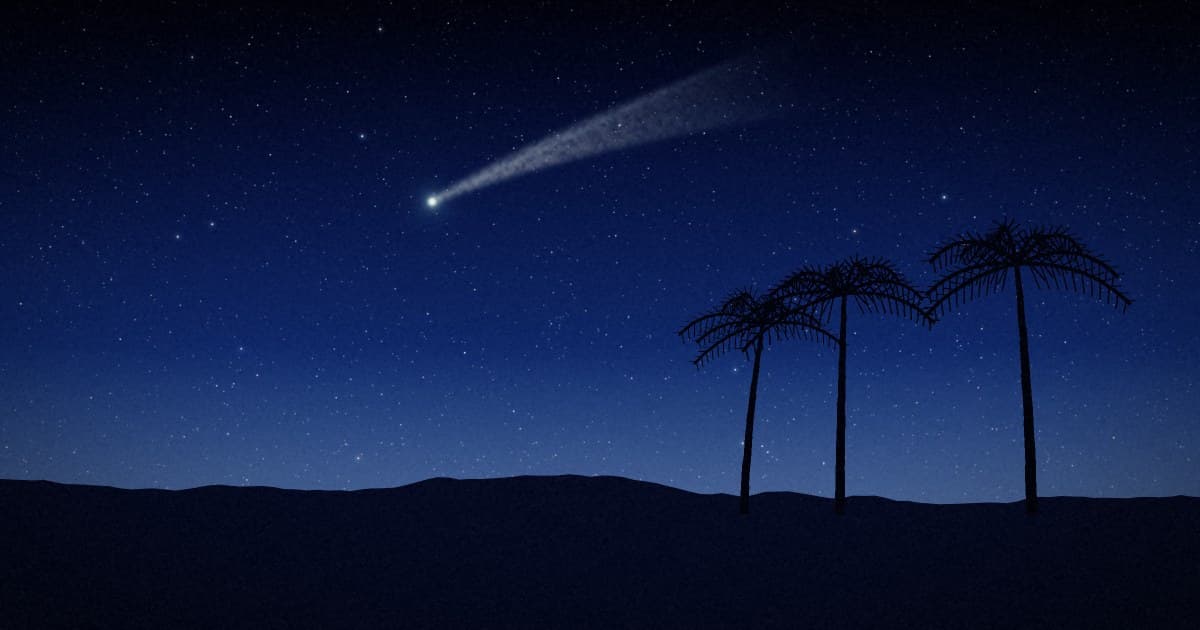
Most of the sky runs like clockwork. The Sun, Moon and planets keep their paths, and a good astronomer could predict an eclipse decades ahead. But every so often something turns up that no table predicted: a smudge of light with a long, ghostly tail, hanging among the stars for a few weeks and then gone.
The old Indian astronomers had a word for these visitors: ketu, a banner, a bright sign. In the Brihat Samhita, Varahamihira gives them a whole chapter.
The one thing you can't calculate
Varahamihira says it plainly. You can't work out the rising or setting of comets by calculation. Calculation was the pride of Indian astronomy, so this is a remarkable thing to admit.
His reason is philosophical as much as practical. Comets are portents. A portent is a sign that arrives unannounced, and if you could compute it, it would stop being a portent.
He then sorts the apparitions into three classes:
- Celestial ketus appear among the stars. These are the comets we know.
- Atmospheric ketus are fire-like glows seen on flagstaffs, weapons, rooftops and trees, and even on horses and elephants. They sound remarkably like the eerie electric glow sailors would later call St. Elmo's fire.
- Terrestrial ketus are everything else.
He's careful about false alarms too. A glow "despite the absence of fire" counts as a ketu, except for glow-worms, phosphorescent lights over graves, gems, crystal and marble. Even a sky-omen needed a process of elimination.
One comet or a thousand?
The sages disagreed wildly about how many comets there were. Parashara spoke of 101 ketus and Garga of 1,000. The sage Narada said there is only one ketu, appearing in many forms and places.
Varahamihira's answer is pure common sense:
"What difference does it make whether there is a single Ketu or many? Under any circumstance, its effects ought to be declared through the positions of its appearance and setting, contact with planets or asterisms, smoky mantle and colours."
In other words, stop counting and start observing. Where it rises, which stars and planets it touches, how hazy it is and what colour it is: that is what tells you its meaning.
A field guide to comets
The chapter still preserves the old catalogue, and it's a strange and vivid one:
- The sons of Mars, sixty in number, called Kaukkuma
- The Ganakas, eight comets that "look like a cluster of stars"
- The Kabandhas, ninety-six "sons of Kala" (Time), shaped like a headless body
- Kapalaketu, which appears in the east at new moon
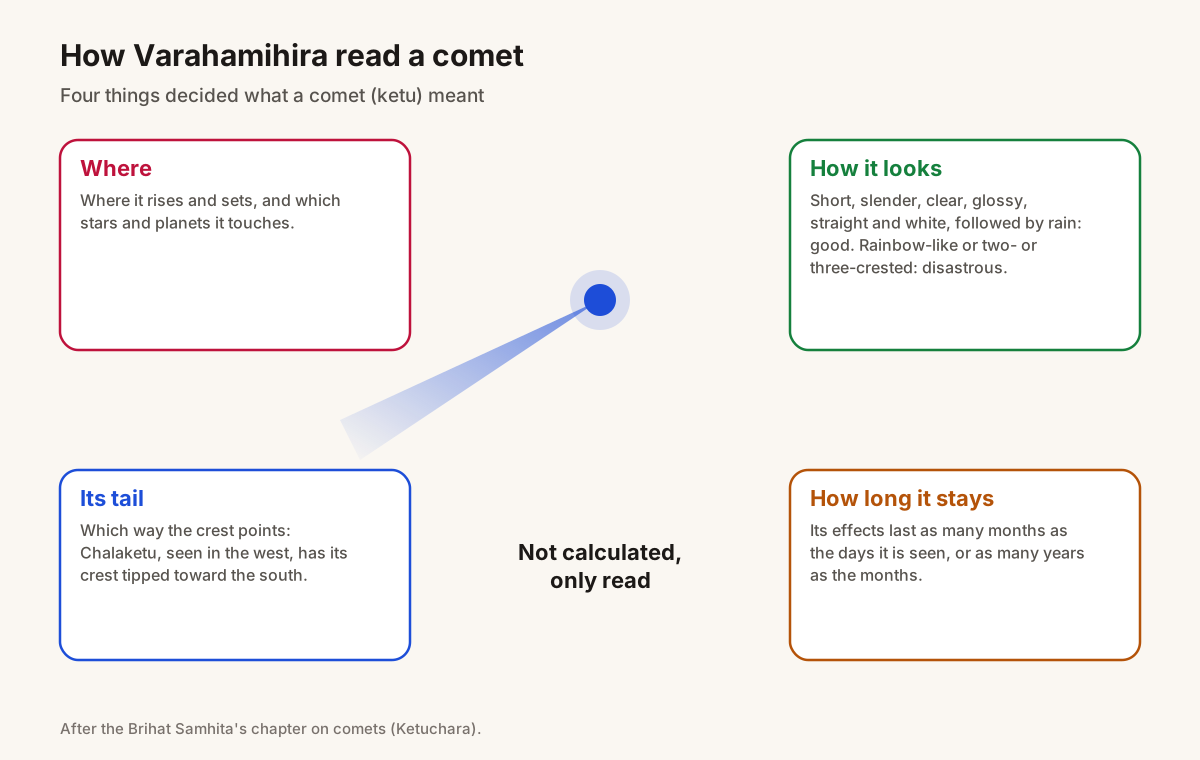
- Chalaketu, seen in the west, with its crest tipped toward the south
- Shvetaketu, which rises in the east at midnight
- Kumuda, white, visible for just a single night in the west
- Dhruvaketu, whose motion, size, colour and shape follow no fixed rule
Taken together, it's an early attempt to classify comets by appearance: tail direction, colour, brightness and when they appear.
Not every comet is a bad omen
We tend to remember comets as harbingers of doom. Varahamihira doesn't:
"If a Ketu be short, slender, clear, glossy, straight, white and visible but for a short while, and if its appearance be immediately followed by a rain, there would be abundance of food crops and happiness."
The opposite type, a comet that is large, hazy, crooked or long-lasting, is a Dhumaketu, a "smoke-banner". It's considered disastrous, "all the more so when it resembles the rainbow or is possessed of two or three crests."
He also gives a rule of thumb for how long a comet's influence lasts. Its effects last as many months as the days it stays visible, or as many years as the months it stays visible. And the effects only begin after its first three fortnights.
The comet and the shadow planet
If you know Vedic astrology, the name will ring a bell. Ketu is also one of the nine grahas in your birth chart, the south node of the Moon, paired with Rahu.
The two Ketus are different things. The node in your chart is a calculated point, the place where the Moon's path crosses the Sun's. You can find it for any date, past or future. The comet is the opposite, something no calculation can find. Yet they share a family resemblance. Both are sudden, detached and unpredictable, and both bring endings and breakthroughs that seem to come from nowhere. The classical texts even give the graha comet names. The Horasara of Prithuyasas lists Ketu's other names as Shikhin (the crested one), Dhvaja (the banner), Dhuma (smoke) and Anala (fire). For more on its nature, read Rahu and Ketu: desire and detachment.
The takeaway
Indian astronomy was confident enough to calculate eclipses and honest enough to admit what it couldn't calculate. Comets were the sky's uninvited guests: not computed, only read, from their place, their colour, their tail and the length of their stay. Varahamihira's advice still works as a way of looking at the unexpected. Don't panic about the omen. Observe it carefully, and read it in context.
For the other great "shadow" event of the sky, read eclipses: Rahu, Ketu and the shadow. Or calculate your chart free to see where Ketu sits in yours.
Discover Your True Planetary Placements
Calculate your true Sidereal Lagna, Chandra Rashi, Nakshatras, and 120-year Vimshottari Dasha timeline with verified astronomical precision.
Calculate Your Free Kundli