
Gulika: Saturn's Shadow Point
Gulika, the 'son of Saturn', is the key shadow sub-planet. How Parashara's eighth-of-the-day rule fixes it, its effect in each house, and Gulika Kalam.

Beyond the nine planets, classical charts carry a set of shadowy extras called upagrahas, "sub-planets". They have no bodies in the sky. They're points of time and arc, worked out from the Sun or from the length of the day. The most important of them is Gulika, and on one thing every text agrees. As R. Santhanam writes in Essentials of Predictive Hindu Astrology: "Everyone agrees Gulika is Saturn's son."
If you've ever checked Gulika Kalam in a daily panchanga, you've already met him.
Saturn's eighth of the day
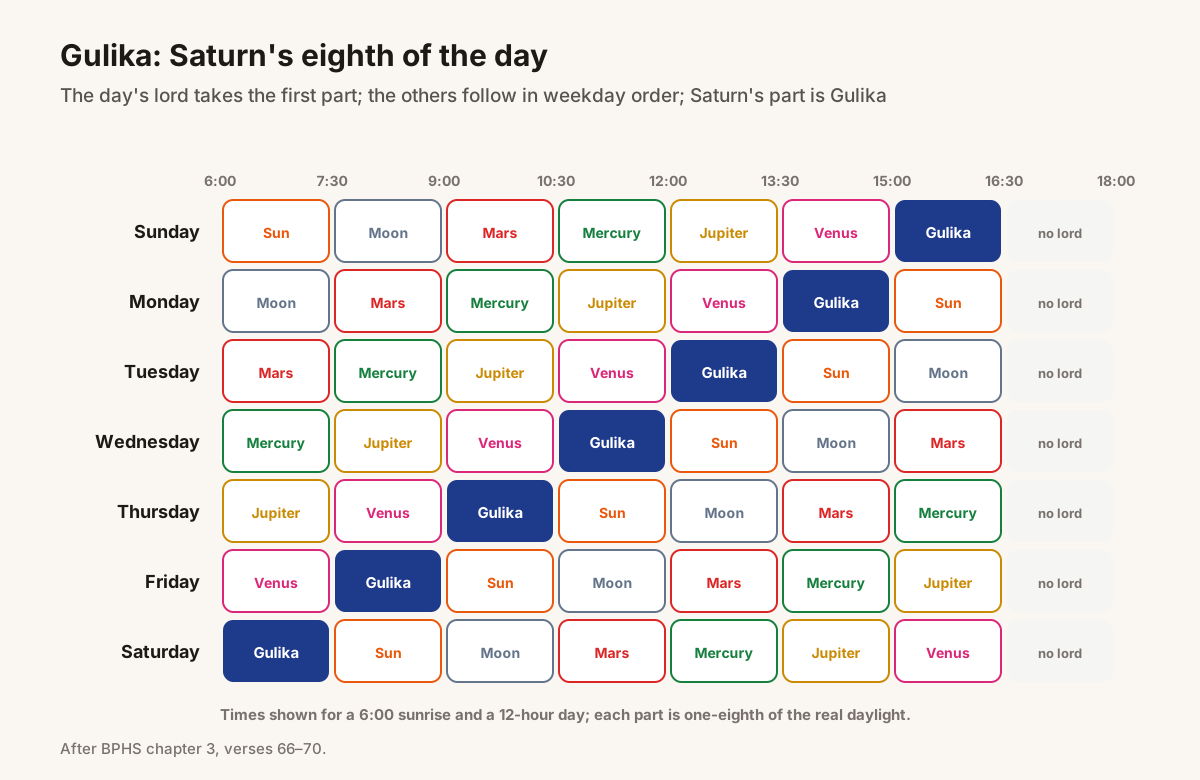
Parashara gives the rule in chapter 3 of the Brihat Parashara Hora Shastra (BPHS): "Divide the day duration (of any week day) into eight equal parts. The eighth portion is Lord-less. The seven portions are distributed to the seven Grahas commencing from the Lord of the week day. Whichever portion is ruled by Śani, will be the portion of Gulik."
So the day's lord takes the first eighth, and the others follow in weekday order. That puts Saturn's portion:
- Sunday: the 7th eighth of the day
- Monday: the 6th
- Tuesday: the 5th
- Wednesday: the 4th
- Thursday: the 3rd
- Friday: the 2nd
- Saturday: the 1st, starting at sunrise
With sunrise at 6:00 and a 12-hour day, Sunday's Gulika runs from 15:00 to 16:30 and Saturday's from 6:00 to 7:30. At night the same eight-fold split applies, but the first part goes to the lord of the fifth weekday counted from the day's lord.
The other planets' portions have names too: the Sun's is Kaala, Mars's Mrityu, Mercury's Ardhaprahara and Jupiter's Yamaghantaka. That last one is the Yamaganda of the panchanga.
From a window of time to a point in the chart
Gulika Kalam is a window. Gulika in a birth chart is a point: the degree rising on the eastern horizon at Gulika's moment. BPHS says: "The degree, ascending at the time of start of Gulik's portion ... will be the longitude of Gulik."
Not every text agrees on which moment. The Jataka Parijata assigns these points "at the end of their respective muhurtas," and the Uttara Kalamrita uses the end of Saturn's portion too. Santhanam prefers Parashara's start, but advises readers to decide "after his own vigorous tests."
There's also Mandi. Some texts treat Mandi and Gulika as two sons of Saturn with different methods. Mandi rises a set number of ghatis after sunrise: 26 on Sunday, 22 on Monday, down to 2 on Saturday, for a 30-ghati day. Santhanam concludes the two are one entity under two names. M. Ramakrishna Bhat, in Fundamentals of Astrology, keeps them separate. He notes that Mantreswara used Mandi to verify the ascendant and judge longevity.
A worked example
Our sample native was born on Saturday, 14 March 1992, at 7:45 am in Delhi. Sunrise was 6:32 and sunset 18:29.
On a Saturday, Saturn owns the first eighth of the day, so Gulika's portion ran from 6:32 to 8:01. The native was born inside it, during that day's Gulika Kalam.
- By Parashara's rule (the start, 6:32), the rising degree was Aquarius 28°35′. Gulika falls in the 12th house, in Aquarius.
- By the end-of-portion rule (8:01), the rising degree was Aries 0°02′. Gulika falls in the 2nd house.
Ninety minutes apart, two different houses. It's worth knowing which method your software uses.
What Gulika does in each house
Gulika behaves like its father. "In the matter of effects Mandi is similar to Saturn," writes Ramakrishna Bhat. Like any malefic, it does well in the upachaya houses, the houses of growth. BPHS says:
- 3rd house: "charming in appearance, will head a village, be fond of virtuous men and be honoured by the king"
- 6th house: "devoid of enemies, be strong-bodied, splendourous, liked by his wife"
- 10th house: "endowed with sons, be happy ... fond of worshipping gods and fire and will practice meditation and religion"
- 11th house: "a leader of men, be helpful to his relatives"
In the other eight houses, BPHS describes struggle in that house's affairs: illness in the 1st, poverty in the 2nd, unhappiness in the 4th, trouble with children in the 5th, strain in marriage in the 7th, hardship in the 8th, ordeals in the 9th and losses in the 12th.
The rule that softens it
House results are only the start. Santhanam gives the key modifier: "If Gulika's Rasi dispositor is endowed with dignity, like exaltation, Moolatrikona, own sign, good shadbala etc. the evil results attributed to Gulika will modify, and favourable results will increase." A weak, debilitated dispositor makes the harm "pronouncedly felt."
Ramakrishna Bhat goes further: "Mandi cannot be rejected outright as a perpetrator of bad things. At times he does good things also." When the lord of Mandi's sign is strong and well placed in a kendra or trikona, he promises fame and status.
There's also a lovely detail from the Jatakalankaram, quoted in the notes to BPHS: Gulika's own sign is Aquarius. Saturn, they say, "has given his Mooltrikon to his son."
In our example, both methods land well. By Parashara's rule, Gulika sits in Aquarius, its own sign, and its dispositor Saturn is in its own sign too. By the other rule, Gulika's dispositor is Mars, exalted. Either way, the dispositor is dignified, which takes the edge off.
When Gulika acts
Gulika has no dasha of its own. As Santhanam puts it, "his role will have to be fulfilled through the periods of the planets he is connected with." So watch:
- the periods of planets conjunct Gulika
- the period of Gulika's dispositor
- transits of malefics over Gulika's degree
Gulika Kalam in daily life
The daily window matters in electional astrology. Ramakrishna Bhat notes that "the rising of Gulika is strictly avoided in Electional astrology or Muhurta Sastra." A verse quoted in a commentary on the Jaimini Sutras calls Gulika's time sarva karya vinashakrit, "destroyer of all undertakings". That's why every panchanga marks it, alongside Rahu Kalam and Yamaganda (how to choose a muhurta).
The takeaway
Gulika is Saturn's son: the degree rising at the start of Saturn's eighth of the day, or at its end in some texts. It harms in most houses but helps in the 3rd, 6th, 10th and 11th. A dignified dispositor softens it, and its effects arrive through the periods of the planets it touches. In daily life, its window is one to keep free of new beginnings.
Calculate your chart free, then find your birth weekday and time in the list above to locate your own Gulika. For the day's other limbs, read the panchanga explained.
Discover Your True Planetary Placements
Calculate your true Sidereal Lagna, Chandra Rashi, Nakshatras, and 120-year Vimshottari Dasha timeline with verified astronomical precision.
Calculate Your Free Kundli