
Lal Kitab: The Red Book of Simple Remedies
Lal Kitab reads the chart its own way and prescribes remedies anyone can do, like coins in a river or 43 days of one act. How the Red Book works, used wisely.
Most astrological remedies ask a lot: long rituals, expensive gemstones, priests and ceremonies. Lal Kitab, the "Red Book", is famous for the opposite. Its remedies are small, practical and often free. Feed a cow. Drop a coin in a river. Wear a saffron mark on your forehead for 43 days.
It's one of the most popular systems in North India, and one of the least understood. Here's how it works.
A different way of reading the chart
Lal Kitab was originally written in Urdu and is often called the "Wonder Book of Astrology". The edition by Lalit Sharma and Krishna Jagrit explains that the first part of the book is its grammar (vyakaran). Its biggest departure from classical Jyotish is simple:
The birth chart is drawn in the traditional way, "but the only important difference is that the Rashis are not considered."
In Lal Kitab the houses are fixed. The 1st house is always treated as Aries, the 2nd as Taurus, and so on to the 12th as Pisces, whatever sign is actually rising. Planets are read by house, not by sign.
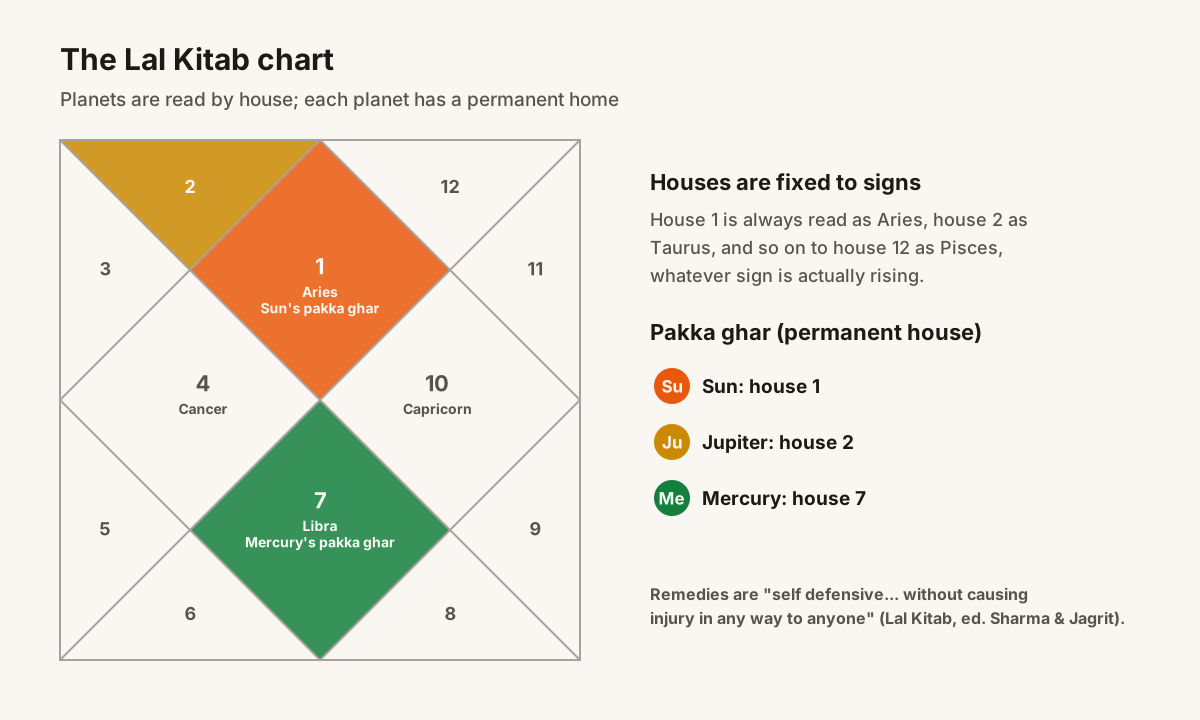
Pakka ghar: every planet's permanent home
Lal Kitab gives each planet a pakka ghar, a permanent house where it naturally belongs:
- The 1st house is the pakka ghar of the Sun, which is also where Lal Kitab considers it exalted. The 7th, opposite, is where it is weakest.
- The 2nd house is the pakka ghar of Jupiter.
- The 7th is the pakka ghar of Mercury. A Mercury placed there is said to protect health so well that even powerful planets in the angles, the 2nd or the 11th can't harm it.
The rule built on this is easy to remember. Planets in their pakka ghar, their own house or their exaltation give good results. Planets in an enemy's house or their debilitation give bad ones. And if a planet's pakka ghar is occupied by its enemy while the planet sits elsewhere, it "will destroy the good results of the house in which he stands placed."
Good houses and bad houses
Lal Kitab also lists, for each planet, the houses where it does well. For the Sun: good results in houses 1 to 5, 8, 9, 11 and 12, and difficulty in the 6th, 7th and 10th. Its friends are the Moon, Jupiter and Mars, and its enemies Saturn, Venus, Rahu and Ketu. The book even notes combinations that lift a planet. Mars in the 6th with Ketu in the 1st, for example, makes the Sun "produce results of an exalted planet."
It also asks you to read certain houses together. The 1st, 7th, 8th and 11th "must be examined together as they are mutually interested."
The remedies: small acts, steady time
The heart of Lal Kitab is its upay, remedies. The book describes them as "completely self defensive against the evils created by the planets without causing injury in any way to anyone concerned." They protect you without harming anyone else.
Many are tied to a specific planet in a specific house. Examples from the book:
- Moon in the 2nd: give green clothes to small girls, continuously for 43 days. Place something of the Moon, such as a square piece of silver, in the foundation of your house.
- Moon in the 6th: serve milk to your father with your own hands. Don't drink milk at night, and don't give milk away as charity except at places of worship.
- Mercury in the 4th: apply a saffron (kesar) tilak on your forehead regularly for 43 days. Offer jaggery to monkeys.
- Jupiter in the 10th: throw copper coins into a running river for 43 days. Offer almonds at religious places, and wear a saffron tilak.
Notice the pattern. Each remedy acts out the planet's own symbolism. The Moon is milk, silver, mothers and girls. Jupiter is saffron, temples and teachers. Mercury is green and quick-witted creatures. And many are done for 43 days, long enough to become a habit.
Using Lal Kitab wisely
Lal Kitab is powerful folk wisdom, and it works best with some care:
- Match the remedy to the placement. Lal Kitab remedies are house-specific. A remedy for Jupiter in the 10th isn't meant for Jupiter in the 4th.
- Do one remedy at a time, for the full period, rather than ten at once.
- Do it yourself. These remedies are about your own action and intention.
- Keep it humane and simple. Anything that harms another person or creature isn't in the spirit of the book.
- Combine it with classical guidance. Lal Kitab is one tradition within Jyotish, and many astrologers use its remedies alongside the classical mantras, charity and conduct for the same planet.
That's how Vedhora approaches it too. When a reading suggests a remedy, it picks the planet that needs support in your chart, offers simple classical practices first, and adds a Lal Kitab practice only when your chart has the exact placement it was written for.
The takeaway
Lal Kitab turns astrology into everyday action: a house-based reading of the chart, a permanent home for each planet, and remedies that are small, symbolic and repeated until they change you. Used with care, the Red Book is one of the most practical gifts in the Jyotish tradition.
Calculate your chart free and ask Vedhora's astrologer which planet in your chart needs support, and the simple remedy that fits it. For a remedy given in the classical texts for a sensitive birth point, read Gandanta: the knot between water and fire.
Discover Your True Planetary Placements
Calculate your true Sidereal Lagna, Chandra Rashi, Nakshatras, and 120-year Vimshottari Dasha timeline with verified astronomical precision.
Calculate Your Free Kundli