
Gandanta: The Knot Between Water and Fire
Gandanta marks the three points where water signs end and fire signs begin. Tithi, nakshatra and lagna gandanta, how narrow it is, and the shanti.
Hold a rope at a knot and you feel the tension of two strands pulling against each other. Jyotish has a word for the knots in the zodiac: gandanta, from ganda (knot) and anta (end). They are the three places where a water sign ends and a fire sign begins.
They're treated with real seriousness in the classics. They're also much narrower than most people think.
Where the knots are
The zodiac has three water-to-fire junctions:
- Cancer to Leo: where the nakshatra Ashlesha ends and Magha begins
- Scorpio to Sagittarius: where Jyeshtha ends and Mula begins
- Pisces to Aries: where Revati ends and Ashwini begins
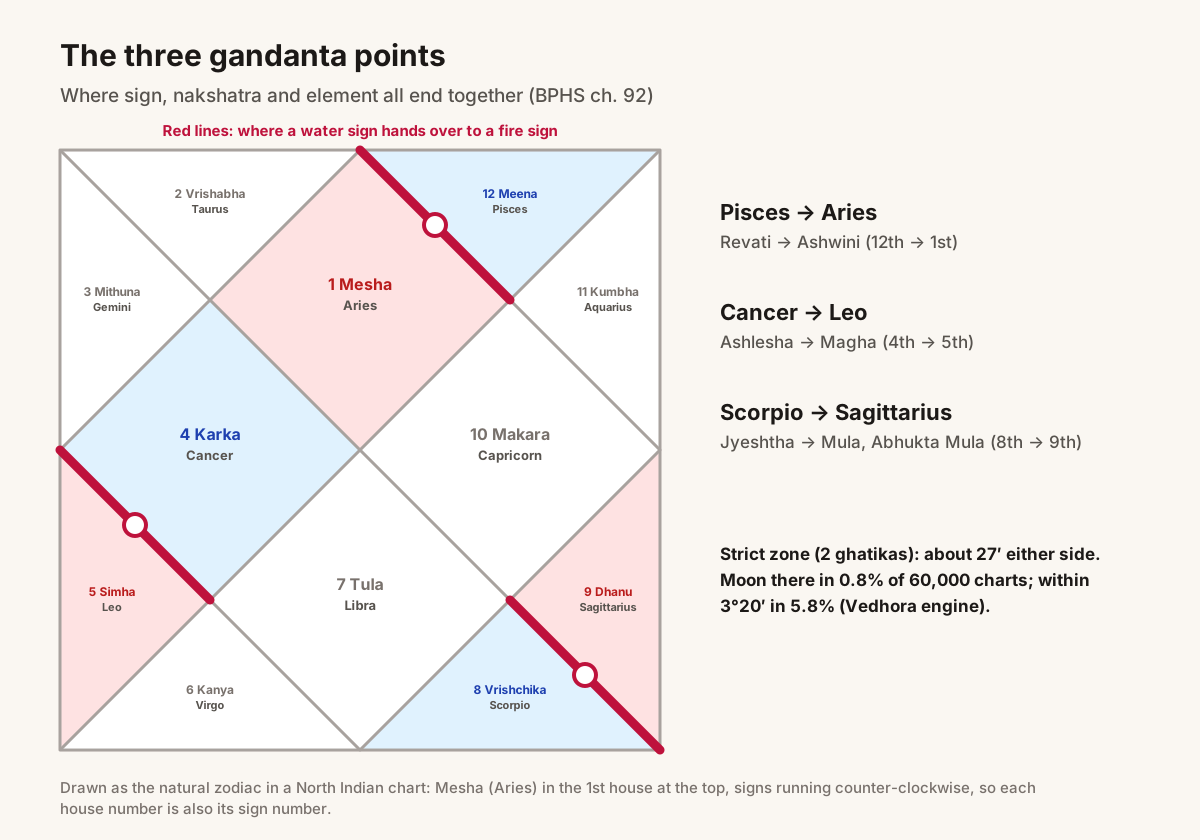
There's a neat structural reason these three points stand out. Nakshatras are 13°20′ wide and signs are 30°, so their boundaries rarely line up. They coincide in only three places in the whole zodiac, every 120°, at exactly these junctions. Here a sign, a nakshatra and an element all end at once. It is the zodiac's double ending.
Jataka Parijata calls the end of Cancer, Scorpio and Pisces Riksha-Sandhi, the junction of stars, and also Pragandanta: "the end of the elbow, a vulnerable part, a critical period." A joint is where a body bends, and it's also where it's easiest to injure.
Three kinds of gandanta
Parashara (Brihat Parashara Hora Shastra, chapter 92) describes three:
- Tithi gandanta: the last 2 ghatikas of the Purna tithis (the 5th, 10th and 15th) and the first 2 ghatikas of the Nanda tithis (the 1st, 6th and 11th).
- Nakshatra gandanta: the last 2 ghatikas of Revati, Ashlesha and Jyeshtha, and the first 2 ghatikas of Ashwini, Magha and Mula.
- Lagna gandanta: the last half-ghatika of Pisces, Cancer and Scorpio rising, and the first half-ghatika of Aries, Leo and Sagittarius rising.
A ghatika is 24 minutes. Put in practical terms:
- Two ghatikas of a nakshatra is about one-thirtieth of it. For the Moon, that's roughly 27 arc-minutes on either side of the junction.
- Half a ghatika for the rising sign is about 12 minutes of clock time.
So the classical gandanta is a very narrow zone.
Abhukta Mula: the tightest knot
One junction is singled out. Parashara (chapter 94) explains that the deity of Jyeshtha is Indra and the deity of Mula is a Rakshasa: "as both the deities are inimical to each other, this Gandanta is considered as the most evil." The last 6 ghatikas of Jyeshtha and the first 8 of Mula are called Abhukta Mula, and the texts prescribe the most elaborate remedies for it.
How common is it?
In 60,000 birth charts we ran through Vedhora's engine, the Moon was within the whole first or last pada of a junction (3°20′, the wider zone many astrologers watch) in 5.8% of charts. Within the strict classical zone of about 27′, it was 0.8%, fewer than one in a hundred.
If someone has told you that you're "gandanta" because your Moon is somewhere in Revati or Ashwini, the classical definition is far tighter than that.
What it means
Parashara's own wording is stark. Birth, travel and auspicious events such as marriage in gandanta "are likely to cause death of the person concerned." Read that in context. These texts used death for serious danger, and they always gave a remedy. The point of the passage is that a gandanta moment needs care and protection, not despair.
In a birth chart, astrologers read a planet in gandanta, especially the Moon or the lagna, as standing at a point of transition and intensity. It is not quite in one sign or the other. It can bring early-life hardship or upheaval, and it often brings a strong pull towards transformation. Fire is born out of water at these points. What dissolves gives way to what begins.
The traditional shanti
Parashara (chapter 92) gives a full remedy for a birth in gandanta:
- The father should see the child only after the period of sutaka (ritual impurity after birth) ends, or after the remedy has been done.
- Charity: a bullock for tithi gandanta, a cow with its calf for nakshatra gandanta, gold for lagna gandanta.
- Abhisheka (ritual bathing) of the child together with the father if born in the first half of the gandanta, or with the mother if in the second half.
- Worship of the deities of the tithi, nakshatra or lagna concerned, followed by havan (fire offering), and feeding Brahmins as one's means allow.
Today families often have a gandanta shanti puja performed in the same spirit. The texts' message is clear: there is always something to be done.
For choosing times
Because gandanta is a moment of junction, Parashara advises against starting travel or auspicious ceremonies in it. This is one reason a good muhurta avoids the ends of Revati, Ashlesha and Jyeshtha and the starts of Ashwini, Magha and Mula (the five limbs of time).
The takeaway
Gandanta is real, classical and precise. These are the zodiac's three knots, where sign, nakshatra and element all turn over at once. It's also narrow: by the strict definition, fewer than one chart in a hundred has the Moon there. And when it does apply, the tradition answers with remedy, not fear.
Calculate your chart free and ask Vedhora's astrologer whether your Moon or lagna is truly in gandanta. For more on the lunar mansions themselves, see the 27 nakshatras explained.
Discover Your True Planetary Placements
Calculate your true Sidereal Lagna, Chandra Rashi, Nakshatras, and 120-year Vimshottari Dasha timeline with verified astronomical precision.
Calculate Your Free Kundli