
The Gods Behind the Nine Planets
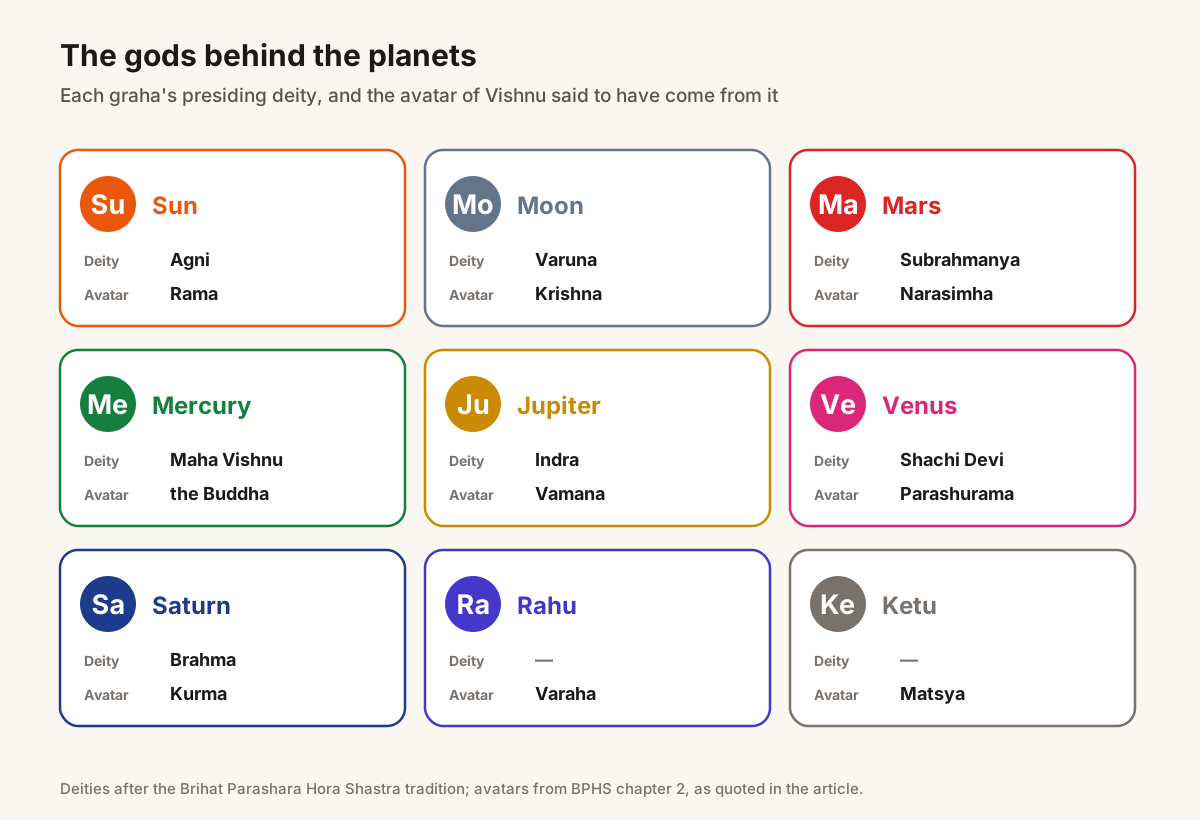
Each graha has a presiding deity, and in Parashara each gave rise to an avatar of Vishnu: Rama from the Sun, Krishna from the Moon. The gods behind them.
In Vedic astrology the planets are not just balls of rock and gas. They are grahas, "seizers", divine powers that take hold of a life for a time. Each one is a deity in its own right, and behind each stands further layers of the divine.
Knowing those layers isn't just mythology. It's the backbone of traditional remedies. When an astrologer says "worship Hanuman for Mars," there's a long chain of reasoning behind it. Here it is.
Layer one: the presiding deities
The Brihat Parashara Hora Shastra (BPHS) names a presiding deity, or adhidevata, for each of the seven classical planets:
- Sun: Agni, the god of fire
- Moon: Varuna, lord of the waters
- Mars: Subrahmanya (Kartikeya), the young commander of the gods' army
- Mercury: Maha Vishnu
- Jupiter: Indra, king of the gods
- Venus: Shachi Devi, Indra's queen
- Saturn: Brahma, the creator
The Saravali gives the same list. Some of the matches are obvious. The blazing Sun has the god of fire, and the watery Moon has the lord of the waters. Mars, the commander of the planetary court, has the commander of the divine army. Others take a moment's thought. Why should slow, severe Saturn belong to Brahma? One way to see it is that Brahma's day lasts a kalpa of 4.32 billion years. No deity knows time on a grander scale, and Saturn is the planet of time.
Layer two: the avatars
Parashara goes further. In a famous passage, quoted in Arun Kumar Bansal's Encyclopedia of Astrological Remedies, Vishnu took his great incarnations through the planets "to protect and sustain this creation":
- Sun → Sri Rama
- Moon → Sri Krishna
- Mars → Narasimha, the man-lion
- Mercury → the Buddha
- Jupiter → Vamana, the dwarf sage
- Venus → Parashurama
- Saturn → Kurma, the tortoise
- Rahu → Varaha, the boar
- Ketu → Matsya, the fish
Look closely and the pairings are beautiful:
- Rama belongs to the solar dynasty, the Suryavamsha, and comes from the Sun. Krishna belongs to the lunar dynasty, the Chandravamsha, and comes from the Moon.
- Narasimha, fierce and protective, bursting out to defend a devotee, is pure Mars.
- Vamana, the wise young Brahmin who wins the three worlds with three steps, has Jupiter's wisdom.
- Parashurama, a Brahmin with a warrior's axe, mirrors Venus, which is Shukracharya, the Brahmin guru of the asuras.
- Kurma, the tortoise who bore the weight of the churning mountain on his back, slow and patient under enormous pressure, is Saturn exactly.
Bansal's table adds a third column, the deities given in Jaimini's view: Shiva for the Sun, Gauri for the Moon, Skanda for Mars, Vishnu for Mercury, Sambasiva for Jupiter, Lakshmi for Venus, Narayana for Saturn. It also gives Durga for Rahu and Ganapati for Ketu.
Layer three: the deities of popular remedy
Then there are the deities people actually turn to in daily practice. The Lal Kitab tradition, as summarised by Bansal, gives a simple list with colours and gifts:
- Sun: Vishnu
- Moon: Shiva
- Mars: Hanuman
- Mercury: Durga
- Jupiter: Brahma
- Venus: Lakshmi
- Saturn: Bhairava
- Rahu: Saraswati
- Ketu: Ganesha
Vedic Astrology and Rasi Characteristics echoes several of these. It recommends worshipping Shiva daily for the Moon ("Om Namah Shivaya", Monday fasts) and Hanuman for Mars, "the mighty and powerful god and controller of Mars." For Venus it says that "Goddess Lakshmi is the Lord of Venus." For Saturn it names Hanuman as the favourite deity.
Layer four: the Mahavidyas
For those who follow the Tantric path, Bansal lists the ten Mahavidyas, the great goddesses of wisdom, by planet. They include Matangi for the Sun, Bhuvaneshwari for the Moon, Bagalamukhi for Mars, Tripurasundari for Mercury, Tara for Jupiter and Kamala for Venus. Saturn has Kali, Rahu Chhinnamasta and Ketu Dhumavati.
So which one should you worship?
With so many layers, it's natural to wonder which is "right". The tradition's answer is generous. Bansal writes that one can worship one's family deity, one's Ishta Devata (personal chosen deity) or one's favourite deity, or the one specific to the troubling planet. Parashara's own remedies for a difficult dasha are similarly practical: the Aditya Hridaya hymn for the Sun, the Vishnu Sahasranama for Mercury, the Mrityunjaya mantra for Saturn, Durga worship for Rahu.
A few principles help:
- Start with the planet that's actually troubling you, the dasha lord or the afflicted planet in your chart.
- Choose the form of the divine you can approach with feeling. A remedy works through devotion, not mechanics.
- Be consistent. The traditional remedies run for 40 days, on the planet's weekday, or for the whole length of a difficult period.
The takeaway
Behind every graha stands a whole family of the divine. There's the presiding deity (Agni for the Sun, Brahma for Saturn), the avatar of Vishnu that came through it (Rama from the Sun, Krishna from the Moon, Kurma from Saturn) and the deities of everyday remedy (Hanuman for Mars, Lakshmi for Venus, Ganesha for Ketu). That's why a planetary remedy is, at heart, an act of worship. You aren't bargaining with a planet. You're turning toward the divine that stands behind it.
For a remedy you can see working, read about what a lamp's flame tells you. To find which planet is running your life right now, calculate your chart free.
Discover Your True Planetary Placements
Calculate your true Sidereal Lagna, Chandra Rashi, Nakshatras, and 120-year Vimshottari Dasha timeline with verified astronomical precision.
Calculate Your Free Kundli