
What a Lamp's Flame Tells You
A steady flame leaning right was said to herald Lakshmi; a sputtering one warned of trouble. How the Brihat Samhita read lamps, and how lamps became a remedy.
Light a diya and watch it for a minute. Sometimes the flame stands tall and still, golden and silent. Sometimes it flickers, spits and leans, or dies for no reason you can see.
Most of us notice and move on. The astrologers of old India didn't. In the Brihat Samhita, Varahamihira gives the lamp a chapter of its own, dipa lakshana, the signs of lamps. It's one of the shortest chapters in the book, and one of the most memorable.
The bad lamp
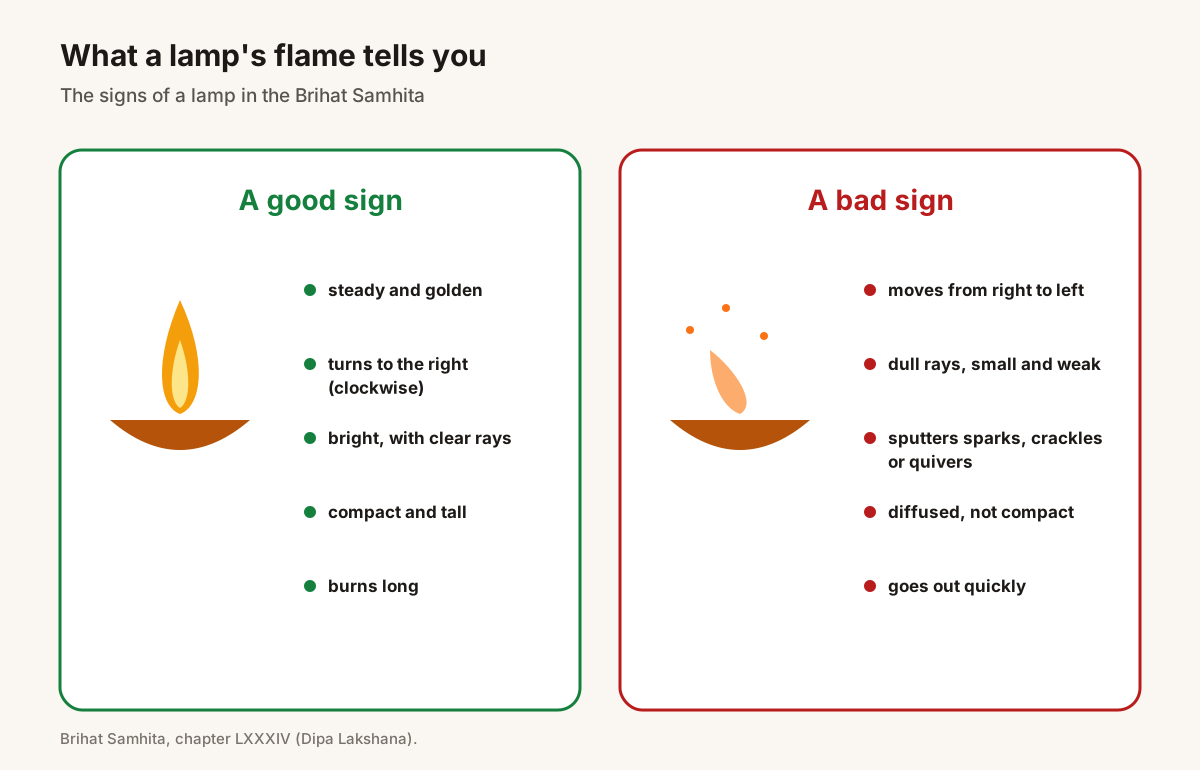
Varahamihira's first verse lists the warning signs. A lamp forebodes trouble, he says, if its flame:
- moves from right to left
- has dull rays or is small and weak
- sputters sparks, crackles or quivers
- looks diffused rather than compact
- goes out quickly
There's an important condition. All of this counts only if the lamp is "furnished with pure oil and wick", and the flame dies "without the agency of grasshoppers or the wind." A moth or a draught doesn't count. The sign is the flame that misbehaves for no reason.
The good lamp
The second verse paints the opposite picture, and it's lovely:
"A light of compact (thick) form, long-sized, quiet (not shaky), brilliant, noiseless, beautiful, turned to the right, of the lustre of beryl or gold, and shining long and brilliant, heralds the immediate arrival of the Goddess of Wealth."
A tall, steady, silent, golden flame that leans to the right and burns long is a sign that Lakshmi is on her way.
Why "to the right"?
The right-hand direction runs all through Indian ritual. You walk around a temple keeping the deity on your right (pradakshina). You turn the lamp in aarti clockwise. A flame bending rightward was read as nature itself doing pradakshina, moving in harmony with the sacred. A flame pulling the other way is out of step.
Varahamihira then says the rest of the lamp's signs follow those of fire generally, "mutatis mutandis". For that, you turn to his chapters on ritual fire.
Reading the sacred fire
Fire omens had a serious, official role. In his list of what an astrologer must know (the science of yatra, or journeys and expeditions), Varahamihira includes "prognosis through the movement of the flame of the sacrificial fire" and "colours of the sacrificial fires as auguries." Before a king set out, the fire was watched.
Its sound mattered too. Kings whose sacrificial fire roared "similar to that of a group of chariots, oceans, clouds, elephants or drums" would march at the head of mighty armies. In the chapter on building a house, "unnatural behaviour of the fire (such as sparks, crackling sound, bad odour and the like)" during the rites was treated as a flaw that had to be corrected.
The logic is the same throughout. A clean, bright, steady, fragrant flame shows things are in order. A smoky, noisy, sputtering one shows something is off.
The lamp as a remedy
Here the ancient omen meets everyday astrology. In modern practice, lighting a lamp is one of the most common planetary remedies. The Encyclopedia of Astrological Remedies by Arun Kumar Bansal pairs lamps with planets again and again:
- For Saturn, especially during Sade Sati and Dhaiya, light a mustard-oil lamp daily before the planet's yantra, with blue or black flowers.
- For Rahu and Ketu, the same: a mustard-oil lamp before their yantras.
- For gentler, sattvic worship, as with the Sun, Moon or Jupiter, light a ghee lamp with incense, flowers and the planet's mantra.
The two oils match the planets' natures. Mustard oil is heavy, pungent and dark, and it suits the slow, dark planets. Ghee is pure, bright and nourishing, and it suits the luminaries and the benefics. The lamp itself is the oldest symbol in the tradition: a small fire held steady against the dark.
Read Varahamihira and Bansal together and you get a quietly beautiful practice. When you light a lamp as a remedy, notice the flame. Use clean oil and a good wick. Shelter the flame from the wind. Let it burn tall and still. If it does, take it as a good sign, and if it doesn't, check the wick and try again. The steadiness of the flame mirrors the steadiness you're asking for.
The takeaway
The Brihat Samhita reads the humble lamp like a tiny oracle. A compact, tall, silent, golden flame leaning to the right heralds Lakshmi. A sputtering, leaning, dying flame, with no draught to blame, warns of trouble. The same logic governed the great sacrificial fires of kings. Today the lamp lives on as a remedy, with mustard oil for Saturn, Rahu and Ketu and ghee for the gentle planets.
For a broader view of remedies in the tradition, read Lal Kitab: the red book of simple remedies. To find which planet in your chart could use a lamp lit for it, calculate your chart free.
Discover Your True Planetary Placements
Calculate your true Sidereal Lagna, Chandra Rashi, Nakshatras, and 120-year Vimshottari Dasha timeline with verified astronomical precision.
Calculate Your Free Kundli