
Mars and Saturn: Fire and Ice
Mars is the burning coal, fast and hot. Saturn is slow, cold and dry. Why each is exalted in the other's world, and how to work with the two great malefics.
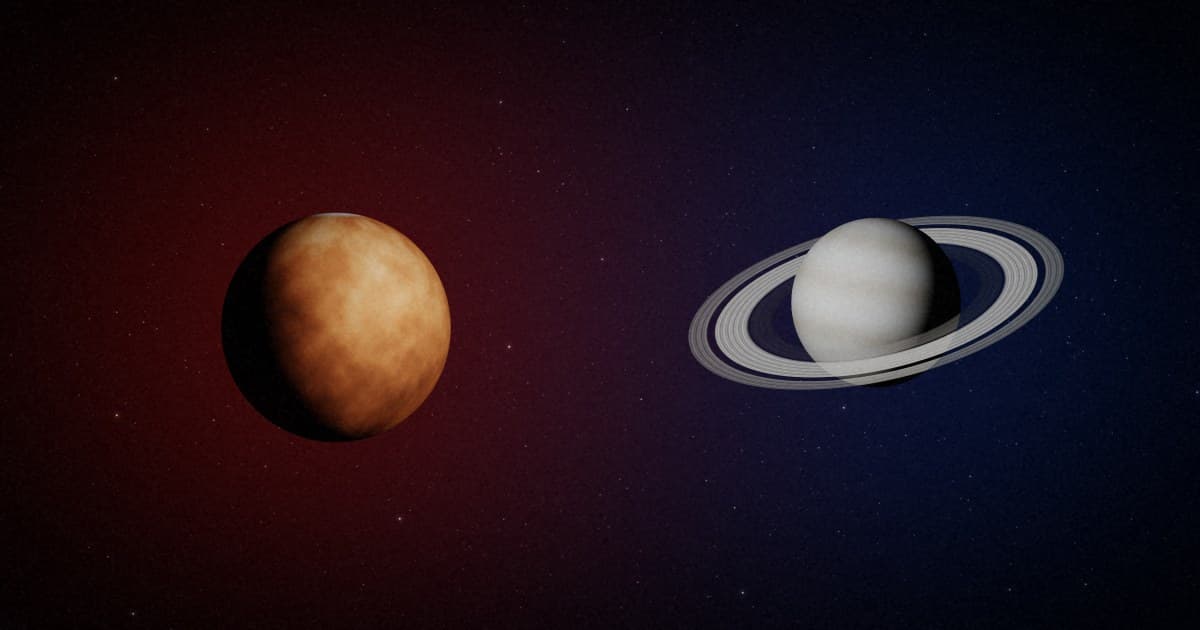
Every chart has two planets people learn to fear: Mars and Saturn. Mars brings accidents, anger and the dreaded manglik dosha. Saturn brings delays, losses and Sade Sati. They're the two great natural malefics of Vedic astrology.
But look at them closely and you'll find they're not one kind of trouble. They're opposites, as different as fire and ice. Once you see how they differ, you'll know how to work with each.
Their names tell the story
The Jataka Parijata lists the planets' traditional names.
Mars is Angaraka ("the burning coal"), Rudhira ("blood"), Kshitija ("born of the Earth"), Vakra ("the crooked one") and Kruranetra ("cruel-eyed").
Saturn is Manda ("the slow one"), Chhayasunu ("son of Chhaya, the Shadow"), Tarani-tanaya ("son of the Sun") and Shani.
One is a glowing coal, born of the Earth. The other is the slow son of the Sun and his shadow. You already know a lot about them from that alone.
Fire
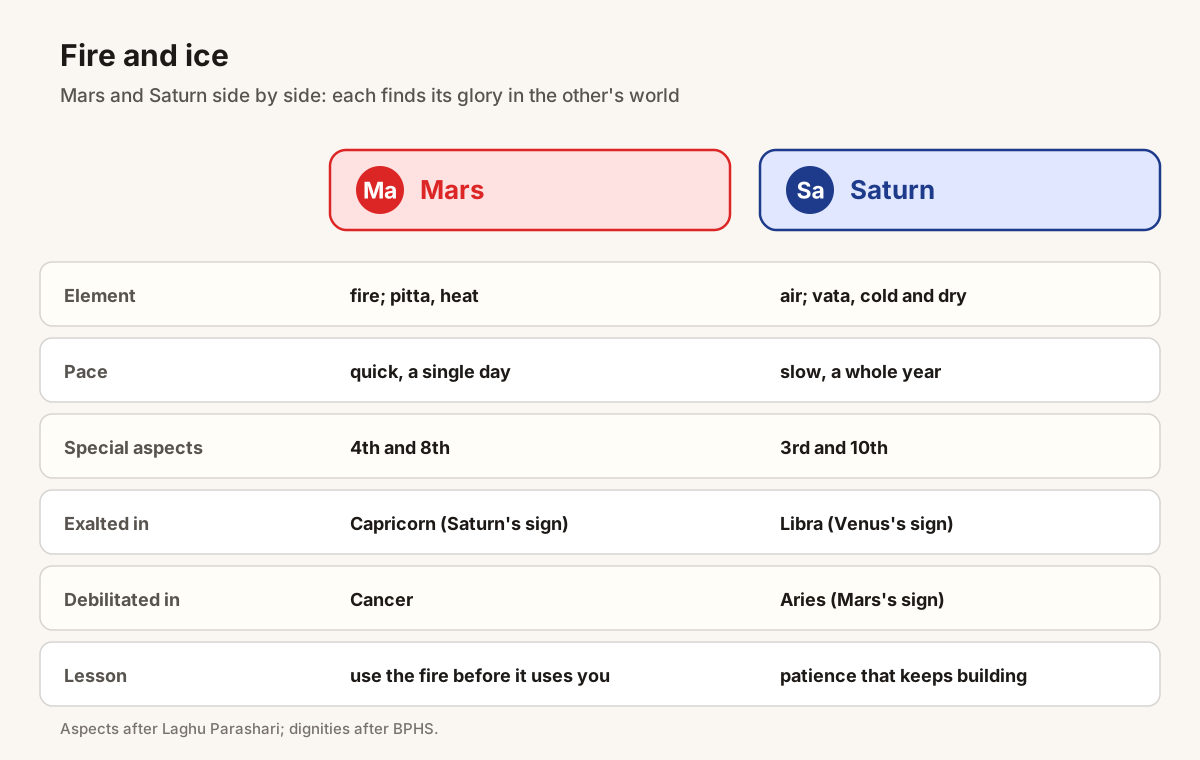
The Brihat Parashara Hora Shastra (BPHS) describes Mars as having "blood-red eyes", being "fickle-minded, liberal, bilious, given to anger" and having a "thin waist and thin physique". Its element is fire, its humour pitta (heat and bile) and its taste bitter. Its abode is "a place of fire", and its strongest direction is the south.
Mars is the commander-in-chief of the planetary court. It's quick, decisive and brave, and also hot-headed. In a chart it rules courage, siblings, land, sport, surgery, engineering and anything that needs force.
Ice
Saturn is the opposite in nearly every way. BPHS gives it "an emaciated and long physique" and "tawny eyes", says it "is windy in temperament", and calls it "indolent and lame". Its element is air, its humour vata (cold, dry, slow), its taste astringent and its abode a "filthy" or neglected place. Its strongest direction is the west, where the Sun sets.
Saturn is the court's servant: the labourer, the one who endures. And it's old. "Out of all the Grahas Sani is the eldest," says BPHS. It rules time, discipline, duty, service, solitude and old age, and in BPHS's blunt phrase, "Sani denotes grief."
A day versus a year
Here's the most practical difference. Each planet "owns" a length of time, and they're worlds apart:
- Mars rules a single day.
- Saturn rules a whole year.
The Jataka Parijata commentary spells out what this means: "If illness is indicated by Saturn, it is long-standing: if indicated by Mars, it is of short duration."
So Mars troubles are sharp and fast: a fever, a quarrel, a cut, a sudden expense. Saturn troubles are slow and heavy: a chronic condition, a long delay, a burden carried for years. The same goes for their gifts. Mars gives a quick win. Saturn gives slow-built, lasting achievement.
How they see
Both planets look sideways at the world. Besides the full aspect on the 7th house that every planet has, each has special aspects:
- Mars also aspects the 4th and 8th houses from itself.
- Saturn also aspects the 3rd and 10th. Laghu Parashari says it aspects them "with extra ordinary" strength.
Mars hits home and hidden matters (the 4th and 8th). Saturn presses on effort and career (the 3rd and 10th) (how aspects work).
Each finds glory in the other's world
Now the most beautiful part. Look at where each planet is exalted and where it falls:
- Mars is exalted in Capricorn, Saturn's own sign. Fire is at its best when it's disciplined. Courage serving a long-term goal is unstoppable.
- Saturn is debilitated in Aries, Mars's own sign. Patience collapses when it's rushed. Slow wisdom forced into haste becomes frustration.
- Mars falls in Cancer, the Moon's watery sign, where fire is drowned by emotion. Saturn is exalted in Libra, Venus's sign of balance, where the old judge becomes fair and just.
The zodiac itself is giving advice. Give your fire some structure, and don't try to hurry your Saturn.
When they meet
A conjunction or mutual aspect between Mars and Saturn is one of astrology's classic hard combinations. It's fire and ice in one place, pushing and braking at the same time. Old texts list many difficult results for it. But they also show the way out. In one such configuration, the Saravali notes that Jupiter's aspect "bestows happiness and long life." Wisdom is the bridge between the two malefics.
In practical terms, people with strong Mars–Saturn contacts often succeed in fields that need controlled force: engineering, surgery, the military, construction and competitive sport, anywhere where energy has to obey rules.
Making friends with both
The two malefics can also become great benefactors. For some ascendants they rule the best houses. Mars is the yogakaraka for Cancer and Leo ascendants, and Saturn for Taurus and Libra (why "bad" planets can help). And everyone can work with their energies:
- For Mars: use the fire before it uses you, through exercise, sport, protective work and honest confrontation. Traditional remedies include worshipping Hanuman, especially on Tuesdays, and giving red lentils.
- For Saturn: accept slowness, through steady routines, service to the old and the poor, and patience with long projects. Traditional remedies include a mustard-oil lamp on Saturdays and honouring Hanuman or Bhairava.
The takeaway
Mars is fire: the burning coal, the commander, fast and hot, ruling a day. Saturn is ice: the slow son of the Shadow, the servant, cold and dry, ruling a year. Mars's troubles flare and pass, and Saturn's settle in and stay. But Mars is exalted in Saturn's sign, and Saturn falls in Mars's. Discipline makes fire great, and haste ruins patience. Learn that, and the two malefics become your best teachers.
Read more about each: manglik dosha explained and Sade Sati in 2027. Or calculate your chart free to see where your Mars and Saturn stand.
Discover Your True Planetary Placements
Calculate your true Sidereal Lagna, Chandra Rashi, Nakshatras, and 120-year Vimshottari Dasha timeline with verified astronomical precision.
Calculate Your Free Kundli