
The Planetary Cabinet
In Vedic astrology the planets form a royal court: the Sun is king, the Moon queen, Saturn the servant. The court even explains which planet rules which sign.
Every kingdom needs a court, and the sky has one too. Long before modern astrology gave the planets personalities, the Sanskrit texts gave them jobs.
The Jataka Parijata states it in one line:
"The Sun and the Moon are sovereigns. Guru and Sukra are counsellors. Budha is the (heir apparent) young prince; Mars is the commander-in-chief and Saturn is the servant."
The commentary adds that "the Sun is the King, the Moon being the Queen." The Bhrigu Sutras give exactly the same court. It's one of the oldest and most useful pictures in Jyotish.
Meet the court
- The Sun, the King. Authority, the centre, the one everyone orbits. In your chart: your sense of self, your father, your relationship with power.
- The Moon, the Queen. She rules the inner palace: feeling, care, the people's mood. In your chart: your mind and your mother.
- Mercury, the Prince. Young, clever and still learning. A text book of astrology notes that, like a child, Mercury "does not act independently and borrows the characteristics of the planet with which it is associated." That is why Mercury takes on the colour of whatever planets sit with it (more on Mercury).
- Mars, the Commander-in-chief. Courage, defence, action and conflict.
- Jupiter and Venus, the Ministers. The counsellors, each offering a different kind of wisdom (the two gurus).
- Saturn, the Servant. Labour, endurance and duty, the one who does the hard work no one else wants.
The court explains the zodiac
Here's the most elegant part, and it's in the commentary to the Jataka Parijata. Ever wondered why Mars rules Aries and Scorpio, or why Saturn gets Capricorn and Aquarius? The cabinet answers it.
The two sovereigns each take one sign at midsummer: the Sun takes Leo and the Moon takes Cancer. Then each hands out the next five signs on their side, in order of rank:
- 2nd sign: the Prince (Mercury). From Leo that's Virgo, and from Cancer it's Gemini.
- 3rd sign: the Minister (Venus). That's Libra and Taurus.
- 4th sign: the Commander (Mars). That's Scorpio and Aries. The 4th is the vahana sthana, the house of vehicles and mounts, fitting for a general.
- 5th sign: the Counsellor (Jupiter). That's Sagittarius and Pisces. The 5th is "the house of knowledge."
- 6th sign: the Servant (Saturn). That's Capricorn and Aquarius. The 6th is the house of service.
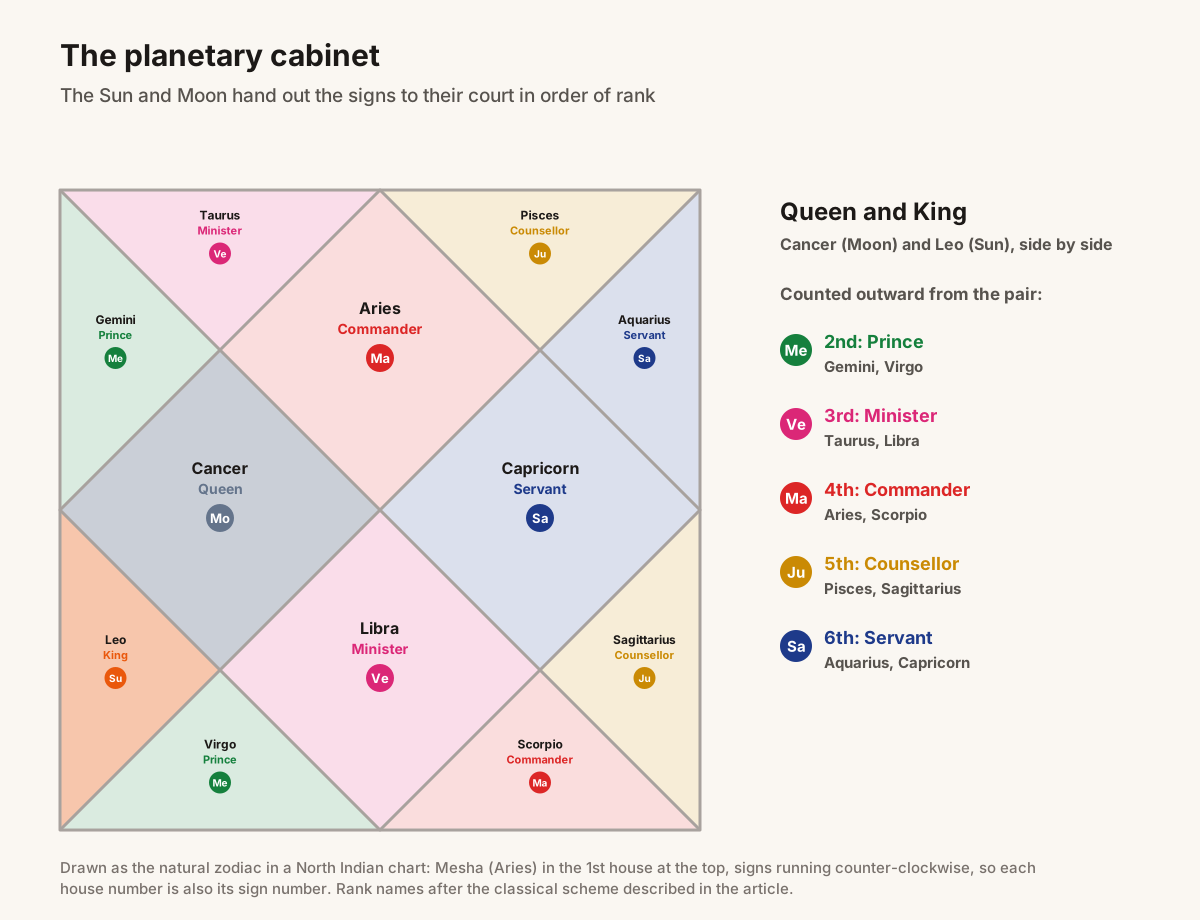
Two mirror-image halves of the zodiac, one solar and one lunar, staffed by the same court. Once you see it, you'll never need to memorise the sign rulers again.
Two courts: the gods and the demons
The Bhrigu Samhita (in Shanker Adawal's edition) adds a second layer. In the court of the gods, Jupiter is the teacher, the Sun the king and Mars the commander. In the court of the asuras, Venus is the teacher of the demons, Saturn is the king and Mercury the finance minister.
This old story quietly explains the planets' natural friendships. The Sun, Moon, Mars and Jupiter tend to support each other, and so do Venus, Saturn and Mercury. Neither court is "evil" in a chart. They're two different ways of running a kingdom: one guided by dharma and the light, the other by worldly skill and endurance (how planetary friendship works).
The cabinet on duty when you were born
The court also has rotating offices. Every year, month, day and hour has a ruling planet, and the officials who happened to be on duty at your birth get a reward. In the six-fold strength (shadbala), the Jyotisha Siddhanta Sara gives:
- The lord of your birth year (the weekday lord on which that lunar year began): 15 virupas
- The lord of your birth month: 30 virupas
- The lord of your birth day: 45 virupas
- The lord of your birth hour (the hora): 60 virupas
The Brihat Parashara Hora Shastra sums it up: "The Lords of the year, month, day and Hora ... are stronger than the other in ascending order." The closer the office is to your actual moment of birth, the more weight it carries (why the hours run in their order).
The same idea governs the annual chart, Varshaphala. Each year the planets compete for the post of Lord of the Year from among five "office holders", the panchadhikaris. As K.S. Charak puts it, the year lord "is generally the strongest planet which influences the lagna."
Reading your own court
So how do you use the cabinet? Look at your chart as a kingdom:
- Are the King and Queen strong? The Jataka Parijata is blunt: in a horoscope, "the Sun and the Moon must — not to say of the Lagna — be strong; otherwise it is not a satisfactory one. Of these, the Moon is the most important."
- Who has real power? The strongest planet in your chart tends to set your role in the world. A strong Sun suits authority, a strong Mercury commerce and words, a strong Mars command and competition, a strong Saturn steady, disciplined work.
- Is the servant respected? A well-placed Saturn is the loyal worker who makes everything run. A neglected one feels like a servant who has stopped cooperating.
The takeaway
The planets of Vedic astrology form a royal court, with the Sun as king, the Moon as queen, Mercury as prince, Mars as general, Jupiter and Venus as ministers and Saturn as servant. That single picture explains the sign rulerships and colours the planets' friendships. It even rewards the officials on duty at your birth. Read your chart as a kingdom, and ask who's on the throne and who does the work.
Calculate your chart free and ask Vedhora's astrologer which member of your planetary cabinet holds the most power.
Discover Your True Planetary Placements
Calculate your true Sidereal Lagna, Chandra Rashi, Nakshatras, and 120-year Vimshottari Dasha timeline with verified astronomical precision.
Calculate Your Free Kundli