
Why 'Good' Planets Can Hurt You
Jupiter isn't always kind and Saturn isn't always cruel. How Laghu Parashari picks the planets that help your chart, kendradhipati dosha and your yogakaraka.

Ask most people which planets are "good" and they'll say Jupiter and Venus. Ask which are "bad" and they'll say Saturn and Mars. That is the natural view of the planets, and it's true as far as it goes.
But open an experienced astrologer's notebook and you'll find Saturn marked as the best planet for one chart and Jupiter as a problem for another. The reason is a short, brilliant text called the Laghu Parashari. Without it, Vedic astrology often goes wrong.
Nature versus role
Every planet has two layers:
- Its nature: Jupiter is wise and generous, Saturn is slow and stern. That never changes.
- Its role in your chart: which houses it rules for your ascendant. That changes completely from chart to chart.
Laghu Parashari is about the second layer. It asks: for this ascendant, which planets carry the good houses and which carry the difficult ones?
The core rules
From the opening chapters of Laghu Parashari:
- Trine lords are always good. Lords of the 1st, 5th and 9th "produce uniformly good results, whether they are benefics or malefics." Saturn ruling your 9th is a friend.
- Lords of the 3rd, 6th and 11th lean towards trouble. They "are always disposed towards evil," whatever their nature.
- Kendra lords change their nature. Natural malefics that rule the angles (1st, 4th, 7th, 10th) stop being harmful and "become progressively more powerful as lords of the 1st, 4th, 7th and 10th houses." Natural benefics that rule angles lose their goodness unless they also rule a trine.
- 2nd and 12th lords are neutral. They act according to their associations and placement.
- The 8th lord is difficult, being the 12th from the 9th, the house of fortune, unless it is also the lord of the ascendant.
- The Sun and Moon aren't harmed by 8th lordship.
- Rahu and Ketu give results according to their house and the planets they sit with.
Kendradhipati dosha: when Jupiter disappoints
Rule 3 has a name: kendradhipati dosha, the flaw of owning angles. Laghu Parashari is blunt about it: "Amongst benefics the evil nature of Jupiter and Venus when they are lords of the Angles is extraordinary." If they also rule or occupy the maraka houses, the 2nd and 7th, they can become harmful in a serious way. Mercury carries less of this flaw, and the Moon much less.
Real examples:
- Gemini ascendant: Jupiter rules the 7th and 10th, two angles. A powerful Jupiter here gives status but can trouble marriage and health in its periods.
- Virgo ascendant: Jupiter rules the 4th and 7th, both angles.
- Sagittarius ascendant: Mercury rules the 7th and 10th.
- Pisces ascendant: Mercury rules the 4th and 7th.
None of this means Jupiter "is bad" for Gemini. It means you judge its periods carefully, and you don't hand out yellow sapphires because "Jupiter is a benefic."
The yogakaraka: one planet doing both jobs
The best planet in many charts is a yogakaraka, a planet that rules both an angle and a trine. Laghu Parashari says that when the lords of angles and trines are connected, especially the 9th and 10th, they give "extraordinarily good Yoga Karaka results."
Work it out sign by sign, and six ascendants have a single planet that rules both:
- Taurus: Saturn (9th and 10th)
- Libra: Saturn (4th and 5th)
- Cancer: Mars (5th and 10th)
- Leo: Mars (4th and 9th)
- Capricorn: Venus (5th and 10th)
- Aquarius: Venus (4th and 9th)
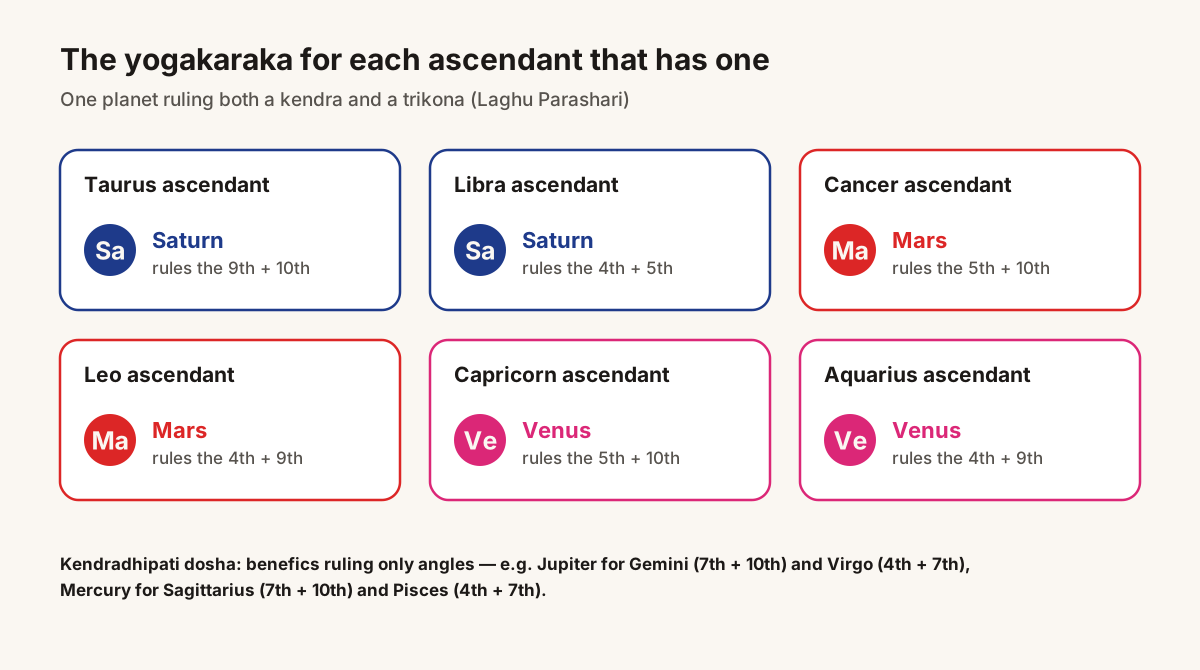
The text itself singles out the Cancer case: Mars, a natural malefic, "gives good results not being the lord of the 10th house only but by being the lord of a Trine house (5th) also."
So for a Taurus or Libra native, Saturn, the planet everyone fears, is the planet of their rise. Its dasha often brings career, recognition and property. Sade Sati still has to be judged, but it isn't the same story for them as for others (Sade Sati in 2027).
When Rahu and Ketu become helpers
Laghu Parashari adds a surprising rule for the nodes: Rahu and Ketu in a trine or angle, not tied to other planets, give good results in their own main period and in the sub-period of a yogakaraka. So "Rahu dasha" isn't automatically bad news.
How to use this
- Find your ascendant. Everything follows from it (what your lagna means).
- List each planet's houses. Mark trine lords as friends and 3rd, 6th and 11th lords as difficult. Watch benefics that rule only angles.
- Find your yogakaraka, if your ascendant has one, and watch its dasha closely.
- Then add strength: a functional benefic that is weak needs support, and a functional malefic that is strong needs care.
This is also why a gemstone or remedy chosen from a sun-sign column can backfire. The right planet to strengthen depends on your ascendant.
The takeaway
"Good" and "bad" planets are a starting point, not the answer. The Laghu Parashari's rules turn the planets from characters into roles, and roles depend on your ascendant. Once you know which planets work for your chart, much of what a dasha brings starts to make sense.
Calculate your chart free and ask Vedhora's astrologer which planets are your functional benefics and whether you have a yogakaraka.
Discover Your True Planetary Placements
Calculate your true Sidereal Lagna, Chandra Rashi, Nakshatras, and 120-year Vimshottari Dasha timeline with verified astronomical precision.
Calculate Your Free Kundli