
Agastya: The Star That Clears the Water
When Canopus, the sage Agastya's star, rises before dawn, muddy monsoon waters turn clear. The myth, the astronomy and the omens of India's southern star.

Every autumn, in the last dark hour before dawn, a brilliant star climbs out of the southern horizon in India. For the people who watched for it, it meant the rains were over. The rivers would settle, the ponds would clear, and the season of lotuses and swans had begun.
That star is Canopus, the second-brightest star in the night sky. In India it has always had another name: Agastya, after one of the most beloved sages of the Puranas.
The sage who stopped a mountain
Varahamihira opens his chapter on Canopus in the Brihat Samhita with a burst of poetry, packing three famous legends into one breath. Agastya is the sage:
- who humbled the Vindhya mountain, whose peaks "grew so high as to obstruct the Sun's passage";
- who ate and digested the demon Vatapi, the one "who tore the stomachs of sages";
- and who drank the ocean dry.
The Vindhya story is the one people remember. As the Puranas tell it, the mountain grew proud and rose until it blocked the Sun's chariot. Agastya, its teacher, asked it to bow down so he could cross to the south, and to stay bowed until he returned. He never returned. He settled in the south, and the mountain still waits.
That's why his star "adorns the southern direction". In northern India Canopus never climbs high. It hangs low over the southern horizon, exactly where a sage who went south and never came back should be.
The star that purifies water
Here the poetry and the astronomy meet. Varahamihira writes:
"At the appearance of sage Agastya (Canopus) the waters that are polluted (in the rainy season) by their contact with mud become clear once again spontaneously, just as the minds (of men) that are corrupted by association with the wicked become pure at the sight of the virtuous."
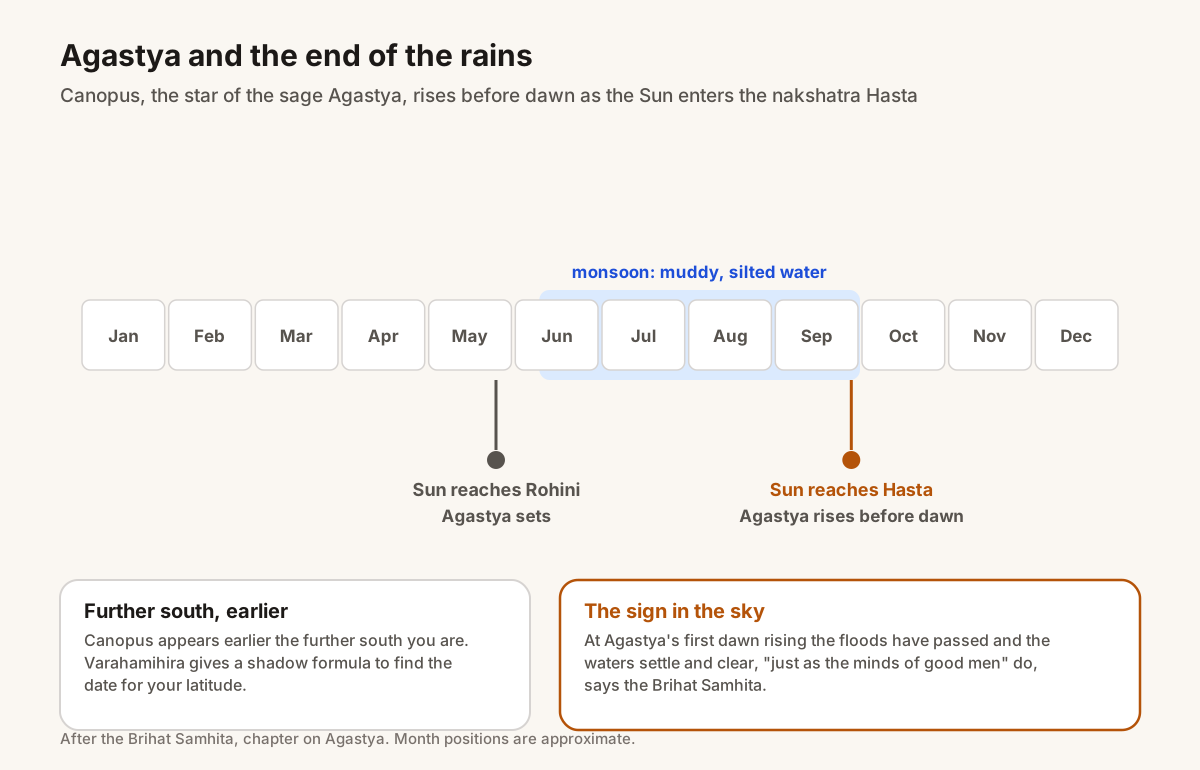
Think about when this happens. He gives the timing precisely: Canopus rises when the Sun is in the nakshatra Hasta, and sets when the Sun reaches Rohini. The Sun passes through Hasta at the end of the monsoon, in early autumn. So Agastya's first dawn appearance marks the exact moment when the floods recede and silted water settles. The star doesn't just accompany the change of season. In the old view, it announces it.
The chapter then turns into a celebration of autumn: rows of white swans with ruddy geese, ponds full of lotuses and lilies, and the Earth herself offering "worship, as it were, to sage Agastya with abundant gems, flowers and fruits."
Where you stand changes the date
Varahamihira knew that Canopus doesn't rise on the same day everywhere. The further south you are, the earlier it appears. So he gives a formula, built on the length of a gnomon's shadow at noon on the equinox, a stand-in for your latitude, to work out where the Sun must be when Agastya rises at your location. He sums up the result poetically: Agastya rises in the south "like a mark on the front of a damsel".
It's a small detail, but it shows how this tradition worked: myth, observation and calculation all on the same page.
Reading the star
Like everything in the Samhita, Agastya's appearance was also read as a sign for the coming year:
- Shining like gold or crystal, as if refreshing the earth with its rays: the earth "will abound in food", and people will be happy and prosperous.
- Rough: illness.
- Russet: drought.
- Smoky: harm to cattle.
- Throbbing (twinkling hard): fear or danger.
- Red like madder: famine and war.
- Tiny: a city under siege.
- Struck by a meteor or comet: famine and disease.
A star low on the horizon looks through a thick slab of air. Haze, dust and moisture really do change its colour and sharpen its twinkle. So the colour of Agastya at dawn was, among other things, a reading of the autumn air itself.
Honouring the sage at dawn
The chapter ends with worship. At the moment "the nocturnal darkness is just pierced" by the first light, the king was to make offerings toward the south, at the spot the astronomer pointed out. The offerings included fragrant flowers, seasonal fruit, gems from the sea, gold, cloth, cows, milk porridge, curd, coloured rice, incense and ointments. Anyone who honoured Agastya according to their means, the text promises, would be "free from diseases" and gain merit.
It's a beautiful idea. At the turning point of the year, you face south in the dark and thank the star that clears the water.
Agastya in your chart
Canopus lies far south of the zodiac, so it doesn't appear in a birth chart. But the season it marks does. The Sun's passage through Hasta and the start of autumn falls under the dakshinayana half of the year, the Sun's southward journey (read about the Sun's two journeys). And the virtue Agastya stands for is one every chart can work toward: letting the mud settle so the mind runs clear.
The takeaway
Agastya is Indian astronomy at its most poetic and its most practical. A bright southern star, rising before dawn as the Sun enters Hasta, marked the end of the rains and the clearing of the waters. People read its colour as a forecast for the year and honoured it with offerings at first light. The legends of the mountain, the demon and the ocean made sure no one forgot to look south.
Next, look the other way: read about the Seven Sages who circle the northern sky. Or calculate your chart free.
Discover Your True Planetary Placements
Calculate your true Sidereal Lagna, Chandra Rashi, Nakshatras, and 120-year Vimshottari Dasha timeline with verified astronomical precision.
Calculate Your Free Kundli