
What Your Planets Taste Like
In the classics every planet has a taste, a season, a place and a tree. The Sun is pungent, Saturn astringent. The sensory side of the grahas, and its uses.
Most astrology describes the planets in abstract words: authority, emotion, communication, discipline. The classical texts go further. They give each planet a flavour, a season, a place it lives, a kind of tree and even a length of time that belongs to it.
It sounds poetic, and it is. But it's also practical. These "sensory" significations are working tools in chart reading, especially in horary astrology (prashna). Here they are, mostly from Chapter 3 of the Brihat Parashara Hora Shastra (BPHS).
The seven tastes
BPHS gives the flavours plainly:
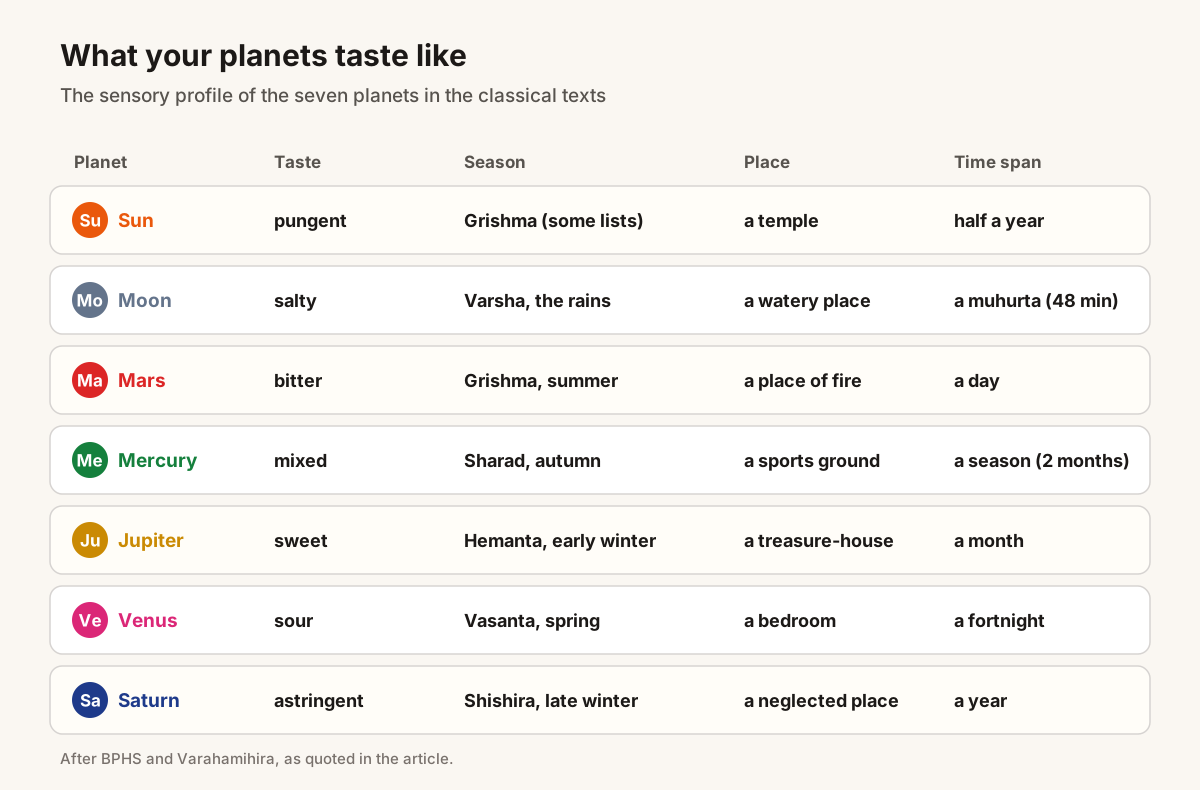
"Pungent, saline, bitter, mixed, sweet, acidulous and astringent are, respectively, tastes lorded by Surya, Candr, Mangal, Budh, Guru, Sukr and Sani."
So:
- Sun: pungent. Sharp, heating, like chilli and ginger.
- Moon: salty. The taste of the sea, of water and the tides.
- Mars: bitter. Hard, purifying, like neem.
- Mercury: mixed. A bit of everything, which suits the planet that takes on the colour of its company.
- Jupiter: sweet. Nourishing and expansive.
- Venus: sour. Tangy and stimulating, like ripe fruit and pickles.
- Saturn: astringent. Drying and contracting, like unripe banana or strong tea.
The Jataka Parijata repeats the same list, and the Saravali agrees.
The seasons
Each planet also rules one of India's six seasons (ritus):
- Venus: Vasanta, spring, the season of flowers and love.
- Mars: Grishma, the burning summer. Other lists give it to the Sun as well.
- Moon: Varsha, the rains.
- Mercury: Sharad, the clear, bright autumn.
- Jupiter: Hemanta, the mellow early winter.
- Saturn: Shishira, the cold late winter.
The pairings make intuitive sense once you know the planets. The watery Moon gets the monsoon, cold Saturn the deep winter, and pleasure-loving Venus the spring.
Where each planet lives
BPHS assigns each planet an abode:
- Sun: a temple
- Moon: a watery place
- Mars: a place of fire, such as a kitchen or forge
- Mercury: a sports ground
- Jupiter: a treasure-house
- Venus: a bedroom
- Saturn: a filthy or neglected place
Trees and plants
Even the plant world is divided up. BPHS assigns strong, stout-trunked trees to the Sun, milky, sap-filled trees to the Moon and bitter plants to Mars. Mercury has fruitless plants, Jupiter fruit-bearing ones and Venus flowering ones. Saturn has "useless" trees, the gnarled and thorny ones nobody plants on purpose.
The span of time
Here's a signification with real predictive bite. Each planet "owns" a length of time:
- Sun: half a year (an ayana)
- Moon: a muhurta, 48 minutes
- Mars: a day
- Mercury: a season, two months
- Jupiter: a month
- Venus: a fortnight
- Saturn: a year
The Jataka Parijata commentary shows how to use it: "If illness is indicated by Saturn, it is long-standing: if indicated by Mars, it is of short duration." A Mars matter flares and passes in days. A Saturn matter grinds on for a year or more. A Moon matter can change within the hour.
Mineral, vegetable or living?
BPHS also sorts the planets into three kingdoms:
- Dhatu (minerals): Rahu, Mars, Saturn and the Moon
- Mula (roots and plants): the Sun and Venus
- Jiva (living beings): Mercury, Jupiter and Ketu
In a horary reading, the planet that dominates the question chart can show whether the matter on someone's mind concerns metal and money, land and plants, or a person or animal.
The body and the senses
Classical tables collected in A Text Book of Astrology go further still, giving each planet a tissue of the body and a sense:
- Body tissues: Sun, bone. Moon, blood. Mars, marrow. Mercury, skin. Jupiter, fat. Venus, reproductive fluid. Saturn, muscle.
- Senses: the Sun and Mars rule sight, the Moon and Venus taste, Mercury smell, Jupiter hearing and Saturn touch.
How astrologers use all this
Why would anyone need to know that Venus is sour or that Saturn lives in a rubbish heap? Because astrology often has to answer concrete questions.
- Lost objects. In horary charts, a planet's abode helps locate things. Venus points toward the bedroom, the Moon toward water, Jupiter toward where valuables are kept.
- Timing. The planet's time span sets the scale of an event, as in the Mars and Saturn example above.
- Description. If a chart points to a place, a food, a plant or a season, these lists translate the planet into the real world.
- Remedies and lifestyle. Knowing a planet's nature, from its season to its taste, helps you recognise its qualities in daily life, and gives traditional remedies their logic.
The takeaway
The grahas aren't just abstractions. They have flavours, seasons, homes, trees and clocks. The Sun is pungent and lives in a temple. The Moon is salty and lives by water, and her time is the passing hour. Saturn is astringent, rules the cold season and counts in years. Learn these correspondences and the chart starts to read like the world itself.
For the court these planets form, read the planetary cabinet. To meet your own planets, calculate your chart free.
Discover Your True Planetary Placements
Calculate your true Sidereal Lagna, Chandra Rashi, Nakshatras, and 120-year Vimshottari Dasha timeline with verified astronomical precision.
Calculate Your Free Kundli