
Mercury: The Prince Who Takes Sides
Mercury is the clever young prince of the planetary court, taking the colour of whatever it sits with. Why it stays near the Sun, and Budha-Aditya yoga.

Every royal court has a young prince, bright, charming and quick, not yet sure whose side he's on. In Vedic astrology that prince is Mercury, Budha, "the wise one".
The Brihat Parashara Hora Shastra names him plainly: "Prince-apparent is Budh." Understanding this one role explains almost everything Mercury does in a chart.
The clever one
BPHS describes Mercury as "endowed with an attractive physique and the capacity to use words with many meanings. He is fond of jokes. He has a mix of all the three humours." In one line: "Budh is speech-giver."
That's Mercury: language, wit, wordplay, learning, trade and calculation. Its traditional names in the Jataka Parijata include Budha (the wise), Bodhana (the one who awakens understanding) and Vid (the knower).
The Bhrigu Sutras add that Mercury "represents the essential qualities of the planet, duality, speed and wisdom." Mercurial people "generally have a youthful appearance." Like any good prince, it never quite grows old.
The planet that becomes its company
Here's Mercury's defining trait. It's neutral: neither benefic nor malefic by nature, neither male nor female (BPHS lists Mercury and Saturn as neuter). Its taste is "mixed", a little of every flavour.
So it takes on the nature of whatever it's with. A Text Book of Astrology says that, as a prince, Mercury "like a child ... does not act independently and borrows the characteristics of the planet with which it is associated." The Bhrigu Sutras say the same thing practically: Mercury "gives favourable results when he is in good association and receives benefic aspects."
In practice:
- Mercury with Jupiter: a scholar, teacher or wise counsellor.
- Mercury with Venus: an artist of words, a designer or a diplomat.
- Mercury with Mars: a sharp debater, an engineer, sometimes a cutting tongue.
- Mercury with Saturn: a methodical, serious, patient mind.
To read Mercury, first look at its company.
Always near the Sun
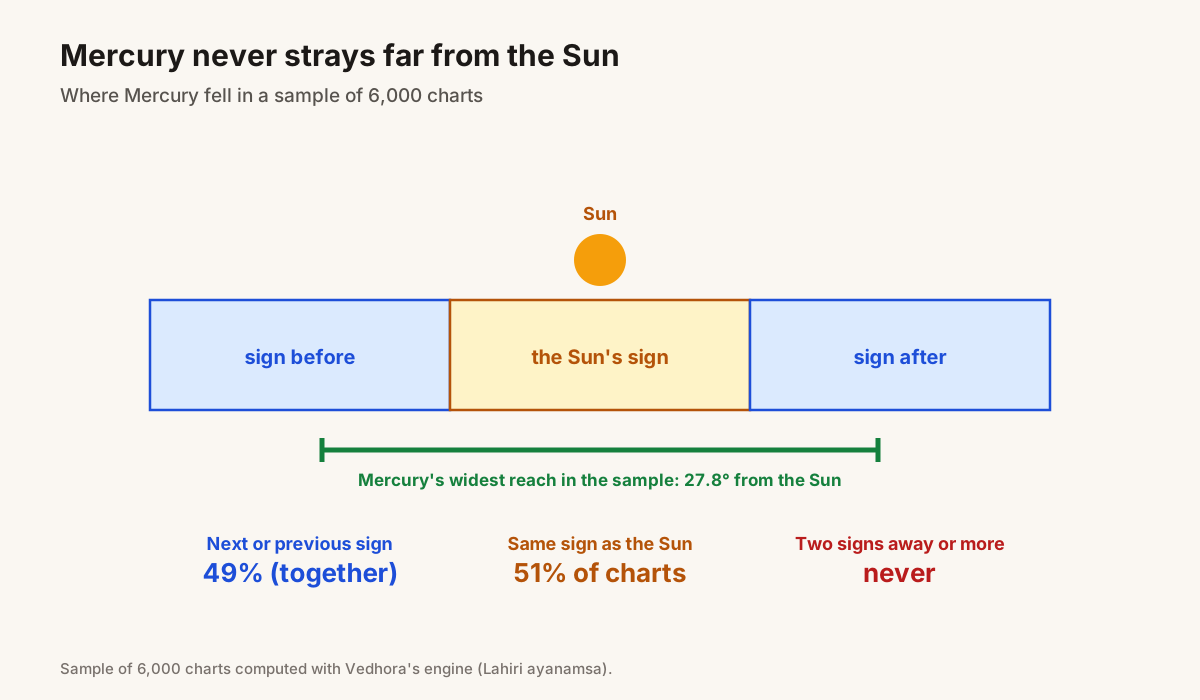
Mercury never wanders far from the Sun. Seen from Earth it's always within about 28° of it, which is why the Bhrigu Sutras note that Mercury "can rarely be seen with naked eye." We checked this across 6,000 birth charts with Vedhora's engine:
- Mercury was in the same sign as the Sun in 51% of charts.
- In the other 49% it was in the sign just before or just after. Never further.
- The widest gap in the sample was 27.8°.
That closeness makes Mercury the planet most often combust, lost in the Sun's glare. In our wider 60,000-chart study it was combust in about four charts out of ten (what combustion really means).
Budha-Aditya yoga: read the fine print
Because Mercury and the Sun are so often together, their union has a famous name: Budha-Aditya yoga. B.V. Raman lists it as #24 of his Three Hundred Important Combinations: "If Mercury combines with the Sun ... highly intelligent, skilful in all work, good reputation, personal respect and surrounded by all comforts and happiness."
But Raman adds a crucial condition. "It should not be taken for granted that irrespective of the distance between the Sun and Mercury, Budha-Aditya Yoga would be present. On the contrary, Mercury should not be within 10° of the Sun." And he notes it "is not, of course rare."
By that rule, the yoga forms in about 27% of charts in our sample: same sign as the Sun, but more than 10° away from it. Mercury needs a little distance from the king to show its own brilliance.
The Moon's son
Mythology adds a twist. Mercury is the son of the Moon. His names include Induputra and Saumya, both meaning son of the Moon, and Taratanaya, son of Tara. Yet in the classical friendship tables, the relationship is lopsided. The Moon counts Mercury as a friend, but Mercury counts the Moon as an enemy. S.G. Khot notes the oddity in Astrology and Diagnosis: "Mercury is the Son of the Moon ... Strangely the Moon is an enemy of Mercury."
There's a lovely piece of psychology in it. Mercury is the mind's intelligence, born of the Moon's feeling, and it often defines itself against emotion. The clever child doesn't always want to be its mother's son (how planetary friendships work).
Mercury's world
Some of Mercury's classical significations:
- Abode: the sports ground, a place of play and competition
- Season: Sharad, the clear, bright autumn
- Element: earth. Sense: smell. Body: the skin
- Direction of strength: the east, which it shares with Jupiter
- Time: a season of two months
- Strength: "strong during day and night", the only planet BPHS describes that way
- Avatar: the Buddha, and its presiding deity Vishnu (the gods behind the planets)
Working with your Mercury
Because Mercury mirrors its company, the best way to strengthen it is to choose good company: good books, good teachers, good conversation. Traditional remedies include reciting the Vishnu Sahasranama, honouring Durga or Vishnu, and giving green moong dal on Wednesdays.
The takeaway
Mercury is the young prince of the planets: witty, quick, eloquent and neutral, taking on the colour of whatever sits beside it. It never strays more than a sign from the Sun, so it's often combust, and Budha-Aditya yoga needs a little distance to shine. Born of the Moon but often at odds with feeling, Mercury is the intelligence that names, trades, calculates and jokes. To read it, look at its company. To improve it, improve yours.
To see your own Mercury's company, calculate your chart free. For its place in the planetary court, read the planetary cabinet.
Discover Your True Planetary Placements
Calculate your true Sidereal Lagna, Chandra Rashi, Nakshatras, and 120-year Vimshottari Dasha timeline with verified astronomical precision.
Calculate Your Free Kundli