
The Seven Planetary Ages of Life
An ancient text gives each planet a stage of life, from the Moon of infancy to the Saturn of old age. The Yavanajataka's planetary ages and dasha timing.
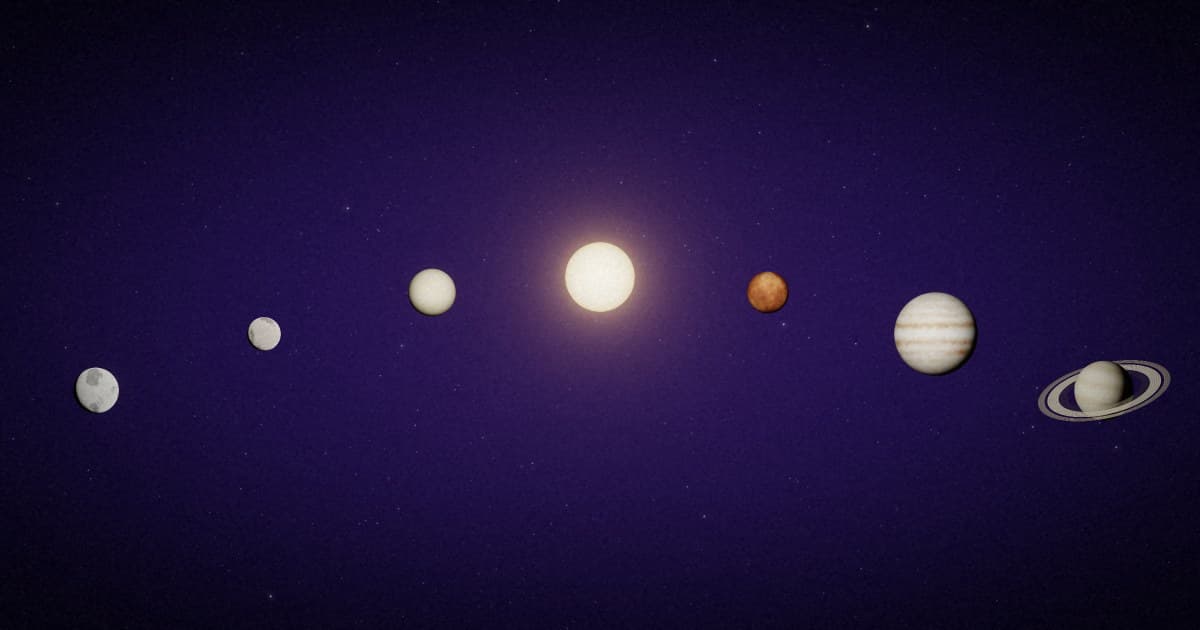
Shakespeare gave us the seven ages of man. Centuries before him, a Sanskrit astrology text gave the same idea a planetary form: seven stages of life, each ruled by one of the seven planets.
The text is the Yavanajataka of Sphujidhvaja, one of the oldest surviving Sanskrit works on horoscopy. Its chapter on the planetary ages is short, wise and still useful.
The seven ages
The Yavanajataka (chapter 39) sets the order: "The Moon, Mars, Mercury, Venus, Jupiter, the Sun, and Saturn in order possess these ages." Each planet owns a season of life:
- The Moon: infancy. The age "of drinking one's mother's milk." Everything is feeling, nourishment and closeness to the mother, the Moon's own themes.
- Mars: early childhood. The age "of growing teeth." The body asserts itself, a will appears, energy and scraped knees.
- Mercury: schooling. "The time of learning one's lessons," lasting until the stirring of adult desire. Language, curiosity, play and the learning mind.
- Venus: youth. The age of attraction and romance, beauty and pleasure, falling in love with the world.
- Jupiter: middle age. Responsibility, family, teaching, building a name and a household. The age of wisdom earned.
- The Sun: beyond middle age. Authority, standing and the self fully formed. People look to you.
- Saturn: old age. The text calls it "the unfortunate time of old age": slowing down, detachment, the long view.
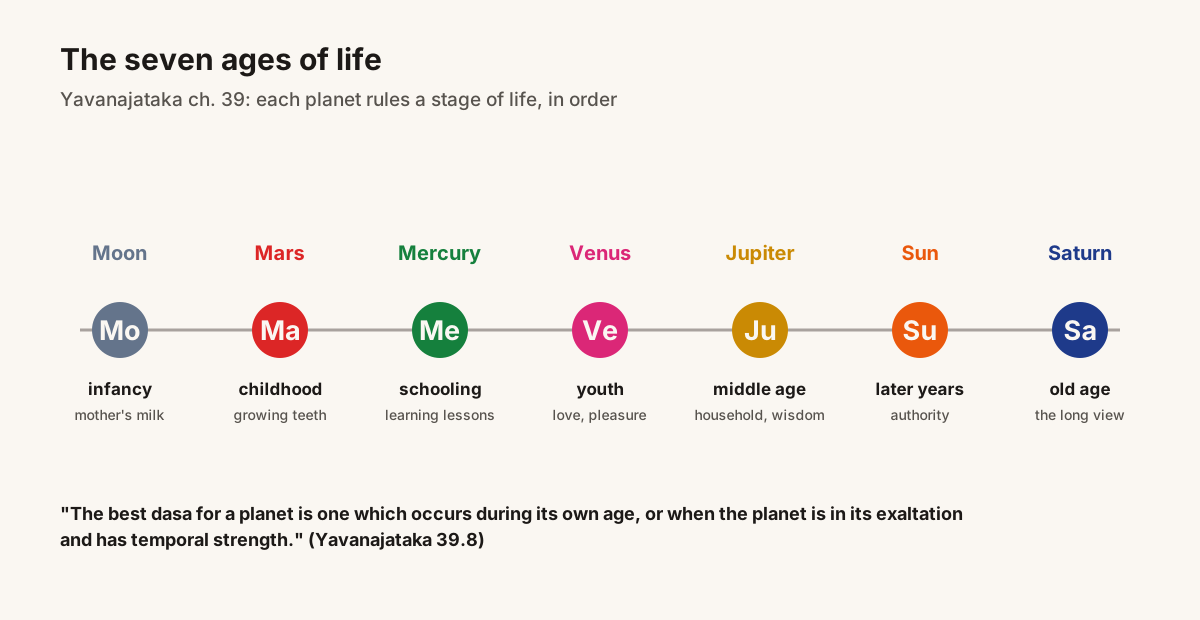
The sequence isn't arbitrary. It follows the planets' own natures, from the gentlest and fastest-moving (the Moon) to the slowest and most sober (Saturn). A life moves in the same direction.
The rule that makes it useful
The text then gives the key teaching (39.8):
"The best dasa for a planet is one which occurs during its own age, or when the planet is in its exaltation and has temporal strength."
A planet's period works best when it arrives at the stage of life that matches its nature. A Venus period in your twenties falls in Venus's own age, the age of love and pleasure, so its gifts land naturally. A Venus period in your seventies may still bring comfort and beauty, but the romance belongs to a different stage.
The Yavanajataka grades the rest too:
- Middling: when the planet is in its own sign, its own triplicity, a friend's sign, or the sign the Moon occupied at birth.
- Ruined, pale and rough: when the planet is debilitated, in an enemy's sign or navamsa, or overcome.
So the quality of a period depends on two things: the planet's condition and when in life it arrives.
What each planet's period brings
Chapter 40 of the same text describes the flavour of each planet's period, which reads like a character sketch:
- Moon: gentle gains through women, gifts, travel, milk and comforts. Moods that wax and wane, a pull towards dharma and the elders.
- Mars: money through land, metals, fire and competition. Quarrels with siblings and fevers, but also boldness and fame.
- Mercury: praise for one's good qualities, friendship among good people, income from writing, trade, the arts, storytelling and travel.
- Venus: pleasure, beauty, good food, music and romance, wealth through land, trade and clever arrangements.
- Jupiter: "his good qualities increase, his intelligence is awakened, and he becomes a leader," earning through counsel, teaching, law and healing.
- Sun: strength, fame, respect and "a great accumulation of honour," with fiery tempers and authorities to manage.
- Saturn: fatigue and effort, old things and inheritance, being "put in charge of cities, villages and tribes," and courage in misfortune.
Applying it to your Vimshottari dashas
Today most astrologers use the Vimshottari dasha system (how your dasha clock is set), which assigns periods by the Moon's nakshatra. The Yavanajataka's insight still applies: notice which period falls in which stage of your life.
Here is a real example from Vedhora's engine. Someone born in Delhi on 14 March 1992 at 7:45 am starts life in a Jupiter period, then runs:
- Saturn from age 8 to 28
- Mercury from 28 to 45
- Ketu from 45 to 52
- Venus from 52 to 72
This person meets Saturn's long period in childhood and youth, the opposite of Saturn's natural age. That often means early responsibility and growing up fast. Their Venus period arrives in their fifties and sixties: comfort, art and enjoyment as a reward in later life rather than a teenage romance.
Two people with the same planets can live very different stories, simply because their periods fall at different ages.
The takeaway
The seven planetary ages are a simple, humane idea: every planet has a season, and its period blooms best in its own. Look at your dashas against your age. Where a planet's period matches its season, expect its gifts to come easily. Where it doesn't, expect them to come in a different form, and give them time.
Calculate your chart free to see your full dasha timeline, then ask Vedhora's astrologer what your current period means at this stage of your life.
Discover Your True Planetary Placements
Calculate your true Sidereal Lagna, Chandra Rashi, Nakshatras, and 120-year Vimshottari Dasha timeline with verified astronomical precision.
Calculate Your Free Kundli