
Combust Planets: Too Close to the Sun
A combust planet is hidden in the Sun's glare. The orbs astrologers use, why Mercury is combust in four charts out of ten, and what combustion really means.
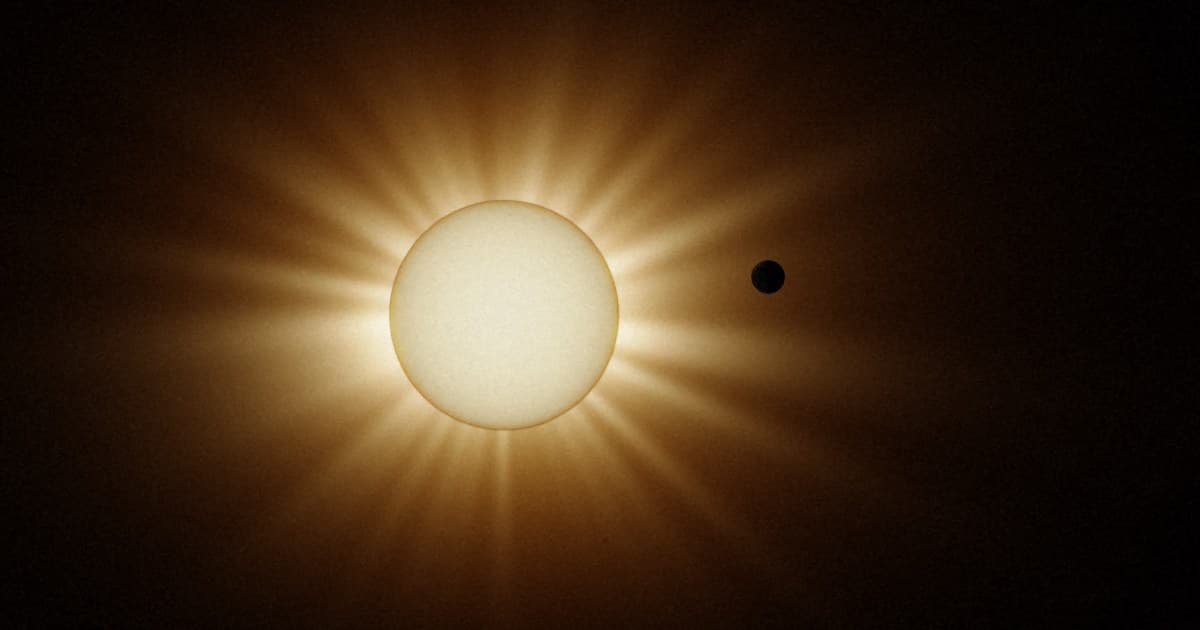
Stand outside just after sunset and you might see Venus blazing in the west. Wait a few weeks and it's gone, swallowed by the evening glare. It hasn't disappeared. It has moved too close to the Sun to be seen.
Jyotish calls that state asta, "set", and in English we say the planet is combust. It's one of the oldest observations in astrology, and it began as pure astronomy.
It started with the naked eye
Dr. K.S. Charak, in Elements of Vedic Astrology, quotes the great astronomer Aryabhata on exactly when each planet vanishes:
"When the Moon has no latitude, it is visible when situated at a distance of 12 degrees from the Sun. Venus is visible when 9 degrees distant from the Sun. The other planets taken in the order of decreasing sizes (Jupiter, Mercury, Saturn and Mars) are visible when they are 11, 13, 15 and 17 degrees distant from the Sun."
Those visibility limits became the combustion limits. A combust planet was a planet you couldn't see. Its light was there but overpowered.
The orbs astrologers use today
The standard table, as given by Charak and the AIFAS texts:
- Moon: within 12° of the Sun
- Mars: within 17°
- Mercury: within 14° (12° when retrograde)
- Jupiter: within 11°
- Venus: within 10° (8° when retrograde)
- Saturn: within 15°
Rahu and Ketu, being shadow points, are never combust.
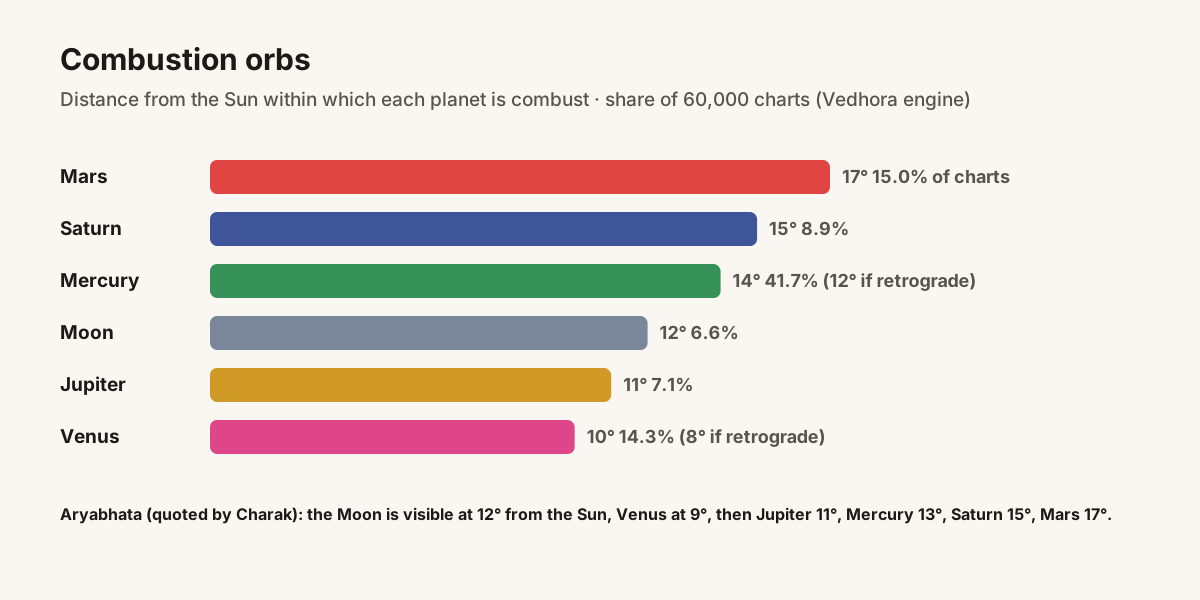
Why are the orbs for retrograde Mercury and Venus smaller? A retrograde Mercury or Venus is on the near side of the Sun, closer to Earth and brighter, so it can be seen sooner after leaving the glare.
How often it happens
We ran 60,000 birth charts through Vedhora's engine and applied these orbs:
- Mercury is combust in 41.7% of charts
- Mars in 15.0%
- Venus in 14.3%
- Saturn in 8.9%
- Jupiter in 7.1%
- The Moon in 6.6% (that is, born close to the new moon)
Mercury is the outlier for a simple reason: seen from Earth, it never strays more than about 28° from the Sun. Venus never goes beyond about 47°. Both are tied to the Sun's side, so combust Mercury is part of ordinary life for a very large share of people.
What combustion does
Charak's summary is direct: "Planets when close to the Sun tend to lose their strength and vitality... A combust planet loses its capacity to do good."
The symbolism is easy to feel. The Sun is the self, authority, the father and the ego. A planet inside its glare has to work in the Sun's shadow. Its qualities are present but harder to express in their own voice:
- Combust Mercury: the mind and speech serve a bigger purpose, sometimes brilliantly, sometimes at the cost of saying what you really think. Shankar Kapoor's Bhrigu Sutram links a combust Mercury, the significator of speech, to difficulties in expression.
- Combust Venus: love, pleasure and refinement can be overshadowed by duty or pride.
- Combust Mars: drive and courage are absorbed into the Sun's will. Energy works best under a clear purpose.
- Combust Jupiter: wisdom and faith need to be earned personally rather than assumed.
- Combust Saturn: discipline and the Sun's authority sit uneasily together.
Not all combustion is equal
The tradition itself makes distinctions:
- Saturn and Venus are treated gently. In the classical longevity calculation, a combust planet loses half its contributed years, but Saturn and Venus are exempt from this reduction.
- Strength in Ashtakavarga can override it. C.S. Patel notes that even when Mercury is "in debilitation or combust or in inimical house, still, he is a beneficiary if associated with 4 or more bindus" in his own Ashtakavarga (how the bindus work).
- Depth matters. A planet 1° from the Sun is far more combust than one at the edge of the orb.
- Dignity still counts. A combust planet in its own or exalted sign keeps more of itself than one in a weak sign.
Living with a combust planet
If your reading flags a combust planet, don't treat it as broken. Treat it as a planet that needs light of its own:
- Give its qualities a space away from the Sun's domain. A combust Mercury does well with writing or learning done for its own sake, not only for a boss.
- Use the planet's day. Wednesday for Mercury, Friday for Venus, Tuesday for Mars: a mantra, charity, or simply practising the planet's virtue that day.
- Work with the Sun, not against it. Respect for elders, healthy pride and a clear purpose help a combust planet's energy flow into something worthwhile.
The takeaway
Combustion is an astronomer's fact that became an astrologer's insight: a planet too close to the Sun is a voice that's hard to hear. It's common, especially for Mercury, and it's always one factor among many. Read it with depth, dignity and Ashtakavarga, and it tells you where your light needs to be your own.
Calculate your chart free and ask Vedhora's astrologer whether any of your planets are combust, and how deeply. For the related idea of planets that appear to move backwards, read retrograde planets: strong, not broken.
Discover Your True Planetary Placements
Calculate your true Sidereal Lagna, Chandra Rashi, Nakshatras, and 120-year Vimshottari Dasha timeline with verified astronomical precision.
Calculate Your Free Kundli