
Yogini Dasha: The 36-Year Cycle
Yogini dasha is a fast 36-year timing system of eight yoginis, from Mangala to Sankata. How it's calculated from your birth star and what each yogini means.

Most people who've had a Vedic reading know the Vimshottari dasha, the 120-year cycle of planetary periods. But it isn't the only clock. Alongside it runs a faster, older-feeling one: the Yogini dasha, a 36-year cycle of eight goddesses called yoginis.
K.S. Charak, in Elements of Vedic Astrology, calls the two "the two very widely used dashas". Of Yogini he adds that it "is widely used by India's old and brilliant astrologers, particularly in the Himalayan belt, for fast and sure predictions."
The eight yoginis
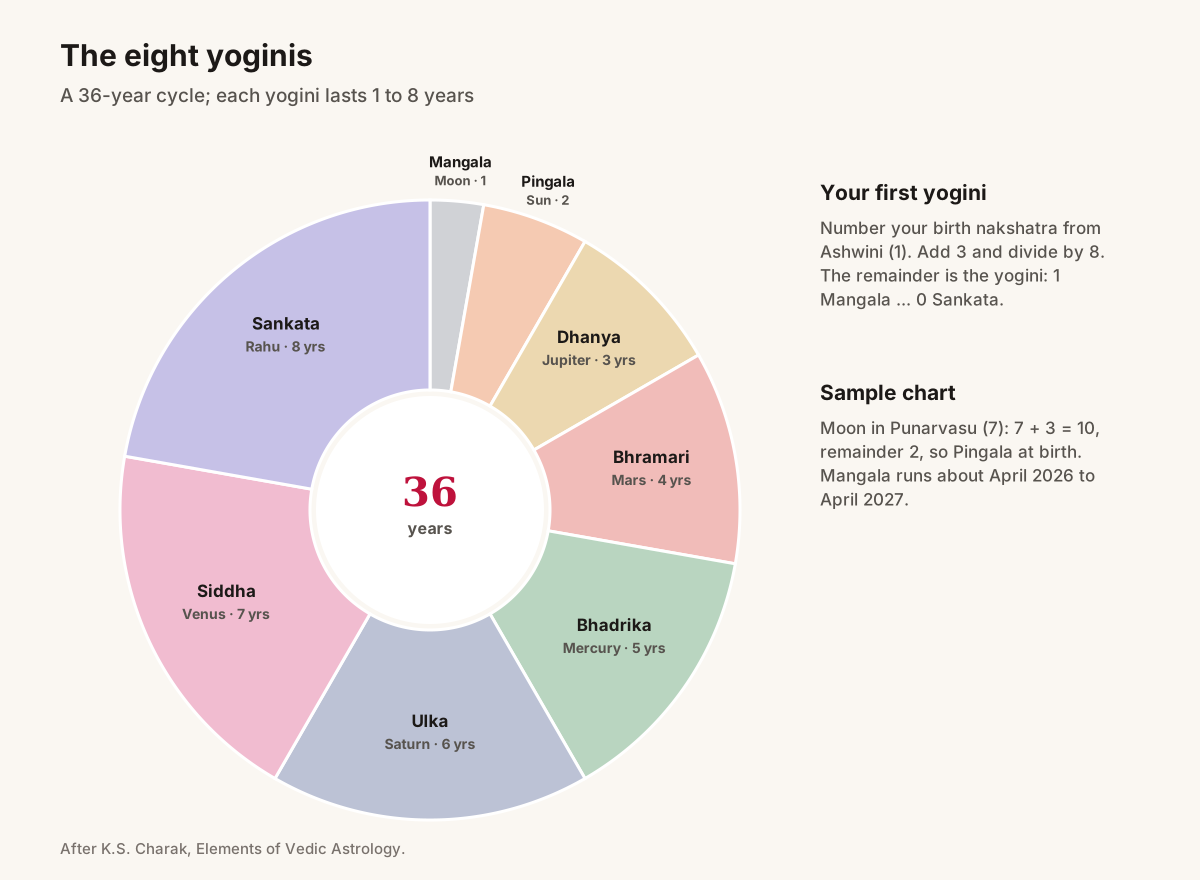
Each yogini has a planetary lord and a length in years. The years run 1 to 8, so the whole cycle comes to 36 years:
- Mangala, "auspicious": ruled by the Moon, 1 year
- Pingala, "tawny": the Sun, 2 years
- Dhanya, "blessed, wealthy": Jupiter, 3 years
- Bhramari, "the wanderer, the bee": Mars, 4 years
- Bhadrika, "good, gracious": Mercury, 5 years
- Ulka, "the meteor": Saturn, 6 years
- Siddha, "the accomplished": Venus, 7 years
- Sankata, "crisis": Rahu, 8 years
The names tell you a lot. Mangala, Dhanya, Bhadrika and Siddha are traditionally the comfortable periods. Ulka and Sankata are the testing ones. Pingala and Bhramari are mixed and restless.
Finding your starting yogini
Like Vimshottari, the Yogini dasha starts from your birth nakshatra, the Moon's star at birth. Charak gives the rule:
"The Yogini dasha operating at the time of birth is obtained by adding 3 to the nakshatra of the Moon, and dividing by eight. The remainder gives the number of the Yogini dasha operating at the time of birth."
Number the nakshatras from Ashwini (1) to Revati (27), add 3, and divide by 8. The remainder points to the yogini: 1 is Mangala, 2 Pingala, and so on. A remainder of 0 means the 8th, Sankata.
Charak's table gives the result directly:
- Mangala: Ardra, Chitra, Shravana
- Pingala: Punarvasu, Swati, Dhanishtha
- Dhanya: Pushya, Vishakha, Shatabhisha
- Bhramari: Ashwini, Ashlesha, Anuradha, Purva Bhadrapada
- Bhadrika: Bharani, Magha, Jyeshtha, Uttara Bhadrapada
- Ulka: Krittika, Purva Phalguni, Mula, Revati
- Siddha: Rohini, Uttara Phalguni, Purva Ashadha
- Sankata: Mrigashira, Hasta, Uttara Ashadha
Then, "as in the Vimshottari dasha, the balance of Yogini dasha must be determined from the remaining part of the Moon's nakshatra" (how the dasha balance works).
A worked example
Take our sample chart: born 14 March 1992 in Delhi, with the Moon at 85°58′, in Punarvasu, the 7th nakshatra.
- 7 + 3 = 10. Dividing by 8 leaves a remainder of 2, so the first yogini is Pingala (the Sun, 2 years).
- Punarvasu runs from 80°00′ to 93°20′. The Moon had covered 5°58′ of it, about 45%, so about 55% of Pingala remained: roughly 1 year 1 month.
- The yoginis then follow in order:
- Pingala (Sun): birth → about April 1993
- Dhanya (Jupiter, 3): → 1996
- Bhramari (Mars, 4): → 2000
- Bhadrika (Mercury, 5): → 2005
- Ulka (Saturn, 6): → 2011
- Siddha (Venus, 7): → 2018
- Sankata (Rahu, 8): → 2026
- Mangala (Moon, 1): about April 2026 → April 2027, the current period
- then Pingala again, as the second 36-year round begins
So in late 2026 this person has just come out of an eight-year Sankata into a short, auspicious Mangala. Taken alone, that's a sign of relief and a fresh start.
Using Yogini with Vimshottari
The strength of the Yogini dasha is confirmation. Charak describes it as "an additional confirmatory tool" alongside Vimshottari. When both systems point the same way, a prediction becomes much more reliable.
In the same example, the Vimshottari dasha in late 2026 is Mercury's mahadasha. Mercury sits in the 1st house, debilitated but beside the Sun. The Yogini dasha says the Moon's Mangala period has just begun. A careful astrologer reads them together: Mercury's long themes of skills, voice and personal effort, coloured for this one year by the Moon's emotional ease and public goodwill.
Yogini dashas also divide into sub-periods, antardashas, with eight yoginis inside each, in proportion to their years. Charak reproduces tables showing which antardashas are favourable inside each mahadasha.
Why "yoginis"?
The yoginis are goddesses, attendants of the Divine Mother, and the system has a devotional feel. Each period is a phase of a feminine power moving through life, not just a planet's turn. Many astrologers recommend honouring the yogini of a difficult period, especially Sankata, through prayer to the Goddess.
The takeaway
The Yogini dasha is a 36-year cycle of eight yoginis: Mangala, Pingala, Dhanya, Bhramari, Bhadrika, Ulka, Siddha and Sankata, lasting 1 to 8 years and ruled by the Moon through Rahu. It starts from your birth nakshatra (add 3, divide by 8) and moves quickly, which makes it ideal for confirming the timing that Vimshottari suggests.
Calculate your chart free to find your birth nakshatra and your starting yogini. For the main dasha system, read how a dasha unfolds.
Discover Your True Planetary Placements
Calculate your true Sidereal Lagna, Chandra Rashi, Nakshatras, and 120-year Vimshottari Dasha timeline with verified astronomical precision.
Calculate Your Free Kundli