
When Did Kali Yuga Begin?
Indian astronomy dates Kali Yuga to midnight at Ujjain, 18 February 3102 BCE, with the planets at the zodiac's start. The yugas, the date, the modern check.

Ask an Indian astronomer of a thousand years ago what day it was, and you might have got an answer like "day 1,600,000". Not a date in a month, but a count of days since one fixed starting point: the beginning of Kali Yuga.
That moment sits at the heart of Indian timekeeping. Here's what the texts say about it, and what happens when you check the sky.
The four ages
Indian cosmology measures history in vast cycles. V.P. Jain's Elements of Astronomy gives the standard figures:
- Satya (Krita) Yuga: 1,728,000 years
- Treta Yuga: 1,296,000 years
- Dvapara Yuga: 864,000 years
- Kali Yuga: 432,000 years
Together they make one Mahayuga of 4,320,000 years. The lengths fall in the ratio 4 : 3 : 2 : 1. Each age is shorter than the last, as virtue gradually fades. A thousand Mahayugas make a kalpa of 4.32 billion years, a single day of Brahma.
We're said to be living in the last and shortest age: Kali Yuga, the age of quarrel.
The midnight it began
Richard L. Thompson sets the scene in Vedic Cosmography and Astronomy:
"Imagine the following scene: It is midnight on the meridian of Ujjain in India on February 18, 3102 B.C. The seven planets, including the sun and moon, cannot be seen since they are all lined up in one direction on the other side of the earth. Directly overhead the dark planet Rahu hovers invisibly in the blackness of night."
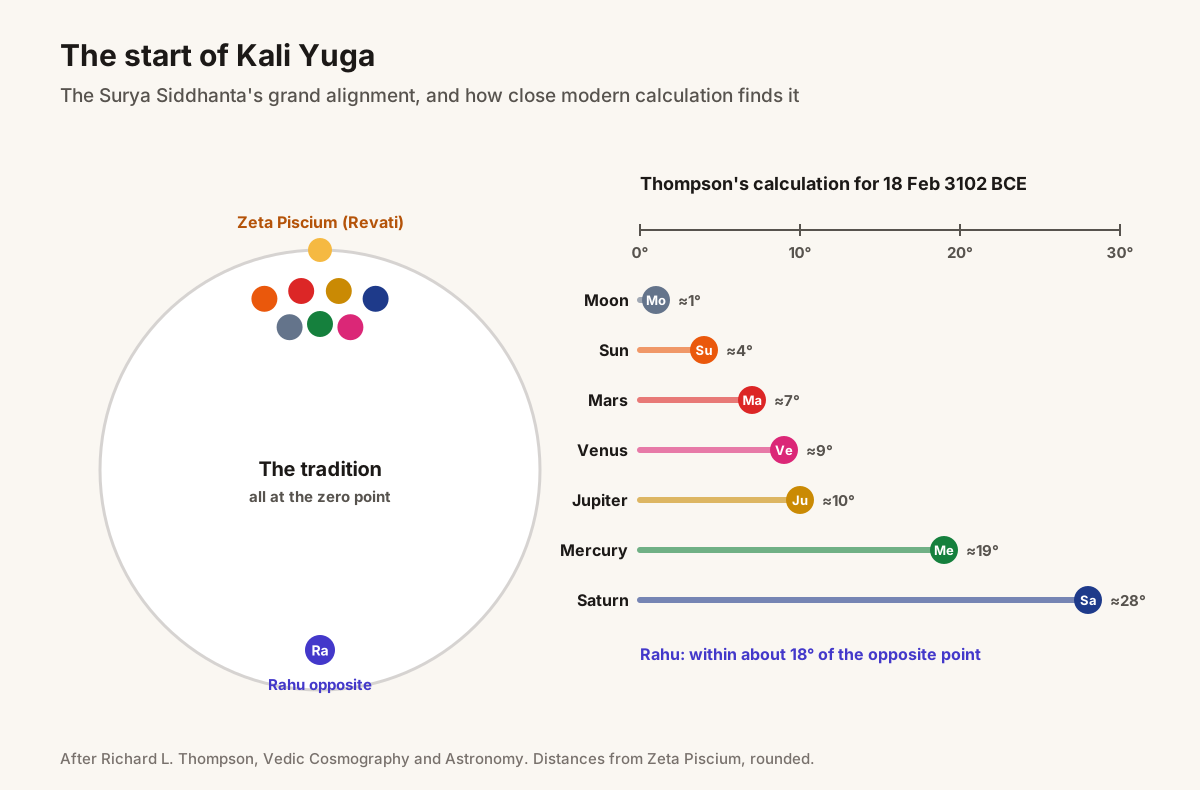
According to the astronomical texts, that's when Kali Yuga began. The Surya Siddhanta assumes that at that moment the Sun, Moon and five planets were all aligned with the star Zeta Piscium, called Revati, the zero point of the sidereal zodiac. Rahu stood exactly opposite. Other Siddhantas make nearly identical assumptions. Aryabhata's system starts the count at sunrise rather than midnight.
A calendar that counts days
This wasn't just a story. It was the working foundation of calculation. The Surya Siddhanta computes planetary positions from the ahargana, the exact number of days elapsed since Kali Yuga began. Thompson gives an example: 1 October 1965 was day 1,850,569 of Kali Yuga. Work that count backwards and you land on 18 February 3102 BCE.
There's also a lovely personal anchor. Aryabhata wrote that he was 23 years old when 3,600 years of Kali Yuga had passed. That puts the year at 499 CE, and his birth in 476 CE, consistent with the same starting point.
By the traditional count, about 5,127 years of Kali Yuga have passed by 2026. That leaves roughly 427,000 still to go.
So, were the planets really lined up?
Here's the fascinating part. Thompson ran modern planetary calculations for sunrise on 18 February 3102 BCE, measuring each planet's position from Zeta Piscium. He found a real, though not perfect, gathering:
- The Moon: about 1° from the star
- The Sun: about 4°
- Mars: about 7°
- Venus: about 9°
- Jupiter: about 10°
- Mercury (about 19°) and Saturn (about 28°) were further off.
- Rahu was within about 18° of the point opposite the star.
Five of the seven planets were within about 10° of the zodiac's starting point. Thompson also searched for alignments this tight across the whole span from 3102 BCE to modern times, in steps of three days. He found only three ten-year periods out of some 510 with an alignment as close.
He notes that the Surya Siddhanta assumes an exact alignment of the planets' mean positions, but only an approximate alignment of their true positions. That's just what the modern calculation shows. His conclusion is that the date wasn't plucked from thin air. It records a genuinely rare event in the sky.
Why the date matters to Hindu tradition
For devotees, the start of Kali Yuga is tied to the end of the Mahabharata era. The Jyotisha Siddhanta Sara mentions the belief that Kali Yuga began with the departure of Lord Krishna. That's why the events of the Bhagavad Gita are placed about five thousand years ago.
In the traditional view, each age loses a quarter of dharma. In Satya Yuga, dharma stands on four legs. In Kali it stands on one. The age is marked by quarrel, haste and forgetfulness of the sacred.
The silver lining
Kali Yuga isn't all gloom in the texts. Varahamihira, writing in the Brihat Samhita about the art of forecasting, asks:
"Is there a science superior to this (astrological) science, by knowing which alone one gets the power of visualizing the past, present and the future even in this Kali age which destroys all good things?"
In a confused age, he's saying, the sky still keeps perfect time. The planets still move by their rules, and the one who reads them can still see clearly. Jyotish, in this view, is one of the lamps left burning for Kali Yuga.
The takeaway
Indian astronomy dates the start of Kali Yuga to midnight at Ujjain on 18 February 3102 BCE, when the planets were held to stand together at the start of the zodiac. The Surya Siddhanta counts every day from that moment, and Aryabhata dated his own life by it. Modern calculation shows the planets really were unusually bunched near the zodiac's starting point that day. The age that began then is called the age of quarrel. But the same tradition offers its own lamp: the clear, unchanging order of the sky.
For the oldest cycle of all, read about the five-year yuga of the Vedas. For the cosmos those ages unfold in, see Mount Meru and the shape of the cosmos.
Discover Your True Planetary Placements
Calculate your true Sidereal Lagna, Chandra Rashi, Nakshatras, and 120-year Vimshottari Dasha timeline with verified astronomical precision.
Calculate Your Free Kundli