
Viparita Raja Yoga: Winning Through Trouble
When the lords of the 6th, 8th and 12th fall in each other's houses, trouble can turn into strength. Harsha, Sarala and Vimala yogas, with the caveats.

Some people seem to be made by their problems. A crisis becomes their opening, a rival becomes the reason they win, and a loss clears the way for something better. Jyotish has a name for this pattern: Viparita Raja Yoga, the "reversed" royal combination.
It is one of the most hopeful ideas in the classical texts. It's also one of the most misunderstood, so let's look at it properly.
The three difficult houses
The 6th, 8th and 12th houses are the dusthanas, the houses of difficulty:
- 6th: conflict, debt, illness, competition, service
- 8th: sudden change, crisis, hidden matters, longevity, transformation
- 12th: loss, expenses, isolation, foreign lands, spiritual release
Their lords normally bring the trouble of their houses wherever they go. Viparita Raja Yoga asks a clever question: what if one source of trouble lands inside another?
Harsha, Sarala and Vimala
B.V. Raman's Three Hundred Important Combinations gives the three classical forms. The lords of the 6th, 8th and 12th, occupying the 6th, 8th or 12th, create:
- Harsha Yoga (6th lord in a dusthana): "fortunate, happy, invincible, physically strong, wealthy, famous and afraid of sinful deeds."
- Sarala Yoga (8th lord in a dusthana): "long-lived, fearless, learned, a terror to enemies, celebrated and prosperous."
- Vimala Yoga (12th lord in a dusthana): "frugal, happy, independent and possessed of ennobling qualities."
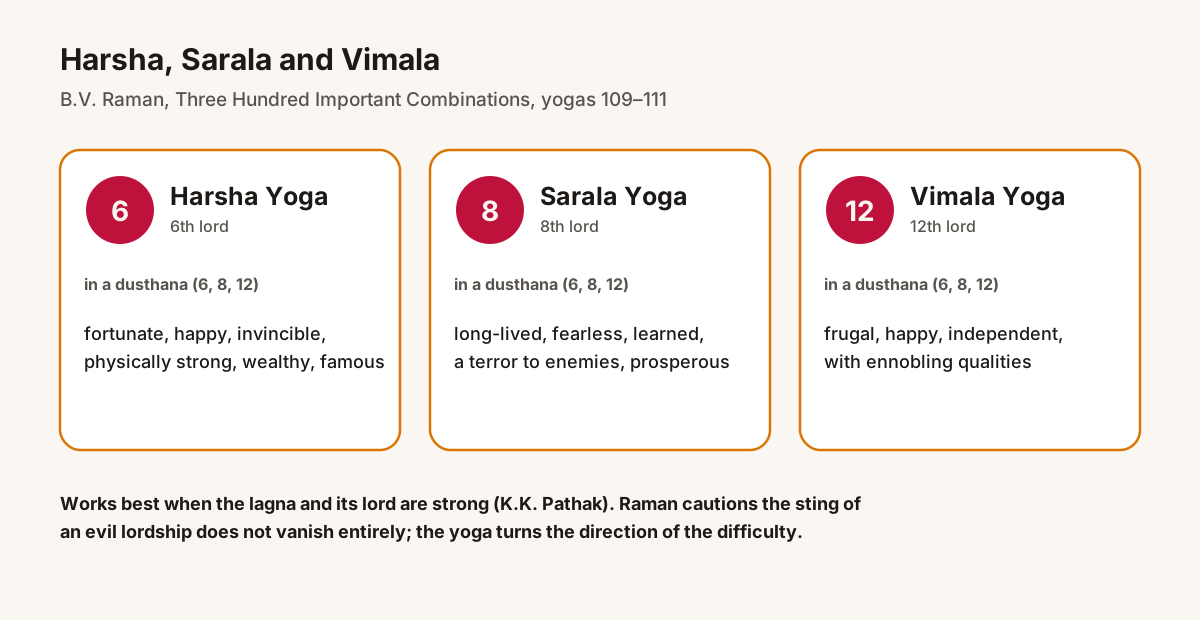
The idea is like poison neutralising poison. The lord of enemies (6th) placed in the house of loss (12th) can mean your enemies lose. The lord of crisis (8th) in the house of conflict (6th) can mean you come out of crises stronger.
The caveat the texts themselves give
Raman doesn't stop at the promise. He writes that "in actual practice, quite the contrary have been the results", and that Parashara and the sage Lomasa "do not seem to favour the conception that the sting arising from an evil lordship can disappear entirely" just because the lord sits in another dusthana.
That is the classical tradition being honest with itself. A dusthana lord doesn't become a benefic just by moving house. What changes is the direction of the difficulty.
What makes it work
K.K. Pathak's Advanced Study of Vimshottari Dasha shows when the yoga delivers:
- Sarala at its best. The 8th lord in the 8th "destroys hurdles and misfortunes in its dasha and gives smooth sail thereafter." Pathak cites the Shiva Jataka saying such a lord can give the effects of a Raja Yoga in its own period, though not without some danger along the way.
- Vimala depends on the lagna. With the 12th lord in the 12th, "if Lagnesh be powerful, the native's income will be more than his expenditure." Such a person may follow a virtuous profession and even a saintly life. If the lagna lord is weak and malefics crowd the 12th, the same placement brings poverty and debt in its period.
- Mixed packages. For Leo and Virgo ascendants, Saturn in the 6th forms Harsha Yoga. But because Saturn also rules their 7th, Pathak warns that the same placement can trouble married life.
So the deciding factor is almost always the strength of the lagna and its lord. A strong self can turn trouble into advantage. A weak one simply has trouble.
How common is it?
We checked 60,000 charts with Vedhora's engine: 56.8% have at least one of the 6th, 8th or 12th lords placed in a 6th, 8th or 12th house. More than half of all people "have" Viparita Raja Yoga by the bare rule. That's another reason to judge it by strength, not by name.
Recognising it in real life
When Viparita Raja Yoga works, it tends to show up as:
- Rising after a crisis. The breakthrough comes after an upheaval, not instead of it.
- Winning through opposition. Competitors, disputes or tests become the path to success.
- Gain through others' loss. Insurance, inheritance, restructuring, turnarounds, research: fields where endings create openings.
- Freedom from fear. People with a strong Sarala often say they stopped being afraid after the worst happened.
The timing is usually the dasha or sub-period of the planets involved, often the moment the difficulty peaks.
What to do with it
If your chart has this yoga, the practical advice from the tradition is simple. Strengthen the lagna lord: your health, your discipline, your sense of self. Don't run from the house's problems. Engage them, because the yoga rewards those who face their 6th, 8th and 12th houses rather than those who avoid them.
The takeaway
Viparita Raja Yoga is real, but it isn't a free pass. It describes trouble that turns in your favour, and it works best when the ascendant is strong enough to ride the turn. Read it alongside the lagna lord, the dashas and the full chart, the way the classical writers did.
Calculate your chart free and ask Vedhora's astrologer whether your dusthana lords are working for you or against you. For another way a weak planet can turn strong, read Neecha Bhanga: when a fallen planet rises.
Discover Your True Planetary Placements
Calculate your true Sidereal Lagna, Chandra Rashi, Nakshatras, and 120-year Vimshottari Dasha timeline with verified astronomical precision.
Calculate Your Free Kundli