
Kemadruma Yoga: When the Moon Stands Alone
Kemadruma yoga sounds frightening but is far rarer than people think. What the classics say, the cancellations few hear about, and data from 60,000 charts.
Few yogas get described as harshly as Kemadruma. The old texts list poverty, grief, hard labour and loneliness, and say it can pull down even someone born into a royal family. No wonder people panic when an app flags it in their chart.
The real picture is calmer. Kemadruma is common by its bare definition and rare once the classical cancellations are applied. Here is how it works, and why "Kemadruma" on a printout should not frighten you.
The Moon needs company
In Jyotish the Moon is the mind: how you feel, cope and connect. The classical astrologers paid close attention to what sits on either side of it, because a mind with support behaves very differently from a mind left on its own.
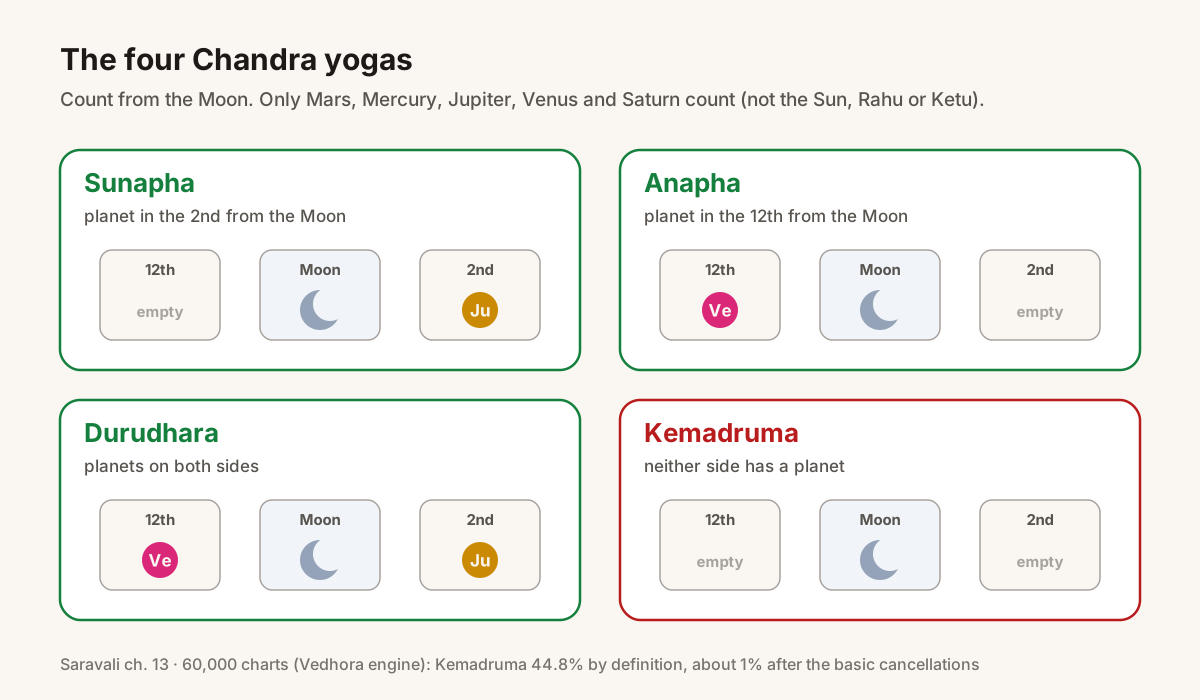
So they named the four possibilities. Count from the Moon's sign and look only at Mars, Mercury, Jupiter, Venus and Saturn. The Sun is excluded by rule, and Rahu and Ketu aren't counted either.
- Sunapha: a planet in the 2nd from the Moon.
- Anapha: a planet in the 12th from the Moon.
- Durudhara: planets on both sides.
- Kemadruma: neither side has a planet. The Moon stands alone.
What the texts promise for each
Kalyana Varma's Saravali (chapter 13) is generous with the first three:
- Sunapha: wealth, a position earned by your own effort, learning, fame and a peaceful nature.
- Anapha: eloquence, generosity, comfort, a calm disposition and good health.
- Durudhara: renown for speech, wisdom and courage, plenty of comforts and a liberal hand, though with the burden of supporting family.
Notice the pattern. A planet ahead of the Moon (Sunapha) is about building and acquiring. A planet behind it (Anapha) is about ease and expression. Both together give the fullest support.
Kemadruma gets the opposite description: deprivation, sorrow, hard work for little reward. Jataka Parijata goes further: "If in any horoscope Kemadruma yoga comes in, the Rajayogas disappear like elephants on seeing a lion."
That line is quoted a lot. The verses right after it usually aren't.
The cancellations people never hear about
The same texts that describe Kemadruma so darkly spend just as much space cancelling it. These are the main ones:
- A planet in a kendra from the Moon (the 1st, 4th, 7th or 10th from it). Saravali goes further, treating empty angles from the Moon as part of the yoga itself. Jataka Parijata (VII.83) records that when the Moon is in a kendra or joined by a planet, many authorities don't accept Kemadruma at all.
- Planets in kendras from the lagna. B.V. Raman, in Three Hundred Important Combinations, gives an example chart with no planets beside the Moon, then shows the yoga cancelled because the angles from both the lagna and the Moon are occupied.
- The Moon conjoined with a planet. A Moon with company in its own sign isn't alone.
- Jupiter's aspect. Jataka Parijata (VII.80–81) says there is no poverty yoga when the Moon or Venus in a kendra is aspected by Jupiter, or when the Moon is with a benefic, or between benefics, and aspected by Jupiter.
- A strong Moon. The same text cancels it when the Moon is in an exalted or very friendly navamsa aspected by Jupiter, when a full Moon is in the lagna with a benefic, or when an exalted Moon in the 10th receives Jupiter's aspect.
- The full Moon aspected by all planets. Saravali says such a person lives long and isn't touched by Kemadruma or similar yogas.
Think of the logic. Kemadruma describes an unsupported mind. Any of these conditions gives the Moon support from somewhere else, whether from an angle, from Jupiter's protection or from the Moon's own brightness.
What the numbers say
To see how common this really is, we ran 60,000 birth charts (born 1950–2009 in six cities) through Vedhora's calculation engine:
- Sunapha (a planet 2nd from the Moon only): 22.0% of charts
- Anapha (a planet 12th from the Moon only): 22.3%
- Durudhara (both sides): 10.9%
- Kemadruma by the bare definition: 44.8%
- Kemadruma still standing after the basic cancellations: about 1%
Nearly half of everyone has "Kemadruma" if you stop at the definition. We then applied only the three most basic cancellations: a planet with the Moon, a planet in a kendra from the Moon, or a planet in a kendra from the lagna. That alone leaves about one chart in a hundred.
A label that fits half the population can't predict a hard life on its own. That's why careful astrologers never stop at the definition.
When it does apply
In the rare chart where Kemadruma survives every cancellation, the classical meaning is real but specific: a mind that has to find its own footing, support that doesn't arrive automatically, and success that comes through self-reliance rather than inheritance or luck. Many self-made people fit that description.
The time it is felt most is the dasha of the Moon, or of a planet closely tied to it. The Moon's strength matters enormously. A waxing, bright Moon in a good sign carries far less of the yoga's weight than a dark, waning one.
Practical support for the Moon
If your Moon really is isolated, the traditional remedies are gentle and built around steadiness:
- Keep a regular Monday practice: the Chandra mantra, or simply quiet time with water and white flowers.
- Honour your mother or mother figures and stay close to them. In Jyotish she is the Moon's living form.
- Build support on purpose: regular sleep, people you can call, routines that hold you on hard days.
- Offer milk, rice or white cloth to those in need on Mondays, as charity rather than bargaining.
The takeaway
Kemadruma is one of the best examples of why yogas must be read in full. The definition is easy and common. The classical cancellations are many and usually present. If an app or report has told you that you have it, look for the planet in the angles, Jupiter's aspect or a strong Moon before you worry.
Want to know whether your Moon is truly unsupported? Calculate your chart free and ask Vedhora's astrologer. For more on what the Moon means in your chart, read why Vedic astrology starts from the Moon sign.
Discover Your True Planetary Placements
Calculate your true Sidereal Lagna, Chandra Rashi, Nakshatras, and 120-year Vimshottari Dasha timeline with verified astronomical precision.
Calculate Your Free Kundli