
Nabhasa Yogas: The Shape of Your Chart
Before single planets, astrologers read the pattern all seven make together. The 32 Nabhasa yogas, a simple count anyone can do, and 60,000 charts.

Most astrology starts with single planets: your Moon here, your Saturn there. The oldest layer of Jyotish starts somewhere else. It looks at the shape all seven planets make together, the way you might look at a constellation before naming its stars.
These patterns are the Nabhasa yogas, from nabhas, the sky. They're among the most ancient ideas in the tradition, and one of them can be found in your chart in under a minute.
1,800 patterns, 32 that matter
Kalyana Varma opens chapter 21 of Saravali with a striking line: "Yavanas have explained 1800 kinds of Nabhasa Yogas, out of which I detail below 32." The Yavanajataka, one of the earliest Sanskrit astrology texts, describes these shapes in loving detail: the ship, the bow, the wagon, the plough, the tortoise, the lotus.
Saravali sorts the 32 into four families:
- Asraya (by sign type): all planets in movable signs (Rajju), fixed signs (Musala) or dual signs (Nala).
- Dala (by benefic or malefic angles): benefics alone in the kendras (Mala, the garland) or malefics alone in them (Sarpa, the serpent).
- Akriti (shapes): twenty patterns such as the lotus, the wagon, the bird, the plough, the bow and the half-moon.
- Sankhya (numbers): how many signs the seven planets occupy.
Why they matter: they work all the time
Most yogas switch on in particular dashas. Saravali says something different about the Nabhasa yogas: they "are effective at all times independent of Dasas."
That makes sense. A pattern made by all seven planets isn't one event in your life. It's the background shape of your life. If your chart is a garland, it is a garland in every period.
Saravali also gives a rule of priority. An Asraya yoga gives its results only if no other Nabhasa yoga is present. When a more specific shape exists, that shape speaks first.
The one you can find yourself: the Sankhya count
Take the Sun, Moon, Mars, Mercury, Jupiter, Venus and Saturn (leave out Rahu and Ketu). Count how many different signs they occupy.
- 7 signs: Veena (the lute)
- 6 signs: Damini (the rope or tether)
- 5 signs: Pasa (the noose)
- 4 signs: Kedara (the field)
- 3 signs: Sula (the spear)
- 2 signs: Yuga (the yoke)
- 1 sign: Gola (the ball)
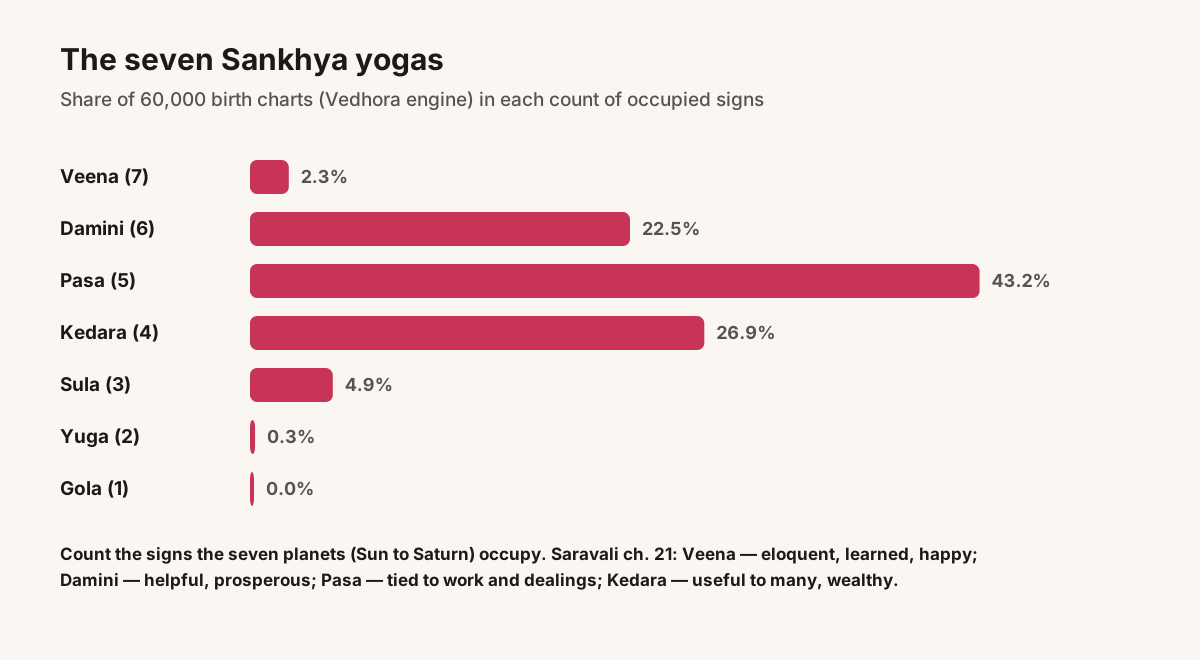
We ran 60,000 birth charts through Vedhora's engine to see how these fall. Pasa (5 signs) is the most common at 43.2%, followed by Kedara (26.9%) and Damini (22.5%). Sula (4.9%) and Veena (2.3%) are uncommon. Yuga is rare (0.3%), and Gola, all seven planets in one sign, essentially never happens.
What each count describes
Here is Saravali's reading, put simply:
- Veena (7 signs): friends, eloquence, love of learning and music, happiness and fame. Life spread wide like the strings of a lute.
- Damini (6): helpful, prosperous, with many children, bold and learned. Someone others are tied to and rely on.
- Pasa (5): "attached to work, worldly in disposition", talkative, with many people under them. A life tied up in duties and dealings.
- Kedara (4): "useful to many", tied to land or agriculture, truthful, wealthy, with a restless mind. A field that feeds others.
- Sula (3): harsh in manner, bold, successful in battle. Energy concentrated to a point.
- Yuga and Gola (2 and 1): very concentrated charts that the texts treat as struggling for balance.
The fewer the signs, the more concentrated the life: intense, focused, sometimes single-minded. The more the signs, the broader the life: varied interests, many people, wide experience.
A few famous shapes
From Saravali and the Yavanajataka:
- Kamala (lotus): all planets in the four kendras. Fame, virtue, long life, great wealth.
- Vapi (well): all planets in the houses after or before the kendras (2, 5, 8, 11 or 3, 6, 9, 12). Skill at gathering and keeping wealth, lasting comforts.
- Mala (garland): benefics alone in the kendras. Happiness, vehicles, comfort, good things arriving.
- Sakata (wagon): all planets only in the 1st and 7th. Hardship, and life moving like a heavy cart.
- Musala (club): all planets in fixed signs. Honour, wealth, wisdom, steadiness.
- Rajju (rope): all planets in movable signs. Love of travel, and fortune made in foreign lands.
Most of these need all seven planets confined to a few houses, so they're rare. The Sankhya count is the one everyone has.
Reading it sensibly
The Nabhasa yoga is the frame, not the picture. A Kedara chart with a strong Jupiter is a very different life from a Kedara chart with a weak one. Use it as the first glance: the overall rhythm of a life, broad or focused. Then read the planets and houses inside it.
The takeaway
Before the ascendant, before the dashas, before any single planet, the old masters looked at the shape of the sky. Count your signs and you'll have your own Nabhasa yoga, the background pattern that, as Saravali says, works at all times.
Calculate your chart free to see your planets laid out, then ask Vedhora's astrologer what your chart's shape says about you. For a single-planet view of the same chart, read the five Mahapurusha yogas.
Discover Your True Planetary Placements
Calculate your true Sidereal Lagna, Chandra Rashi, Nakshatras, and 120-year Vimshottari Dasha timeline with verified astronomical precision.
Calculate Your Free Kundli