
Tara Bala: The Nine Stars of Your Day
Count from your birth star to today's and land on one of nine taras, from Sampat (wealth) to Vadha (obstacle). How tara bala works and how to calculate it.
Some days everything clicks, and some days nothing does. Jyotish has a simple, personal tool for telling them apart that uses nothing but your birth star: tara bala, the strength of the stars.
You don't need a full chart. You need your janma nakshatra (the nakshatra the Moon was in at your birth) and today's nakshatra, which any panchanga gives.
The nine taras
Count the nakshatras from your birth star to the star of the day, counting your own as 1. Every count falls into one of nine taras (stars), and the cycle repeats three times around the 27 nakshatras. K.K. Pathak, in Advanced Study of Vimshottari Dasha, lists them:
- Janma (birth): the 1st, 10th and 19th star from yours
- Sampat (wealth): the 2nd, 11th and 20th
- Vipat (danger): the 3rd, 12th and 21st
- Kshema (well-being): the 4th, 13th and 22nd
- Pratyak (obstacle): the 5th, 14th and 23rd
- Sadhaka (achievement): the 6th, 15th and 24th
- Vadha (harm): the 7th, 16th and 25th
- Mitra (friend): the 8th, 17th and 26th
- Parama Mitra (best friend): the 9th, 18th and 27th
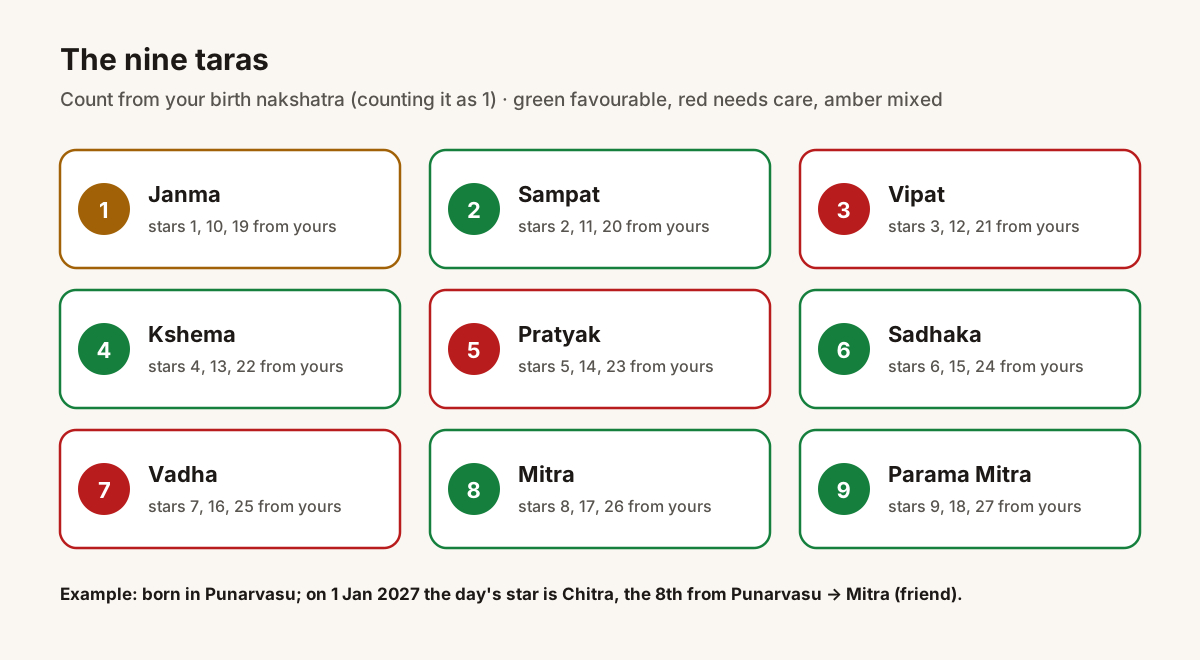
The good ones are Sampat, Kshema, Sadhaka, Mitra and Parama Mitra. The ones to be careful with are Vipat, Pratyak and Vadha. Janma, your own star returning, is mixed: personally significant, but best kept for quiet and inward things rather than big launches.
How to calculate it
Example: you were born with the Moon in Punarvasu. On 1 January 2027, Vedhora's panchanga engine gives the day's nakshatra in Delhi as Chitra.
Count from Punarvasu, inclusive: Punarvasu (1), Pushya (2), Ashlesha (3), Magha (4), Purva Phalguni (5), Uttara Phalguni (6), Hasta (7), Chitra (8).
Eight is Mitra, a friendly day. A good day for meetings, requests and teamwork.
If your count goes above 9, divide by 9 and use the remainder (a remainder of 0 means 9, Parama Mitra).
Where tara bala is used
Choosing times (muhurta). Starting important things on a Sampat, Sadhaka or Mitra day is a classic guideline, and avoiding Vipat, Pratyak and Vadha for big beginnings. Astrologers check it alongside the rest of the panchanga (the five limbs of time).
Sub-periods. Jataka Parijata (XVIII) says to "predict prosperity in general during the bhukti of planets presiding over the asterisms termed Sampat, Sadhaka, Maitra, Parama maitra and Kshema." The taras colour your planetary periods, not just your days.
Family relationships. Garga Hora applies the same idea between relatives. A child born in its parent's Sampat tara is auspicious for that parent. A child born in the parent's Vipat tara may bring strife, and one born in the Kshema tara is gentle towards them.
A surprising link with your dashas
The Vimshottari dasha runs through the nakshatra lords in a fixed order, starting from the lord of your birth star (how your dasha clock is set). So your dashas follow the taras too:
- Your 1st dasha belongs to the lord of your Janma tara
- Your 2nd dasha to the lord of your Sampat tara
- Your 3rd dasha to the lord of your Vipat tara, and so on.
Pathak quotes the sage Satyacharya on what follows: dashas of the lords of the 2nd, 4th, 6th and 8th stars "always give quite auspicious results," while those of the 3rd, 5th and 7th "give quite inauspicious and bad results," and the 1st and 9th are moderately good. The AIFAS text on longevity puts it simply: watch the third, fifth and seventh dashas from birth.
For our Punarvasu native, the order runs Jupiter (Janma), Saturn (Sampat), Mercury (Vipat), Ketu (Kshema), Venus (Pratyak), Sun (Sadhaka), Moon (Vadha), Mars (Mitra) and Rahu (Parama Mitra). Their Mercury, Venus and Moon periods are the ones to handle with more care.
That's one layer of judgement, not a verdict. A strong, well-placed planet can carry a "Vipat" dasha very well. Pathak himself frames it "as a rule", one consideration among many.
Keeping it in proportion
Tara bala is a fine-tuning tool. It won't override a strong chart or a powerful transit. Used sensibly, it's useful:
- for choosing which day of an already-good week to sign, launch, travel or propose
- for knowing when to expect friction and plan around it
- for reading which sub-periods of a dasha lean easy or hard
The takeaway
Your birth star sets up nine kinds of days, repeating through the month: wealth, well-being, achievement and friendship, along with a few that call for care. Count to today's star and you'll know which one you're in. Count your dashas the same way and you'll see why some periods feel easier than others.
Calculate your chart free to find your birth nakshatra, then ask Vedhora's astrologer to pick the best days for what you're planning. To learn about the stars themselves, see the 27 nakshatras explained.
Discover Your True Planetary Placements
Calculate your true Sidereal Lagna, Chandra Rashi, Nakshatras, and 120-year Vimshottari Dasha timeline with verified astronomical precision.
Calculate Your Free Kundli