
Upapada: Your Marriage Point
The Upapada Lagna, the arudha of the 12th house, is the classical point for marriage. How to find it in three steps, what it reveals, how it times marriage.

Everyone knows the 7th house is the house of marriage. Fewer people know that the classical texts point to a second, subtler marriage point: the Upapada Lagna, or UL.
Parashara gives it a whole chapter of the Brihat Parashara Hora Shastra (BPHS), promising that when it's well placed it "will confer on the native happiness from progeny, wife etc." Jaimini devotes a whole section of his sutras to it. If the 7th house is the idea of partnership, the UL is the marriage you actually live.
A point that follows the ascendant
The UL is an arudha, the "image" a house casts into the world (arudha lagna explained). Specifically, it's the arudha of the 12th house.
Why the 12th, the house of spending and loss? Parashara's verse describes it as the house that "follows" the ascendant. The Sanskrit word, anuchara, also means a companion or attendant. And the 12th is the house of giving yourself away, which is a fair description of a marriage. BPHS also calls the UL the Gauna Pada, the "secondary" pada: if the arudha lagna is your image in the world, the UL is the image of the life you share.
How to find your UL in three steps
Step 1. Find the sign on your 12th house and its lord.
Step 2. Count from the 12th house to the sign the lord occupies. Then count the same number of signs onward from the lord. Where you land is the UL.
Step 3. Apply the exception. BPHS says a house's pada can't fall in the house itself or in the 7th from it. If you land in the 12th house itself, or the 7th from it, take the 10th sign from where you landed instead.
One more detail: Scorpio and Aquarius each have two lords in Jaimini's system (Mars and Ketu, Saturn and Rahu). Use the stronger of the two. A simple first test is the one conjunct more planets.
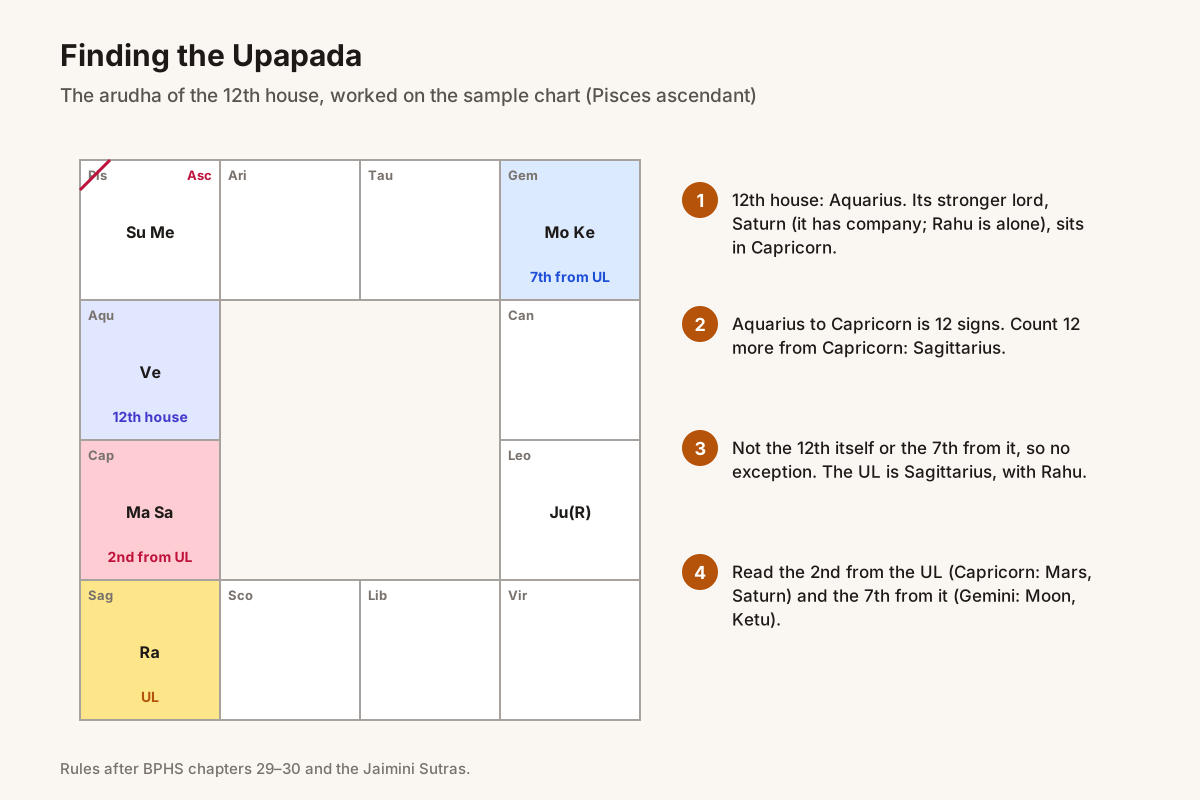
A worked example
Our sample chart (14 March 1992, 7:45 am, Delhi) has a Pisces ascendant.
- The 12th house is Aquarius. Its lords are Saturn and Rahu. Saturn sits with Mars while Rahu is alone, so Saturn is the stronger. Saturn is in Capricorn.
- Counting from Aquarius to Capricorn takes 12 signs. Counting 12 signs on from Capricorn brings us to Sagittarius.
- Sagittarius is neither Aquarius nor the 7th from it (Leo), so no exception applies.
The UL is Sagittarius, the native's 10th house. We'll read it below.
What the UL itself shows
Parashara and Jaimini give the core rules:
- Benefics on the UL, by conjunction or aspect, or a benefic sign there, promise "full happiness from progeny and spouse."
- Malefics on the UL, or a malefic's sign, warn of renunciation or life without a spouse. But the very next verse adds the cancellation: if a benefic aspects or joins it, the "deprival of spouse will not come to pass."
- The Sun gets special treatment. Parashara doesn't count it as a malefic here if it's exalted or in a friend's sign.
Planets on the UL also describe the spouse. P.V.R. Narasimha Rao, in Vedic Astrology: An Integrated Approach, gives examples. Mercury there can show an intelligent spouse (or, when afflicted, an indecisive one). Ketu can show a spiritual one (or short-tempered). The Sun can show a charming spouse from a respectable family, and Mars a bold one (or quarrelsome).
The 2nd from the UL: will it last?
The 2nd house from the UL shows how the marriage is sustained. Narasimha Rao adds that the 2nd and 7th from the UL show its end, and the 8th its longevity. The classical rules for the 2nd:
- Benefics there, or a benefic sign: a lasting marriage and, per Jaimini, a beautiful spouse
- A debilitated planet there: danger to the marriage
- An exalted planet there, or Gemini as that sign: more than one marriage
- The sign's own lord there: any loss comes only late in life, so a long-lived spouse
- Saturn with Rahu there: separation through scandal
And Jaimini's safety clause covers all of them: "If ... there are beneficial aspects or conjunctions, the evil results should not be predicted."
Narasimha Rao makes a point worth remembering: "Nature of spouse and the length of the marriage are two different issues." The UL describes the partner. The houses around it describe the bond.
Reading the example
Real charts mix signals, and this one is a good exercise.
- The UL: Sagittarius is a benefic's sign, but Rahu sits on it, a malefic touch. Jupiter's 5th-house aspect from Leo supplies the benefic contact that cancels the warning. By Jaimini's sign aspects, the waxing Moon in Gemini aspects it too.
- The 2nd from the UL: Capricorn holds Mars and Saturn, two malefics. That's the classic sign of a marriage tested by friction and duty. But Saturn owns the sign, which points to a long-lived partner, and Jupiter aspects Capricorn by sign. By the letter of the texts, exalted Mars there could also show more than one significant relationship.
- The 7th from the UL: Gemini holds Ketu, another node on the marriage axis.
An astrologer would read a marriage that happens and lasts, but asks for patience and real work, with Jupiter as its protector. They'd then check the 7th house, Venus and the navamsa (the D9 chart) before saying anything firmer.
Timing with the UL
The UL is also a timing point. In Jaimini's sign-based Narayana dasha, Narasimha Rao notes that the periods of the 1st, 3rd and 8th houses from the UL favour marriage, since they show its "birth, vitality and life". Periods of the 2nd and 7th from it can bring trouble when the chart supports it. He adds that sub-periods of signs aspecting the UL "may bring marriage" (how astrology times marriage).
He also suggests a simple remedy: fasting on the weekday ruled by the UL's lord to ease troubles in marriage. In our example the UL's lord is Jupiter, so that's Thursday.
Other views
Commentators disagree on the calculation, and it's fair to know that:
- The 12th house for everyone. The common modern practice, used here.
- The arudha of the 7th house. Some commentators read Jaimini's sutra this way.
- The 12th or the 2nd. A Hindi commentary on Jaimini takes the 12th for odd-sign ascendants and the 2nd for even ones.
The takeaway
The Upapada is the arudha of the 12th house: count from the 12th to its lord, count the same again, and skip the 12th and 7th from it. Benefics on the UL bless the marriage and malefics test it, with a benefic aspect always able to cancel the harm. The 2nd from the UL shows whether the bond is sustained. Read it alongside the 7th house, Venus and the navamsa, never alone.
Calculate your chart free to see your 12th house and its lord, then try the count yourself. For compatibility between two charts, see guna milan.
Discover Your True Planetary Placements
Calculate your true Sidereal Lagna, Chandra Rashi, Nakshatras, and 120-year Vimshottari Dasha timeline with verified astronomical precision.
Calculate Your Free Kundli