
How to Read a Birth Chart in 6 Steps
A step-by-step method for reading a Vedic birth chart: the ascendant and its lord, the Moon, the houses, strength, yogas and dashas, with a worked example.
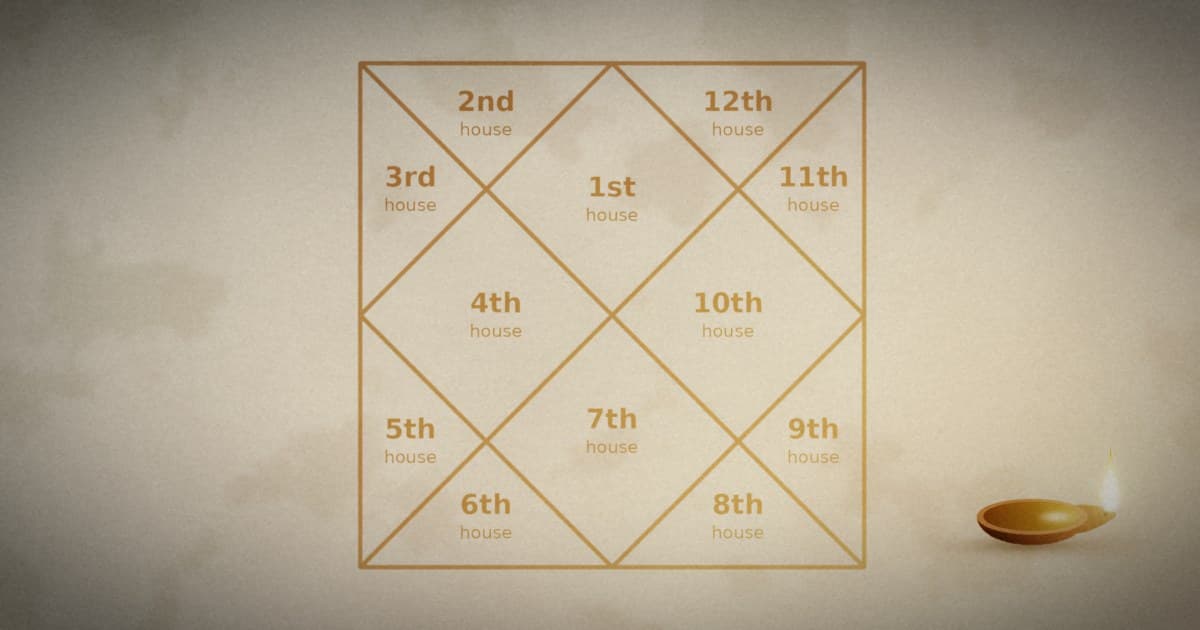
A Vedic birth chart can look like a puzzle the first time you see it: a grid of lines, a scatter of abbreviations, numbers in boxes. But astrologers don't read it all at once. They follow an order.
This tutorial gives you that order in six steps, with a real example: a person born on 14 March 1992 at 7:45 am in New Delhi, calculated in Vedhora's engine.
Step 1: Check the foundation
Every reading stands on three facts: date, time and place of birth. The time matters most. The ascendant moves about one degree every four minutes, and a twenty-minute error can change the rising sign (why twins differ).
Then check the basics of calculation:
- The sidereal zodiac with an ayanamsa. Vedhora uses Lahiri, the Indian standard (what ayanamsa is).
- The chart style you're reading, North or South Indian (how to read both).
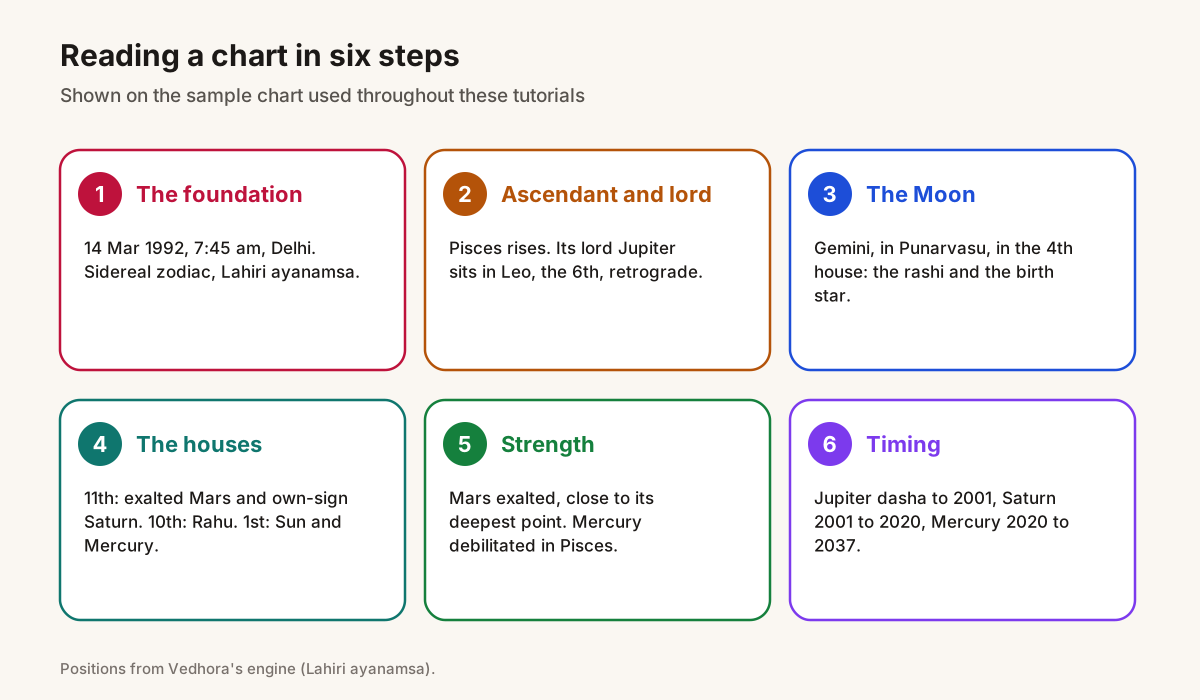
In our example, the ascendant is Pisces at 24°31′, comfortably inside the sign. If it had been at 0° or 29°, we'd want to be extra sure of the birth time.
Step 2: The ascendant and its lord
The ascendant (lagna) is the 1st house: the body, the self, the lens through which the whole chart is seen (what the lagna means). Note its sign, then find its lord, the planet that rules that sign, and where it sits.
Example: Pisces rises, so the ascendant lord is Jupiter. It sits in Leo, the 6th house, and it's retrograde. That suggests a life where the self grows through service, work, competition and solving problems: the 6th-house arena.
The Jataka Parijata is clear about what to check first: "In a horoscope, the Sun and the Moon must — not to say of the Lagna — be strong; otherwise it is not a satisfactory one."
Step 3: The Moon
Vedic astrology gives the Moon enormous weight. It's the mind, and it's the starting point of the dasha clock (why the Moon sign matters). Note:
- The Moon's sign: your rashi, the basis of horoscopes and transits
- The Moon's nakshatra: your birth star, which sets the dashas
- Its strength: waxing or waning, and its company
Example: the Moon is in Gemini, the 4th house, in the nakshatra Punarvasu, ruled by Jupiter. A mind that's curious, communicative and restless (Gemini), rooted in home and inner life (the 4th). Punarvasu is the star of "return and renewal". And because Punarvasu belongs to Jupiter, this person was born in a Jupiter dasha.
Step 4: Map the houses
Now walk through the twelve houses (the houses explained). Three groups matter most:
- Kendras (1, 4, 7, 10): the pillars. Planets here shape life visibly.
- Trikonas (1, 5, 9): the houses of fortune and merit.
- Dusthanas (6, 8, 12): the houses of difficulty, which also bring service, depth and release.
For each important house, look at three things: its sign, its lord, and any planets in it.
Example:
- 1st house: Sun and Mercury sit in Pisces with the ascendant, giving a strong personal presence and a quick mind. Mercury, though, is debilitated in Pisces.
- 10th house (career): Sagittarius, with Rahu there. Career ambitions may be unconventional, foreign or driven, and its lord Jupiter (in the 6th) ties career to service and problem-solving.
- 11th house (gains): exalted Mars and Saturn in its own sign, both in Capricorn. That's a powerful house of income, networks and long-term achievement.
Step 5: Weigh strength, dignity and yogas
Not every planet speaks with the same voice. Ask of each:
- Dignity: is it exalted, in its own sign, friendly, or debilitated (planetary dignity)?
- Placement: is it in a kendra or trikona, or in a dusthana?
- Condition: is it combust, retrograde or vargottama?
- Yogas: do any classical combinations form, such as Mahapurusha, Gaja Kesari or Neecha Bhanga (the five Mahapurusha yogas)?
Example: Mars is exalted in Capricorn, and Vedhora's strength model rates it the strongest planet in the chart. Jupiter is vargottama, in Leo in both the birth chart and the navamsa, a quiet source of steadiness (what vargottama means). Mercury is debilitated but sits right beside the Sun in the ascendant. That's the kind of mixed picture a real chart usually shows.
Step 6: Time it with the dasha (and transits)
A chart shows what is promised. The dasha shows when. Find the current mahadasha and antardasha. The planets ruling those periods bring their houses and themes to life (how the dasha clock is set).
Then check transits, especially of Saturn and Jupiter, over the houses and planets the dasha activates.
Example: this person was born in Jupiter's dasha, which ran until January 2001, followed by Saturn (2001–2020) and then Mercury (2020–2037). During Saturn's dasha, Saturn's placement mattered most: in the 11th, in its own sign, beside exalted Mars. That points to a period of building income, ambition and networks through steady work. During Mercury's dasha, the debilitated, Sun-joined Mercury in the 1st becomes the story. Here the person's own voice, communication and skills move to centre stage, with care needed to avoid scattered effort.
Putting it together
Good chart reading is synthesis: one theme confirmed by several factors. In our example, the 11th house keeps returning. It holds exalted Mars and own-sign Saturn, and the Arudha Lagna (the "image" of the person) also falls there (arudha lagna). When three or four indicators point the same way, you can say it with confidence.
The takeaway
Read a chart in order. Check the data, then read the ascendant and its lord, then the Moon and its nakshatra. Map the houses, weigh each planet's strength and yogas, and finally time it with dashas and transits. Look for themes that repeat. That's where the chart is speaking loudest.
Calculate your chart free and try the six steps on your own chart. Vedhora's astrologer can walk you through each one.
Discover Your True Planetary Placements
Calculate your true Sidereal Lagna, Chandra Rashi, Nakshatras, and 120-year Vimshottari Dasha timeline with verified astronomical precision.
Calculate Your Free Kundli