
Adhik Maas: The Extra Month
Every two or three years the Hindu calendar adds a whole month. How Adhik Maas works, why weddings avoid it, the rare 'lost' month and when the next falls.

The Hindu calendar does something most calendars don't. Every two or three years, it simply adds a whole month. That year has thirteen months instead of twelve, and two months share the same name.
The extra one is called Adhik Maas, the "additional month". It's also known as Mala Masa. Here's why it exists, how astronomers decide where it goes, and what it means for weddings and new beginnings.
The 11-day problem
The traditional Hindu calendar is luni-solar. Its months follow the Moon, from new moon to new moon, but its year has to keep step with the Sun and the seasons.
The trouble is that the two don't fit. Twelve lunar months come to about 354 days, while the solar year is about 365. That's roughly 11 days short every year. Left alone, festivals would drift backwards through the seasons. Diwali would slide from autumn into summer, and the spring festivals into winter.
As A Text Book of Astrology puts it, the fix is to add a month, so the year "will have 13 lunar months. This makes every festival to fall in the same season."
How the extra month is chosen
The extra month isn't slotted in by decree. It falls out of the sky. V.P. Jain explains the principle in Elements of Astronomy and Astrological Calculations:
"When two Amavasyas fall in a solar month (between two consecutive sankranties), there will be two Lunar months of the name of that solar month."
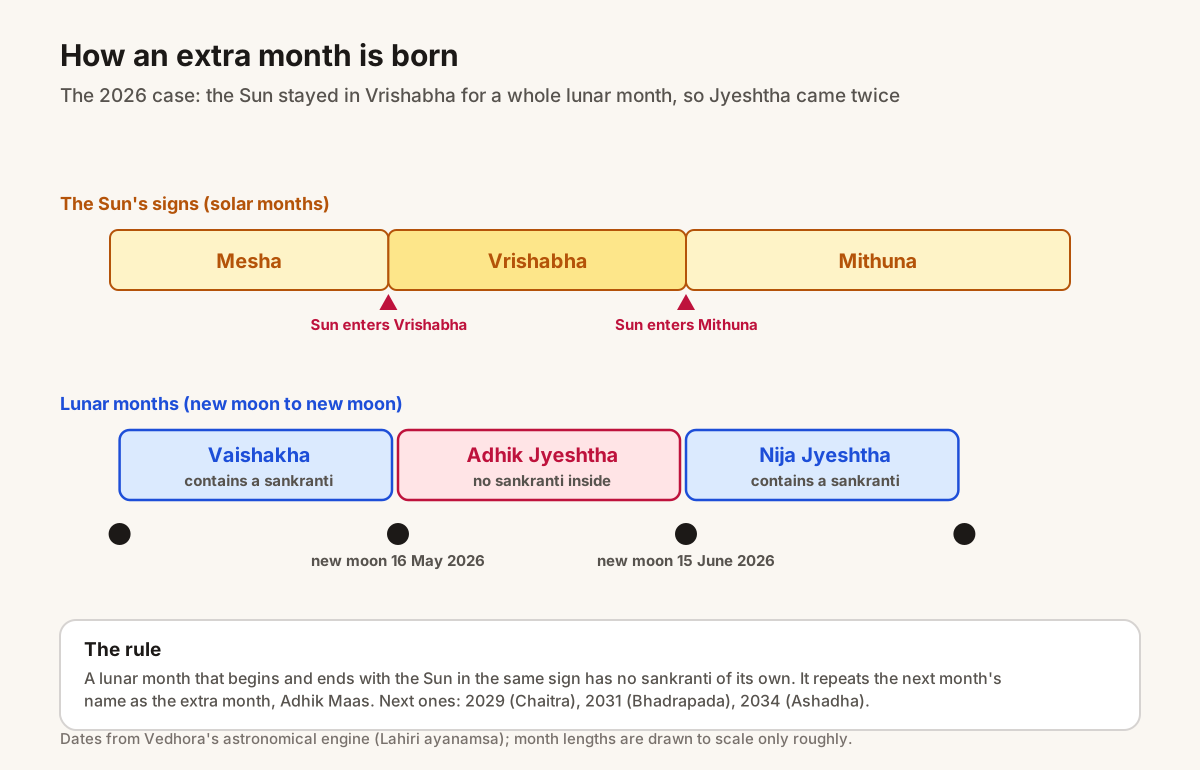
In plain terms, the Sun moves into a new sign about once a month. That moment is a sankranti. Normally every lunar month contains one sankranti. But a lunar month is a little shorter than a solar one, so now and then a whole lunar month begins and ends while the Sun stays in the same sign. That month has no sankranti. It's the Adhik Maas.
It takes the name of the month that follows. The first is the adhika (extra) month, and the second is the shuddha (pure) one. Jain gives a worked example. In 2001, two new moons fell while the Sun was in Virgo, so the lunar month from 18 September to 16 October 2001 became Adhik Ashvin, and the true Ashvin followed.
Why it falls in the warmer months
The Sun's apparent speed changes through the year. When the Earth is farther from the Sun, the Sun takes longer to cross each sign. That gives a lunar month more room to fit entirely inside one sign. So, as the Text Book notes, Adhik Maas tends to fall in the Sun's slow season, roughly spring through autumn.
The month that disappears
The opposite can also happen, though very rarely. If the Sun moves fast enough to make two sankrantis inside one lunar month, a month name is skipped. That's a Kshaya Masa, a "lost month". Jain notes it can only happen in the fast-Sun months of Kartika to Magha (November to February). The last one he records was in 1982–83.
When a lost month happens, the calendar balances it with two extra months that year. Jain gives their names: Samsarpa before the lost month and Malimlucha after it. Those names are very old. The Vedic five-year cycle already had two extra months, and one of them was called samsarpa (read about the Vedic five-year yuga). The same idea has run through Indian timekeeping for some three thousand years.
Recent and coming Adhik Maas
We ran the rule through Vedhora's astronomical engine (Lahiri ayanamsa), checking every new moon against the Sun's sidereal sign. Here's what it finds, with dates in UTC:
- 2018: Adhik Jyeshtha (mid-May to mid-June)
- 2020: Adhik Ashvin (mid-September to mid-October)
- 2023: Adhik Shravana (mid-July to mid-August)
- 2026: Adhik Jyeshtha, from the new moon of 16 May to the new moon of 15 June 2026
- 2029: Adhik Chaitra (mid-March to mid-April)
- 2031: Adhik Bhadrapada (mid-August to mid-September)
- 2034: Adhik Ashadha (mid-June to mid-July)
The gaps range from about 28 to 35 months and average out near 32, as the arithmetic predicts. No lost month falls in this period.
What it means for muhurta
For choosing auspicious times, the extra month is treated differently. Astrology texts are clear that it isn't a month for big new beginnings. Analysis of Marriage through Astrology states that "Adhika (Mala) Maasa is not favourable for marriage," and Birth Chart Mathematics notes that the adhik month "is normally avoided in most muhurthas."
The reasoning is simple. A month without a sankranti has no solar "anchor". It sits outside the Sun's regular rhythm. Weddings, housewarmings, the sacred thread and other milestone rites are moved to the true months around it. In popular practice the extra month is set aside for devotion instead: prayer, fasting, charity and pilgrimage. It's a pause in the calendar, given back to the sacred.
The takeaway
Adhik Maas is the Hindu calendar's leap month. It's added whenever a lunar month begins and ends with the Sun in the same sign, so the festivals stay true to their seasons. It isn't used for marriages or other big beginnings, and it's traditionally kept for devotion. Very rarely a month goes missing instead, balanced by two extra ones, with names that go back to the Vedas. The last one came in summer 2026, and the next falls in spring 2029.
To see the lunar month and tithi of your own birth, calculate your chart free. For the five limbs of every Hindu calendar day, read panchanga: the five limbs of time.
Discover Your True Planetary Placements
Calculate your true Sidereal Lagna, Chandra Rashi, Nakshatras, and 120-year Vimshottari Dasha timeline with verified astronomical precision.
Calculate Your Free Kundli